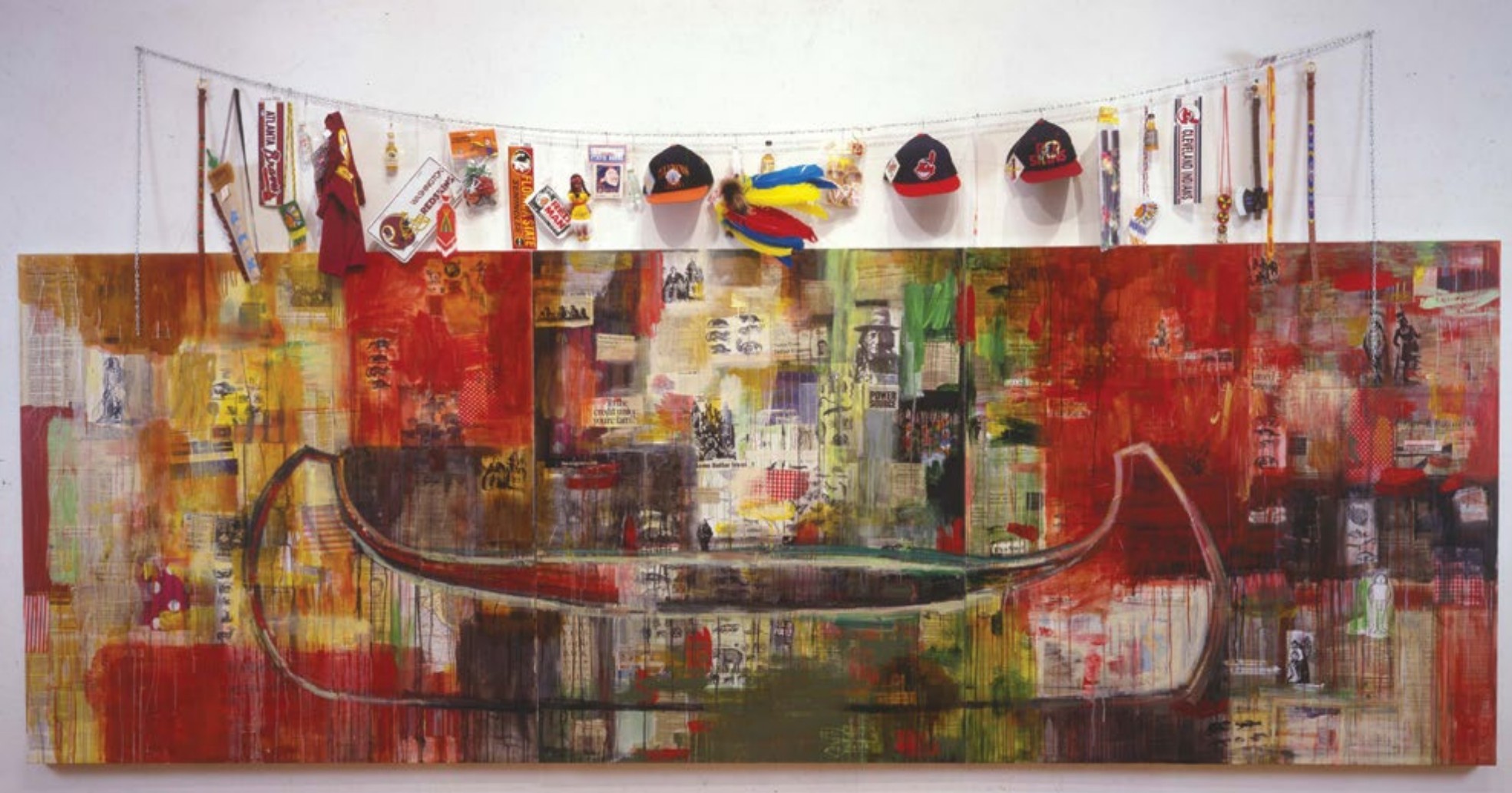
 Trade (Gifts for Trading Land with White People) © Courtesy of Jaune Quick-to-See Smith (Member of the Salish Kootenai Nation, Montana) and the Accola Griefen Gallery, NY
Trade (Gifts for Trading Land with White People)
Jaune Quick-to-See Smith. 1992 C.E. Oil and mixed media on canvas
Curator Note
"A large mixed-media canvas created in response to the 500th anniversary of Columbus’s arrival. Smith overlays a collage of newspaper clippings and images of Native American stereotypes with a dripping, expressionist application of red paint (symbolizing blood and sacrifice). Above, she hangs a string of cheap souvenir trinkets—sports mascots, toy tomahawks—offering to "trade" these worthless items back for the stolen land."
Form
- Large-scale triptych (three panels) similar to a medieval altar.
- Layers of collage (text, photos) covered by washes of oil paint.
- Dripping red paint dominates the surface.
- A distinct canoe shape is outlined in the center.
- A clothesline with 3D objects (hats, toys) hangs above the canvas.
Function
- To protest the commercialization and trivialization of Native American culture.
- To commemorate the survival of Native peoples despite 500 years of colonization.
- To explore the complex, layered identity of contemporary Native Americans.
- To critique the history of uneven exchange (land for trinkets).
- To confront the viewer with the persistence of racist stereotypes.
Content
- The canoe: a symbol of trade, travel, and cultural connection, but empty and stuck.
- The color red: anger, war, blood, but also an intense artistic color.
- The trinkets: Washington Redskins caps, plastic tomahawks, reflecting kitsch appropriations.
- Collage elements: tribal newsletters, photos, history text.
- The title "Trade": references the "sale" of Manhattan for $24 in beads.
Context
- Created during the quincentenary (1992) of Columbus's 1492 voyage.
- Smith is a member of the Salish and Kootenai Tribes of the Flathead Nation.
- Influenced by Abstract Expressionism (Rauschenberg, Jasper Johns) and Native traditions.
- Part of the "Identity Politics" movement in 1990s art.
- Highlights the ongoing struggle for recognition and sovereignty.