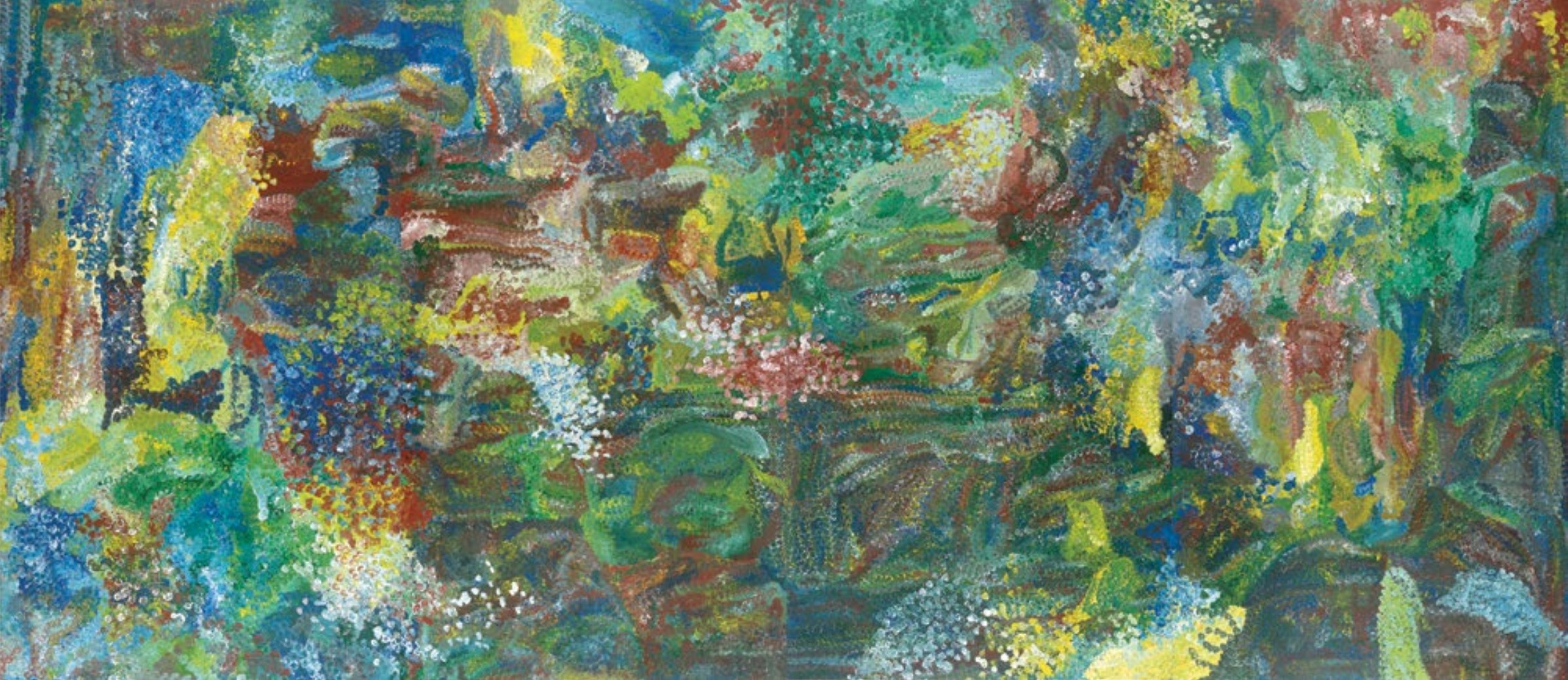
 Earth’s Creation © VISCOPY, Australia/Image © National Museum of Australia/© 2013 Artists Rights Society (ARS), New York
Earth’s Creation
Emily Kame Kngwarreye. 1994 C.E. Synthetic polymer paint on canvas
Curator Note
"A monumental abstract painting by the Anmatyerre artist Emily Kame Kngwarreye, who began painting on canvas in her late 70s. The work is a vibrant explosion of color and gesture, not depicting a specific "Dreaming" story, but rather capturing the essence of the "green time"—the flourishing of the Australian desert after the heavy rains. It challenges the categorization of Indigenous art as merely ethnographic."
Form
- Massive scale (approx. 20 feet wide), composed of four panels.
- High-key colors: lush greens, yellows, blues, and reds.
- Gestural, "dump-dump" dotting technique using brushes to pound paint onto canvas.
- All-over composition with no central focal point.
- Loose, expressive style often compared to Monet or Pollock.
Function
- To capture the vitality and energy of the land (Alhalkere).
- To express the artist’s deep cultural connection to her country ("Everything is there").
- To represent the seasonal cycle of regeneration (the "green time").
- To assert the artist's power as a senior custodian of her land.
- To create a visual experience of immersion in nature.
Content
- The lush vegetation of the desert after the rain.
- The energy of growth and life cycles.
- References the roots, seeds, and yams that are part of her Dreaming.
- Not a map or a diagram, but a sensory impression.
- Celebration of the fertility of the earth.
Context
- Kngwarreye was a batik artist before switching to acrylic on canvas.
- She became one of Australia's most successful artists late in life.
- Her work broke barriers for Aboriginal women artists.
- Often compared to Western Abstract Expressionism, though her influences were purely local.
- Created at Utopia, a remote Aboriginal community in Central Australia.