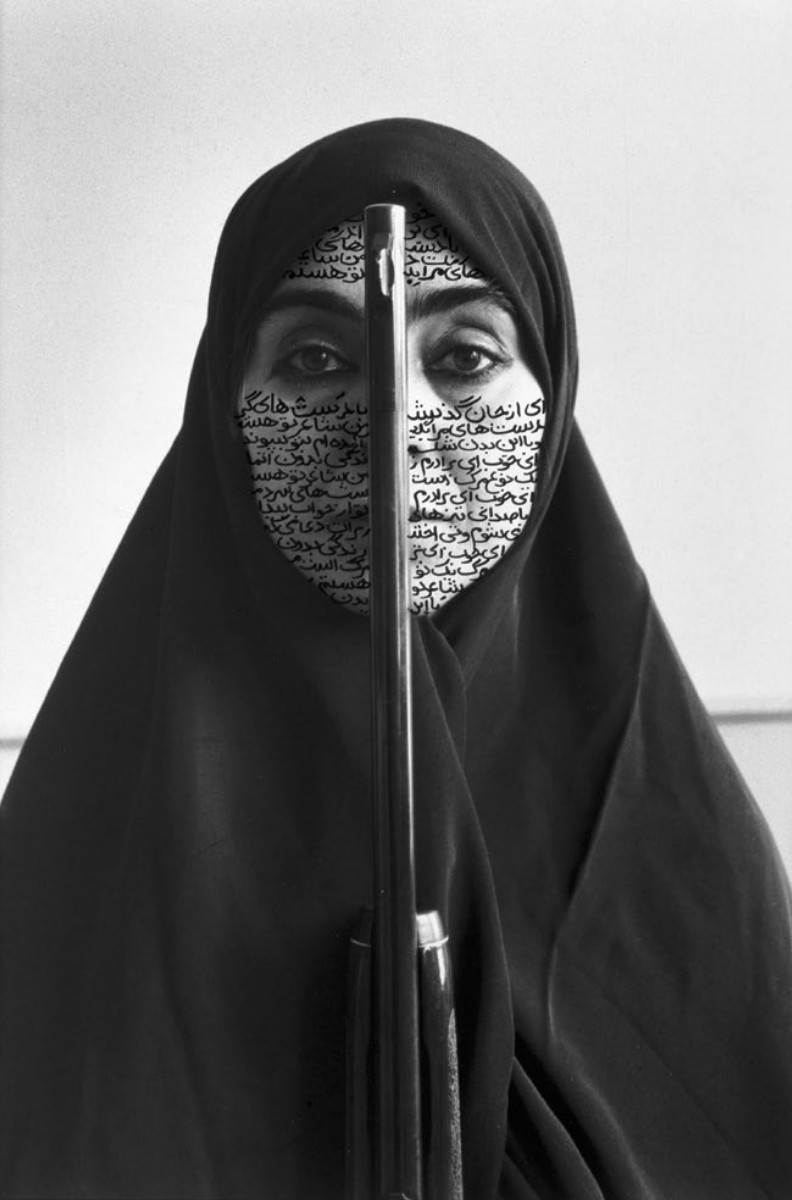
 Rebellious Silence Courtesy Gladstone Gallery, New York and Brussels
Rebellious Silence
From the Women of Allah series. Shirin Neshat (artist); photo by Cynthia Preston. 1994 C.E. Ink on photograph
Curator Note
"A black-and-white self-portrait of the artist, bisected by a rifle barrel and overlaid with Farsi poetry written on her face. Neshat, an Iranian exile returned to a post-revolutionary Iran, explores the paradoxes of the female identity in Islamic fundamentalism. The image confronts the Western gaze with a figure that is at once veiled, armed, and eloquent yet silent."
Form
- Black and white photograph with ink calligraphy inscribed on the print.
- Strong vertical symmetry created by the rifle and the veil.
- High contrast between the black chador and the white skin/background.
- Direct, confronting gaze of the subject.
- Juxtaposition of soft texture (face) with hard texture (gun).
Function
- To explore the complexities of women's identities in the Middle East.
- To challenge Western stereotypes of the "oppressed" Muslim woman.
- To examine the intersection of religion, violence, and poetry.
- To express the personal duality of the artist living in exile.
- To present a figure who is both a victim and a militant.
Content
- The veil (chador): symbol of oppression to some, identity/protection to others.
- The gun: symbol of violence, control, and revolutionary power.
- The text: poetry by contemporary Iranian women about martyrdom and conviction.
- The gaze: refuses to be objectified; challenges the viewer.
- Silence: the mouth is covered/closed, but the eyes and text "speak".
Context
- Created after Neshat returned to Iran in 1990 following the 1979 Islamic Revolution.
- She found a country completely transformed and religiously radicalized.
- Part of the "Women of Allah" series.
- Addresses the "Global Contemporary" theme of political conflict and gender.
- Neshat lives in the US, making her an outsider to both cultures.