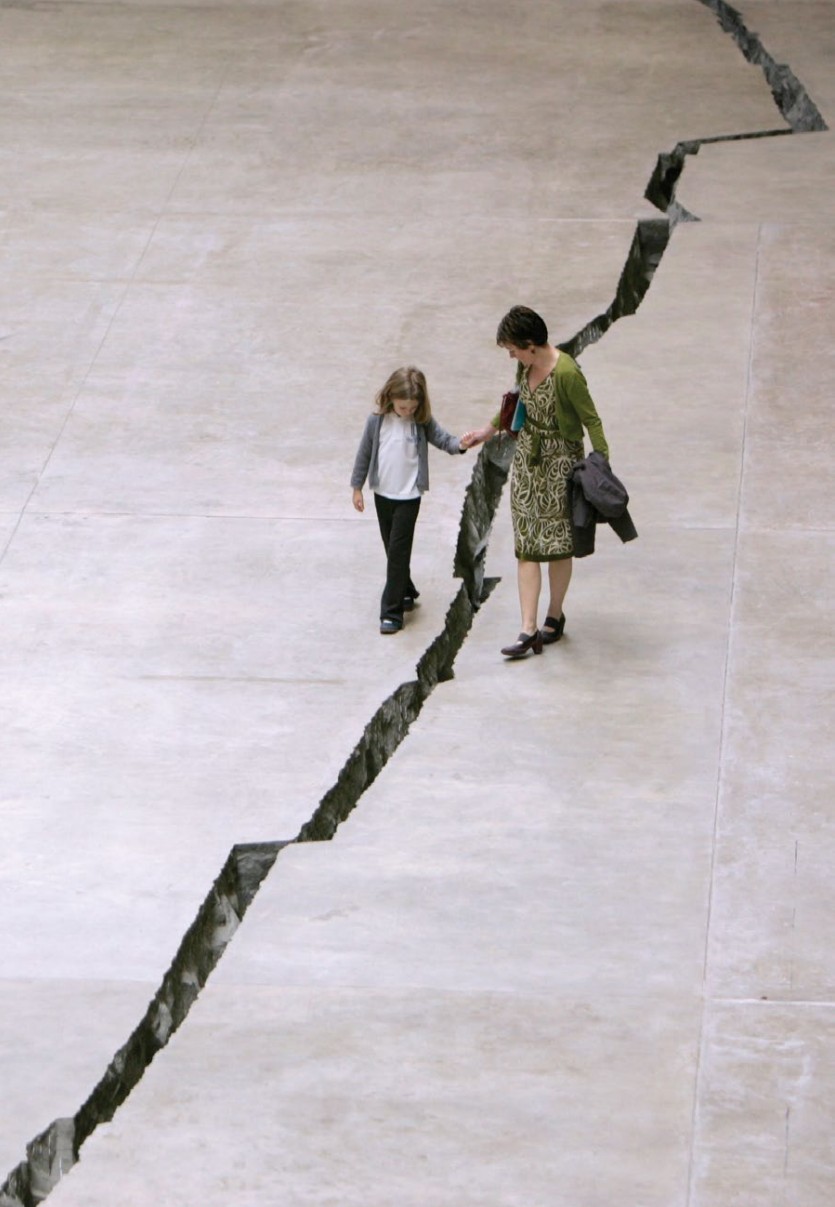
 Shibboleth © Luke Macgregor/Reuters/Corbis
Shibboleth
Doris Salcedo. 2007–2008 C.E. Installation
Curator Note
"A 548-foot long crack opened up in the concrete floor of the Tate Modern’s Turbine Hall. Salcedo, a Colombian artist, created this "scar" to represent the experience of immigrants and the racial segregation of the "Global South" from the "Global North." The crack is a physical rupture, a shibboleth (a code word used to distinguish in-groups from out-groups), marking those who belong and those who do not."
Form
- A deep, meandering crack running the full length of the massive Turbine Hall.
- Actual rupture provided by opening the concrete floor and inserting a cast concrete mold.
- Variable width and depth; sometimes hairline, sometimes wide enough to trip.
- Wire mesh visible inside the crack, suggesting a border fence.
- Minimalist intervention: no object is added, only space is removed/broken.
Function
- To symbolize the divisions in society (racism, class, borders).
- To represent the irrevocable experience of immigration/separation.
- To disrupt the smooth, monumental space of the Western museum.
- To force the viewer to look down and be careful (embodied experience).
- To leave a permanent "scar" even after it is filled in.
Content
- The crack: a border, a wound, a fault line.
- Title "Shibboleth": biblical story (Judges 12:6) where pronunciation determined who was killed.
- Represents the "other" who is excluded.
- The filling of the crack (after the exhibit) represents the attempt to erase history.
- The wire mesh: oppression and containment.
Context
- Salcedo’s work focuses on the victims of political violence in Colombia and beyond.
- Site-specific installation for the Unilever Series at Tate Modern.
- Addresses the "unwanted" immigrant in Europe.
- Challenges the "grandeur" of the museum architecture.
- Reflects on the legacy of colonialism and the "cracks" it left in the world.