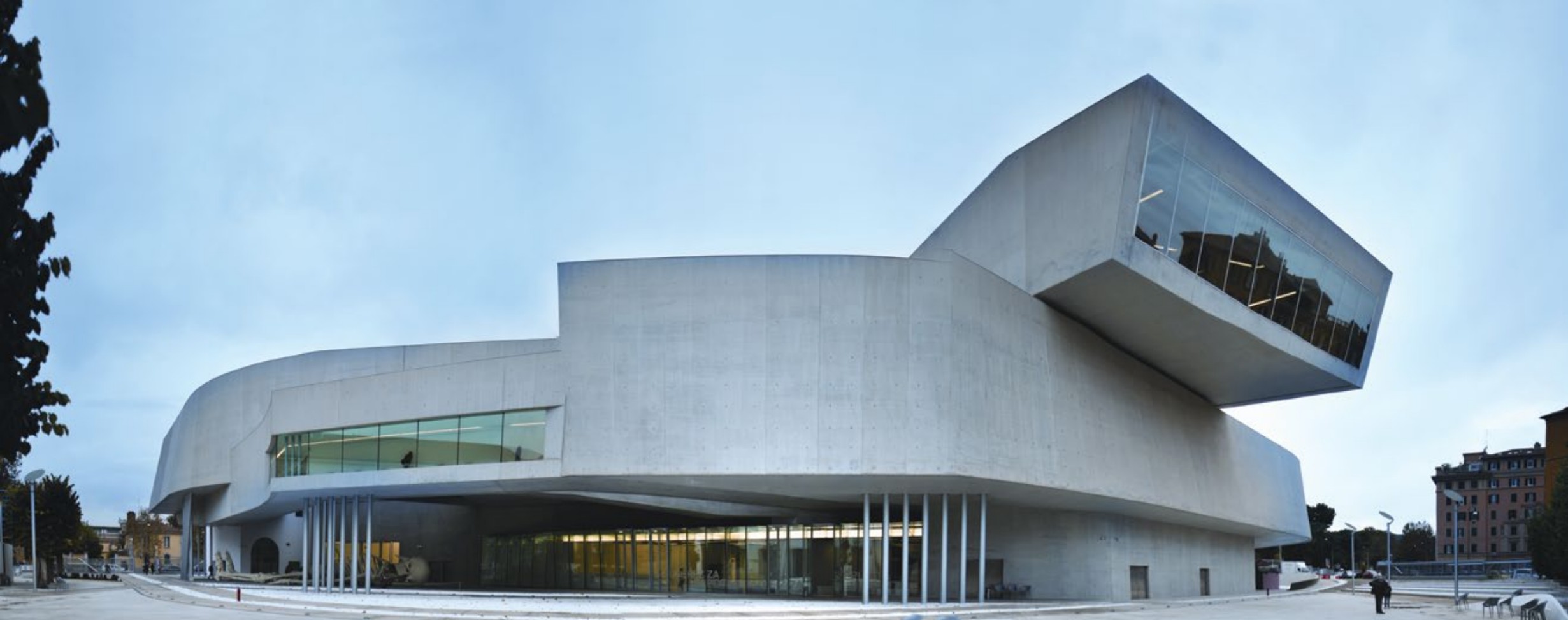
 MAXXI National Museum of XXI Century Arts © Atlantide Photoravel/Corbis
MAXXI National Museum of XXI Century Arts
Rome, Italy. Zaha Hadid (architect). 2009 C.E. Glass, steel, and cement
Curator Note
"A dynamic, fluid building in Rome composed of bending concrete tubes that overlap and intersect. Hadid, the first woman to win the Pritzker Prize, designed a "field of buildings" that rejects the static box. The museum flows through the site, creating a sense of constant movement and exploration, mirroring the complexity of contemporary art."
Form
- Composed of long, bending concrete "tubes" or rails.
- Fluid, curvilinear geometry with no clear beginning or end.
- Use of self-consolidating concrete allowing for smooth, complex curves.
- Large glass curtain walls and ribbon windows on the roof for natural light.
- Intertwining staircases and bridges in the interior (Piranesian space).
Function
- Museum for 21st-century art and architecture.
- To create an urban campus that connects existing military barracks.
- To allow for flexible exhibition spaces (no rigid rooms).
- To guide the visitor through a "drift" or flow of movement.
- To demonstrate the capabilities of parametric design.
Content
- The flowing lines imitate the flow of a river (the fictional "Delta").
- The overlapping paths symbolize the convergence of history and future.
- Rejection of the classical "static" museum for a dynamic one.
- A "field" rather than an object.
- Concrete references Roman engineering history (Pantheon, etc.).
Context
- Built in the Flaminio neighborhood of Rome, contrasting with the ancient city.
- Hadid was an Iraqi-British architect known as the "Queen of the Curve".
- Example of Parametricism (using algorithms to design forms).
- Wins Sterling Prize (2010).
- Global Contemporary architecture as a brand/spectacle.