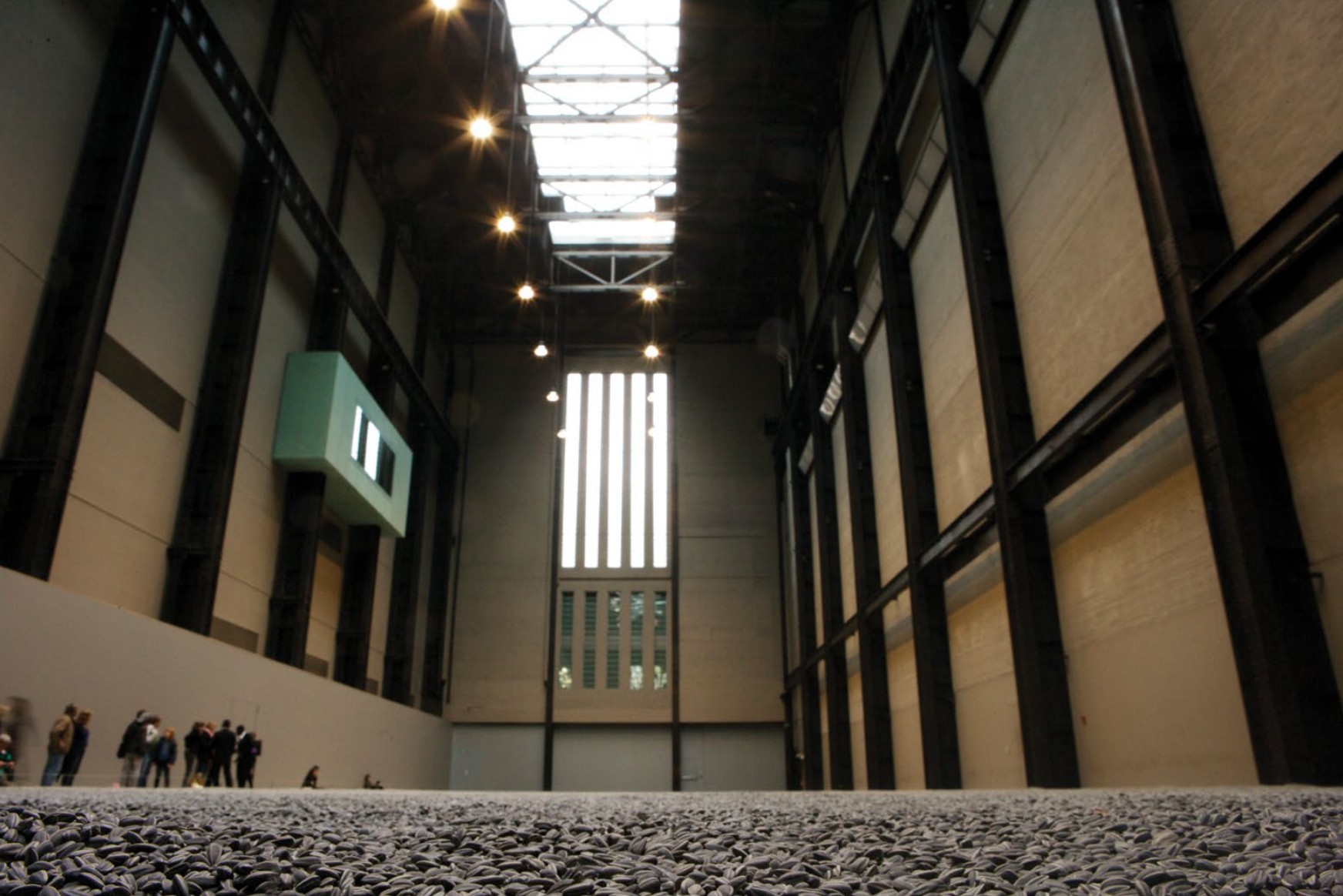
 Kui Hua Zi © Oliver Strewe/Getty Images
Kui Hua Zi (Sunflower Seeds)
Ai Weiwei. 2010–2011 C.E. Sculpted and painted porcelain
Curator Note
"An installation of 100 million handmade porcelain sunflower seeds spread across the floor of the Tate Modern. Each seed was individually painted by 1,600 artisans in Jingdezhen, China. The work comments on the "Made in China" phenomenon, the relationship between the individual and the mass (under Mao), and the loss of traditional craftsmanship."
Form
- Installation of 100 million tiny porcelain objects.
- Covered the floor of the Turbine Hall in a thick layer (10 cm deep).
- Each "seed" is unique, hand-sculpted and hand-painted.
- Realistic texture and weight (porcelain), indistinguishable from real seeds at a distance.
- Grey/black visual field from afar; detailed pattern up close.
Function
- To critique the geopolitical and economic power of China.
- To challenge the perception of "Made in China" as cheap mass production.
- To recall the hunger and propaganda of the Cultural Revolution.
- To emphasize the labor of the individual artisan vs. the mass result.
- To create a sensory, interactive landscape (initially visitors could walk on it).
Content
- Sunflower seeds: a common street snack, showing camaraderie.
- Sunflowers: symbol of the Chinese people looking toward Mao (the sun).
- Porcelain: historical symbol of China's export wealth.
- The "Sea" of seeds: the crushing weight of the collective over the individual.
- The hidden labor: 1,600 people worked for 2 years.
Context
- Ai Weiwei is a dissident artist, critical of the Chinese government.
- Produced in Jingdezhen, the "Porcelain Capital" of China for 1000 years.
- Visitors initially walked on the seeds, but breathing porcelain dust became a hazard.
- Global Contemporary: Focus on labor, production, and human rights.
- Ai Weiwei was later detained by the government, adding political weight to his work.