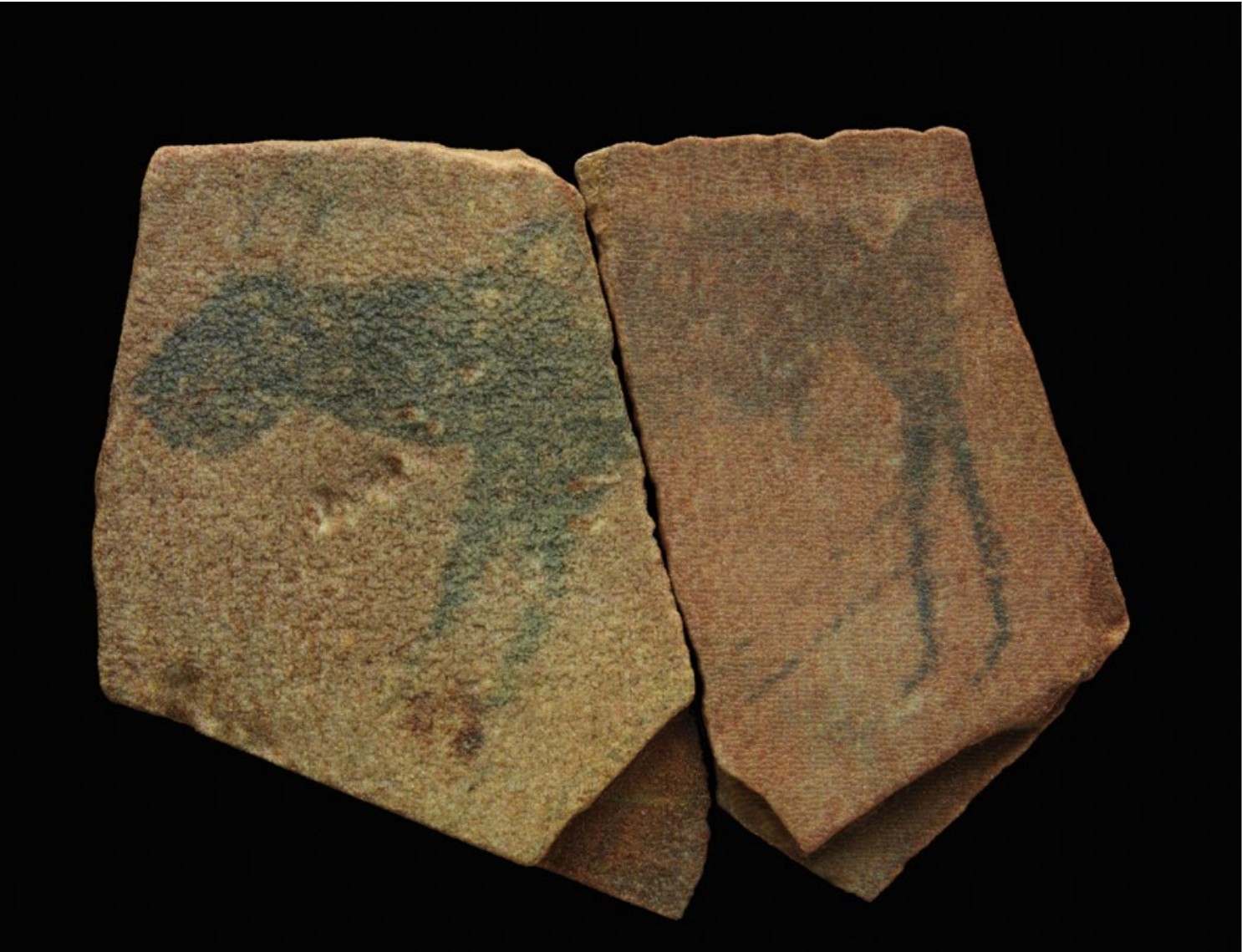
 Apollo 11 stones © Human Origins Program, Smithsonian Institution
Apollo 11 Stones
Namibia. c. 25,500–25,300 B.C.E. Charcoal on stone.
Curator Note
"Seven stone fragments painted with charcoal found in the Apollo 11 Cave in Namibia. They serve as some of the earliest examples of representational art in Africa."
Form
- Portable art created on charcoal on stone (brown-grey quartzite).
- Strict profile view of the animal allows for immediate identification of the species (conceptual realism).
- The rough texture of the natural stone contests with the smooth application of the charcoal medium.
- The animal is depicted with a feline body and human hind legs, suggesting a supernatural or composite being.
- Discovered as two separate fragments that were reunited by archaeologists.
Function
- It is "mobiliary art" (small, portable) likely used for personal ritualistic purposes during nomadic travel.
- Could be part of shamanistic beliefs, serving as a talisman to mediate between the human and spirit worlds.
- May have served as a teaching tool for hunting strategies or to identify clan lineage and totemism.
- The depiction of a powerful beast may represent an attempt to capture the animal's spirit or essence.
- Possible use in sympathetic magic to ensure a successful hunt.
Content
- Depiction of an unidentified animal (therianthrope) combining feline (body) and human (hind legs) characteristics.
- Two slightly curved horns on the head likely belong to an Oryx (antelope), adding to the composite nature.
- Sexual organs are vaguely visible, suggesting a possible connection to fertility or gender significance.
- The animal appears in motion, suggested by the positioning of the legs.
- Lack of background context focuses entirely on the figure itself.
Context
- Found in the Huns Mountains of south-western Namibia in 1969 by German archaeologist W.E. Wendt.
- Named after the NASA Apollo 11 moon landing which happened the same year as the successful excavation.
- Discovered in a rock shelter that showed signs of human habitation extending back over 100,000 years.
- Radiocarbon dating of the charcoal establishes it as one of the oldest examples of representational art in Africa (c. 25,500 B.C.E.).
- Reflects the cognitive capability of early humans to create symbolic and complex imagery.