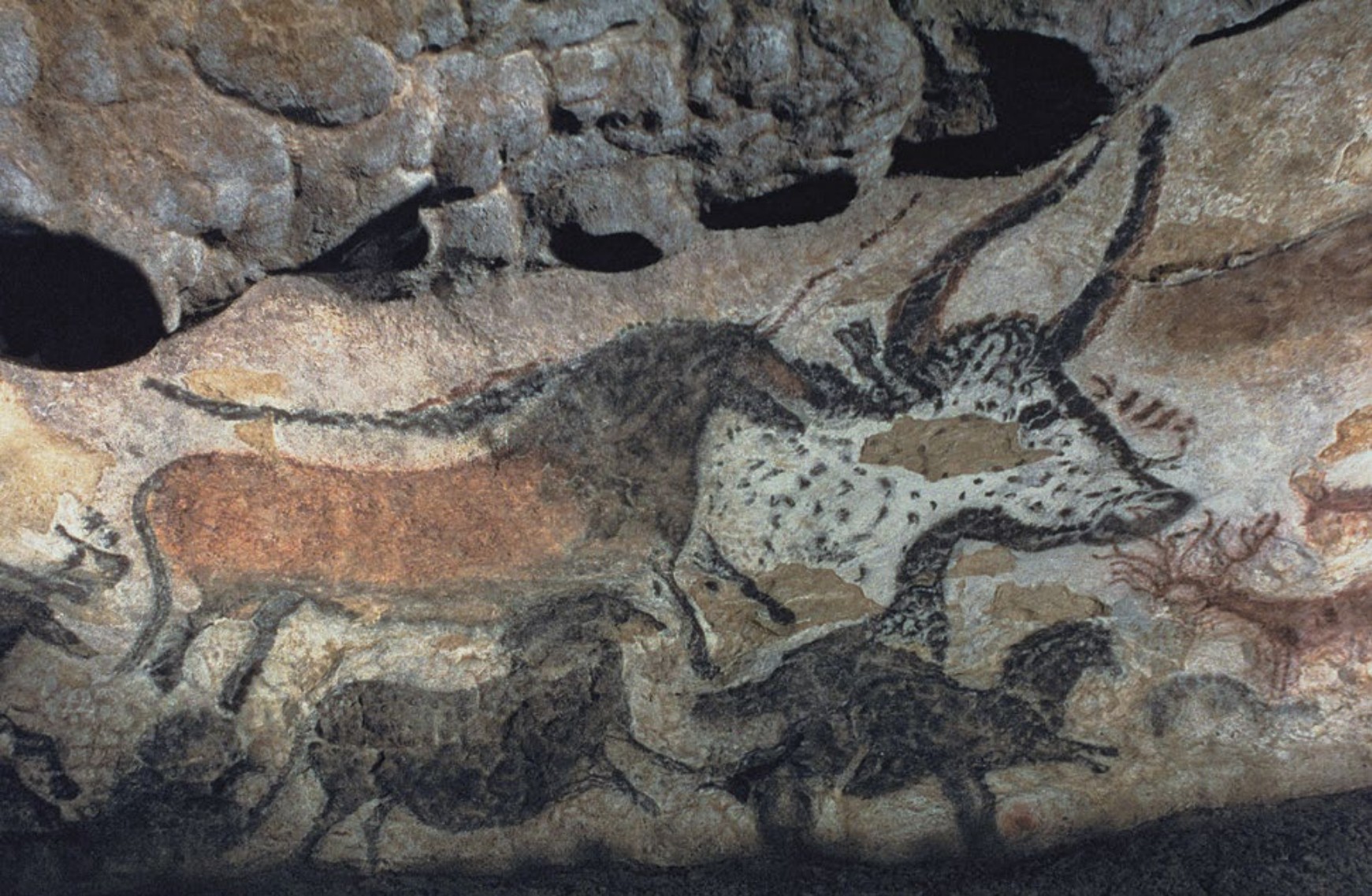
 Great Hall of the Bulls © The Bridgeman Art Library
Great Hall of the Bulls
Lascaux, France. Paleolithic Europe. 15,000–13,000 B.C.E. Rock painting.
Curator Note
"A massive cave complex featuring over 600 wall paintings. It represents one of the most famous examples of Paleolithic artistic expression."
Form
- Polychrome mineral pigments (ochre, charcoal, hematite, manganese) applied directly to white limestone walls.
- Use of "twisted perspective" (composite view) where horns are frontal but bodies are in profile to show the most identifiable features.
- Artists utilized the natural contours of the rock (bulges and crevices) to add volume and depth to the animals.
- Overlapping figures suggest the painting was an additive process over generations, not a single cohesive composition.
- Negative handprints were created by blowing pigment around a hand placed on the wall (stenciling).
Function
- Sacred space for rituals, possibly related to "hunting magic" to ensure a successful catch.
- A deep, acoustic site for initiation ceremonies, storytelling, or trance-like states induced by sensory deprivation.
- Not a dwelling; archaeological evidence shows people did not live deep inside these dark, inaccessible caves.
- May have served as a seasonal calendar or star chart (some theories suggest alignment with constellations).
- Preservation of tribal history and cultural narratives through visual storytelling.
Content
- Depictions of over 600 animals including wild horses, deer, bison, elk, lions, a rhinoceros, and a bear.
- Abstract markings (dots, lines, grids) that may be tracking signs, signatures, or entoptic phenomena.
- A rare narrative scene in the "Shaft of the Dead Man" depicts a bird-headed man falling before a bison.
- Absence of landscape elements (trees, rivers) focuses attention exclusively on the power of the beasts.
- Animals are depicted in motion—running, jumping, or falling.
Context
- Discovered accidentally in 1940 by four teenagers in Dordogne, France.
- Created during the Magdalenian period of the Upper Paleolithic, a time of rich artistic production.
- Closed to the public in 1963 due to carbon dioxide and lichen damage; a replica (Lascaux II) was built for visitors.
- Reflects a society with specialized roles, as the technical skill required implies trained artists.
- Demonstrates early human control of fire (stone lamps found) and scaffolding to reach high ceilings.