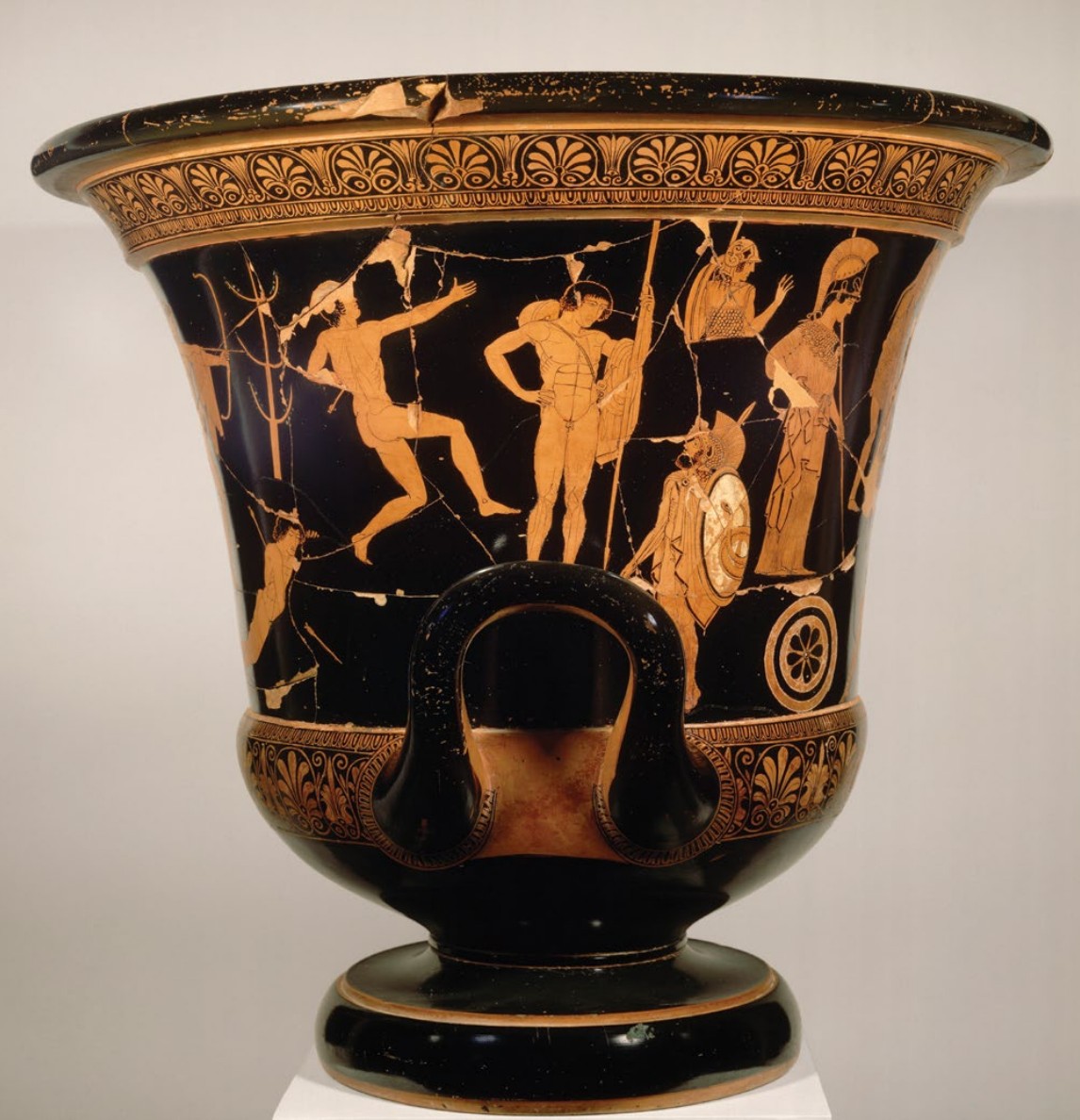
 Niobides Krater © RMN-Grand Palais/Art Resource, NY
Niobides Krater
Anonymous vase painter of Classical Greece known as the Niobid Painter. c. 460–450 B.C.E. Clay, red-figure technique (white highlights).
Curator Note
"A warning against hubris. Niobe bragged that she was superior to the goddess Leto because she had more children. Leto's children (Apollo and Artemis) responded by slaughtering all 14 of Niobe's kids."
Form
- Calyx Krater: A large punch bowl with handles low on the body (resembling the calyx of a flower).
- Red-figure technique: Figures are reserved in red clay against a black glazed background, allowing for internal detail.
- First major use of isocephalism breaking: Figures are placed at different levels, not on a single ground line.
- Attempts at 3D space: Landscape elements (rocks/trees) are suggested, creating depth.
- Severe Style: Figures show stiff poses but with an attempt at naturalism and anatomical detail.
Function
- Utilitarian: Used to mix water and wine at a Symposium (aristocratic male drinking party).
- Didactic: The mythological scenes served as conversation starters or moral warnings.
- Status symbol: Fine pottery was a sign of wealth and culture (and often exported to Etruria).
- Votive or funerary use (found in a tomb, though made for use).
- Illustrates the consequences of Hubris (pride against the gods).
Content
- Side A (Niobid Side): Artemis and Apollo (children of Leto) slaughtering the 14 children of Niobe.
- Side B (Herakles Side): Herakles (center, holding club/Lion skin) surrounded by warriors (possibly Argonauts or Marathon heroes).
- Niobe's children are shown fleeing or dying in agony.
- Herakles looks like a statue on a plinth, suggesting the painting copies a sculpture.
- The contrast between the divine punishment (Side A) and heroic calm (Side B) is thematic.
Context
- Created during the Early Classical Period (c. 460–450 B.C.E.), transitioning from Archaic stiffness.
- Attributed to the "Niobid Painter" (names of potters were rarely recorded).
- Influenced by large-scale wall frescoes of Polygnotos (now lost), which used multi-level compositions.
- Found in Orvieto, Italy (Etruscan territory), showing the vigorous trade of Greek pottery.
- Reflects the Greek obsession with "Hubris" and "Nemesis" (divine retribution).