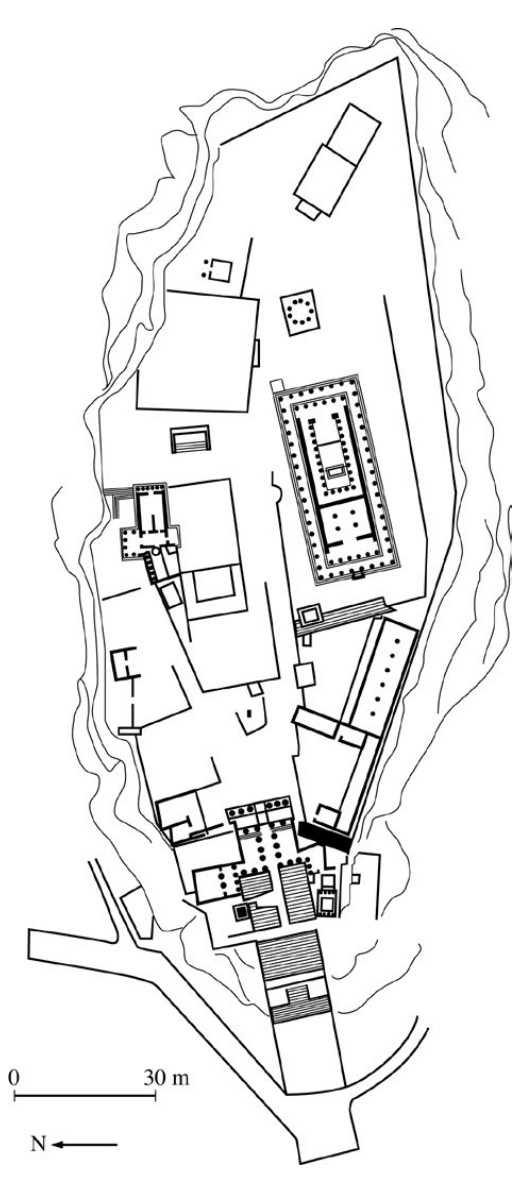
 Acropolis plan
Acropolis
Athens, Greece. Iktinos and Kallikrates. c. 447–410 B.C.E. Marble.
Curator Note
"Pericles rebuilt this sacred hill using money from the Delian League (funds meant for defense against Persia), sparking controversy even then. It includes the Parthenon, which was blown up by Venetian gunpowder in 1687."
Form
- Parthenon: Octostyle (8 columns) Doric peripteral temple with Ionic features (interior frieze).
- Optical refinements: Stylobate curves up, columns lean in, corner columns are thicker (to correct visual sagging).
- Propylaea: Monumental gateway combining Doric and Ionic orders, handling the steep terrain.
- Erechtheion: Asymmetrical, multi-level Ionic temple featuring the Caryatid Porch.
- Temple of Athena Nike: Small, amphiprostyle Ionic temple perched on the edge of the bastion.
Function
- Religious heart of Athens: Dedicated primarily to Athena (Virgin/Polias/Nike).
- Political symbol: Represented the power, wealth, and superiority of the Athenian Empire.
- Treasury: The Parthenon housed the Delian League's funds in the opisthodomos.
- Ceremonial destination: End point of the Great Panathenaic Procession.
- Votive Offering: Rebuilt as a massive offering to the gods after the Persian destruction.
Content
- Parthenon Pediments: East (Birth of Athena from Zeus), West (Contest between Athena and Poseidon).
- Parthenon Metopes: Civilizational battles (Lapiths vs. Centaurs, Gods vs. Giants) = Order vs. Chaos.
- Parthenon Frieze (Ionic): 524ft continuous relief showing the citizens of Athens in the Panathenaic procession.
- Athena Parthenos (Lost): 40ft chryselephantine (gold & ivory) statue by Phidias inside.
- Nike Parapet: Reliefs of Victory figures (e.g., adjusting her sandal) in casual, human poses.
Context
- Built during the "Golden Age" of Pericles (c. 447–410 B.C.E.) following the Persian Wars.
- Funded controversially by the Delian League treasury (money meant for defense).
- Phidias was the general overseer of the artistic program.
- Demonstrates the Greek concept that "Man is the measure of all things" (humanism).
- Suffered damage over time: Church, Mosque, Gunpowder explosion (1687), and looting by Lord Elgin (1800s).