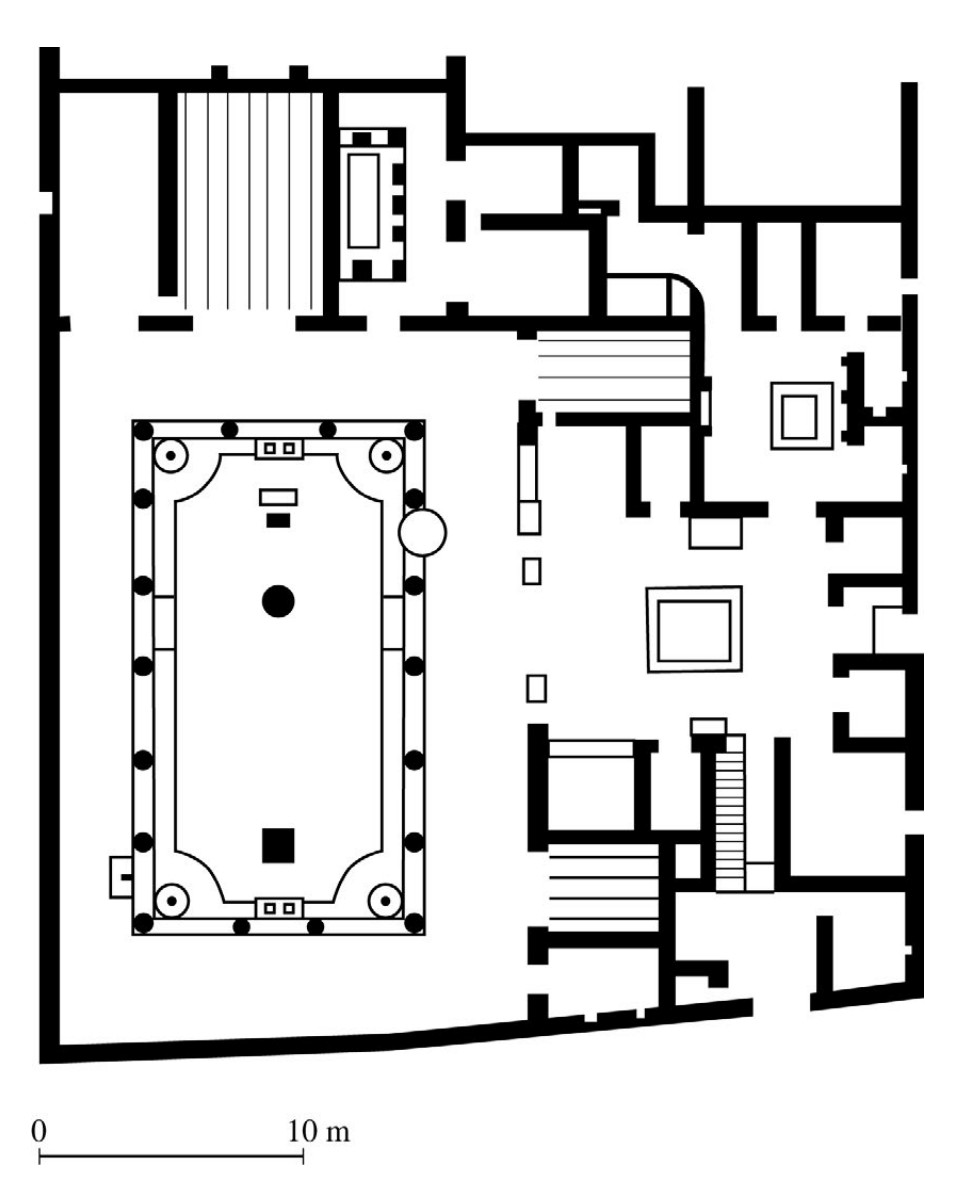
 House of Vetti plan
House of the Vettii
Pompeii, Italy. Imperial Roman. c. second century B.C.E.; rebuilt c. 62–79 C.E. Cut stone and fresco.
Curator Note
"Owned by two former slaves (freedmen) who became wealthy wine merchants. Their home is a gallery of "new money" taste, filled with elaborate mythological frescoes and erotic art to impress guests."
Form
- Standard Roman Domus (townhouse) architecture with narrow entrance (fauces) and open courtyards.
- Axial arrangement: Atrium -> Tablinum -> Peristyle Garden.
- Atrium: Features an impluvium (basin) to catch rain from the compluvium (roof opening).
- Fourth Style Wall Painting: A mix of architectural illusion, framed panel paintings, and chaotic fantasy.
- Lack of exterior windows: Roman houses turned inward for privacy and noise control.
Function
- Private residence of the Vettii brothers (former slaves/freedmen).
- Social stage: Designed to impress clients (client-patron system) and guests.
- Display of extreme wealth and "New Money" status.
- Domestic rituals: Household shrines (Lararium) for the Lares and Penates.
- Commercial function: The brothers likely ran a business from the house (wine merchants?).
Content
- Entrance: Priapus (god of fertility) weighing his massive phallus against a bag of money (wealth/prosperity).
- Ixion Room: Mythological panel paintings (Punishment of Ixion) meant to show culture/education.
- Pentheus Room: Pentheus being torn apart by Maenads.
- Faux marble panels and architectural vistas painted on the walls.
- Peristyle garden with fountains and statues.
Context
- Pompeii, Italy: Buried by the eruption of Mt. Vesuvius in 79 C.E.
- The owners (Aulus Vettius Conviva and Restitutus) were Liberti (freed slaves) who became rich.
- Reflects the social mobility possible in the Roman Empire.
- The Fourth Style of painting was popular at the time of the eruption (62–79 C.E.).
- Provides the best-preserved evidence of Roman domestic life and interior design.