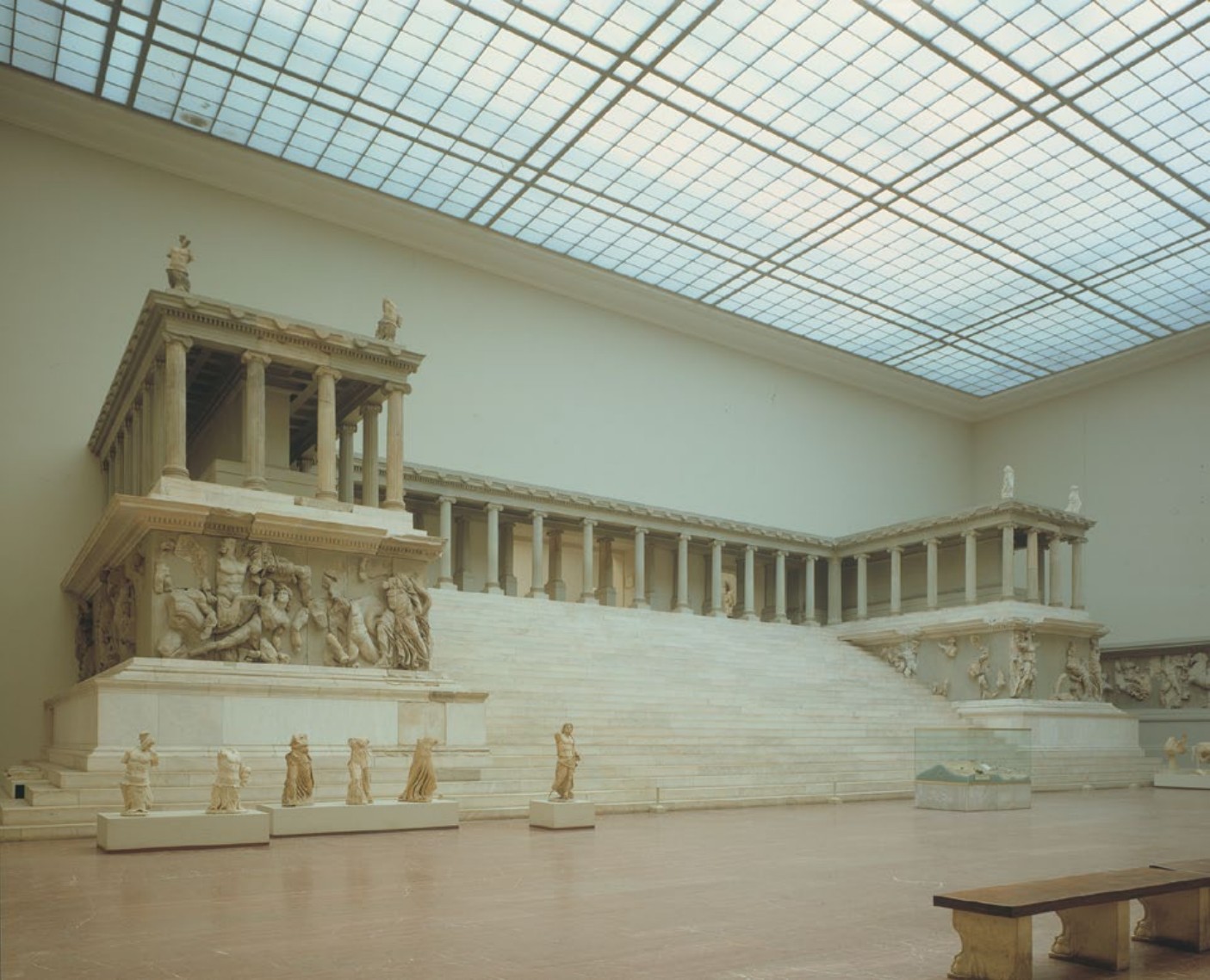
 Great Altar of Zeus and Athena © bpk, Berlin/Antikensammlung, Staatliche Museen/Photo © Juergen Liepe/Art Resource, NY
Great Altar of Zeus and Athena at Pergamon
Asia Minor (present-day Turkey). Hellenistic Greek. c. 175 B.C.E. Marble (architecture and sculpture).
Curator Note
"A stone battle of epic proportions. The giants writhe in agony as the gods effortlessly defeat them. The figures actually spill out of the frieze onto the steps, entering the viewer's space."
Form
- Massive U-shaped Ionic structure with a wide staircase.
- High Relief Frieze (7 feet tall) wraps around the base, featuring figures that spill out onto the stairs.
- Deep carving creates strong chiaroscuro (contrast of light and dark) adding to the drama.
- Hellenistic Baroque: Exaggerated musculature, intense emotion, swirling drapery, and diagonal compositions.
- Spatial complexity: Figures overlap and intertwine in a chaotic mass.
Function
- Dedication to Zeus and Athena (savioir gods).
- Political allegory: The battle of Gods vs. Giants represents the Attalid Kings' victory over the Gauls.
- Display of cultural superiority: Greek civilization (order) triumphing over Barbarian chaos.
- Sanctuary for sacrifice and worship situated on the acropolis of Pergamon.
- Legitimzied the Attalid dynasty as the heirs to Classical Athens.
Content
- Gigantomachy: The cosmic battle between the Olympian Gods and the Earth Giants.
- Athena Panel: Athena grabs the giant Alkyoneos by the hair; Gaia (Earth Mother) rises from the ground pleading.
- Zeus Panel: Zeus battles three giants at once with eagles and thunderbolts.
- Nike flies in to crown Athena, guaranteeing victory.
- Snake-like legs of the giants emphasize their monstrosity and connection to the earth.
Context
- Pergamon (Asia Minor) was a wealthy Hellenistic kingdom that sought to be the "New Athens."
- Created c. 175 B.C.E. during the reign of Eumenes II.
- The altar was dismantled and moved to Berlin in the 19th century (Pergamon Museum).
- Reflects the anxiety and violence of the Hellenistic age compared to the calm of the Parthenon.
- Mentioned in the Bible (Revelation) as the "Throne of Satan" due to its pagan grandeur.