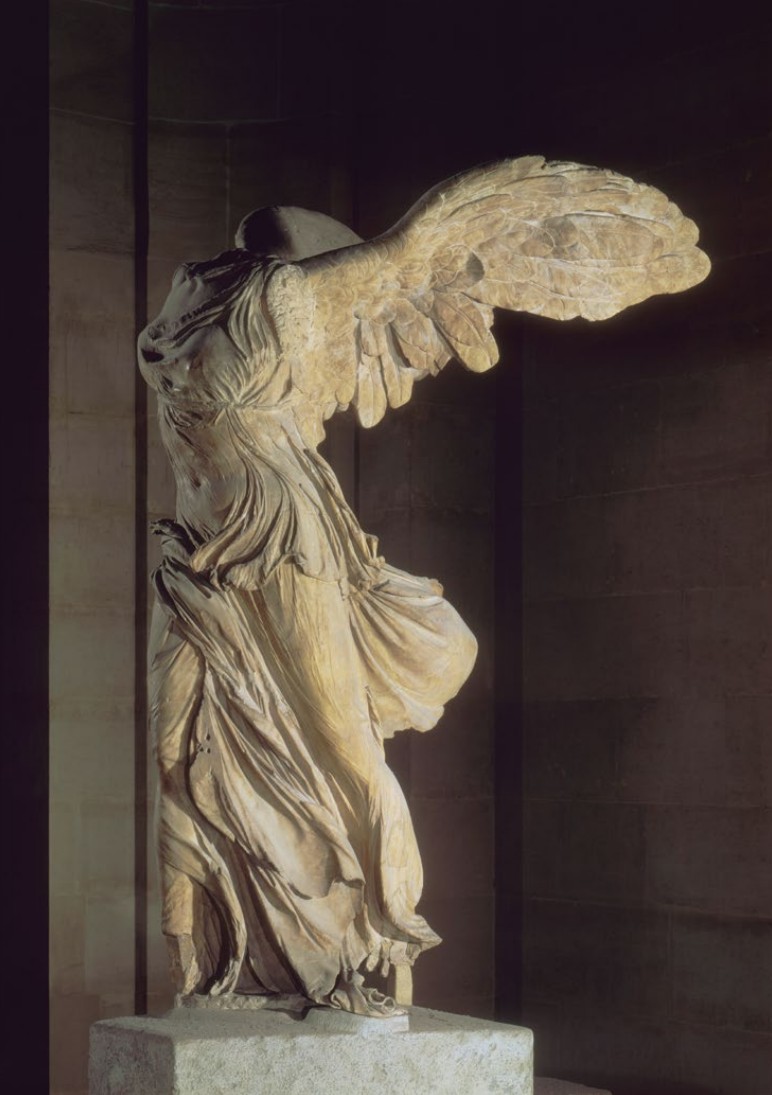
 Winged Victory of Samothrace © RMN-Grand Palais/Art Resource, NY
Winged Victory of Samothrace
Hellenistic Greek. c. 190 B.C.E. Marble.
Curator Note
"Theatrical and dramatic. She originally stood on the prow of a stone ship in a temple fountain, with water splashing around her, her clothes whipped by the wind to celebrate a naval victory."
Form
- Parian marble sculpture standing over 8 feet tall (originally on a prow).
- Hellenistic Dynamism: Strong forward momentum, sweeping diagonal lines, and dramatic motion.
- Wet Drapery: The chiton clings to the torso and legs as if soaked by sea spray and whipped by wind.
- Three-dimensional interaction: Meant to be viewed from multiple angles (spiraling composition).
- Contrast of textures: The smooth nude areas vs. the rippling, chaotic folds of cloth.
Function
- Votive offering to the Great Gods (Cabeiri) of Samothrace.
- Commemorated a significant naval victory (possibly over the Syrian fleet).
- Theatrical installation: Stood in a rock niche above a fountain, creating a multisensory experience (sound of water).
- Personification of Victory (Nike) descending from the heavens.
- Awe-inspiring display of power and divine favor.
Content
- Nike (winged goddess of victory) landing on the prow of a Greek warship.
- Her wings are outstretched, one slightly higher, catching the "wind."
- Right arm (missing) was likely raised to crown the victor or cup her mouth to shout.
- The body twists at the waist, creating a sense of immediate action.
- Missing head adds to the mysterious/timeless aura (though accidental).
Context
- Hellenistic Period (c. 190 B.C.E.): Art moved from Classical calm to emotion (Pathos) and drama.
- Discovered in 1863 in pieces on the island of Samothrace; reconstructed at the Louvre.
- Reflects the turbulent nature of the Hellenistic kingdoms (frequent wars/naval battles).
- The setting (Samothrace) was a major sanctuary for sailors seeking protection.
- Influenced centuries of Western art (e.g., the bonnet ornament of Rolls Royce).