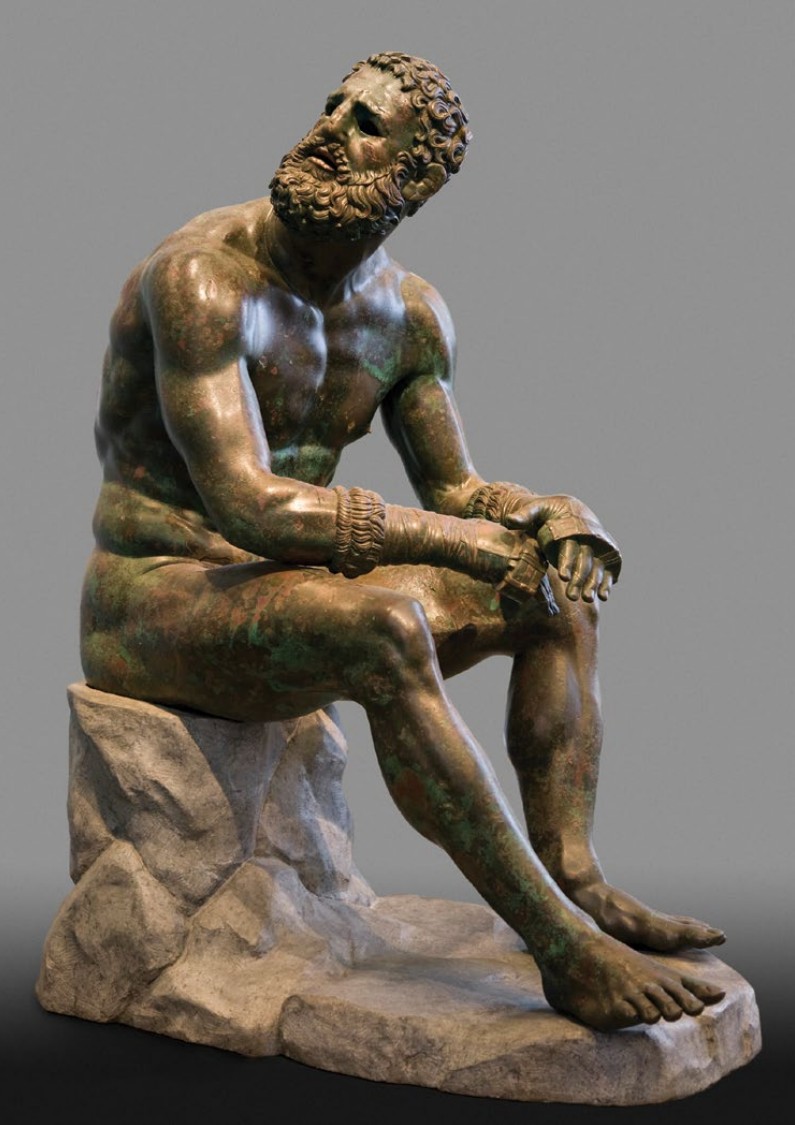
 Seated boxer © Vanni Archive/Art Resource, NY
Seated Boxer
Hellenistic Greek. c. 100 B.C.E. Bronze.
Curator Note
"Not a victorious youth, but a defeated veteran. He has a broken nose, cauliflower ears, and fresh cuts inlaid with copper "blood." He looks up, possibly asking for mercy or resting after a brutal loss."
Form
- Hollow-cast bronze using the lost-wax method (rare survival).
- Realism/Hyper-realism: Depicts an aging, battered body rather than an ideal youth.
- Inlay technique: Copper used for lips, nipple, and "blood" on wounds to add color.
- Seated, slumped posture initiates an emotional connection with the viewer.
- Detailed texturing of the hair and boxing gloves (himantes).
Function
- Likely a votive statue dedicated in a gymnasium or sanctuary.
- Good luck charm: The toes are worn down from being touched/rubbed.
- Evoke pathos (sympathy/pity) for the suffering of the athlete.
- Contrast with earlier Classical statues like the Doryphoros (Strength vs. Exhaustion).
- May represent a specific mythological boxer (e.g., Tydeus or Amycus).
Content
- An older, veteran boxer seated on a rock, resting after a match.
- Facial injuries: Broken nose, cauliflower ears, cuts on the face inlaid with copper.
- He looks up sharply, perhaps at the referee or a new opponent.
- Muscular body shows strength, but the posture shows defeat/fatigue.
- Wearing ancient boxing gloves (leather thongs wrapped around hands).
Context
- Hellenistic Greek (c. 100 B.C.E.): Defines the shift towards emotion and diverse subjects.
- Found in Rome on the Quirinal Hill, carefully buried to preserve it.
- Romans admired Greek boxing (which was brutal, often to the death).
- Unlike Classical art which sought the ideal, Hellenistic art sought the specific and emotional.
- One of the few original Greek bronzes not melted down for weapons.