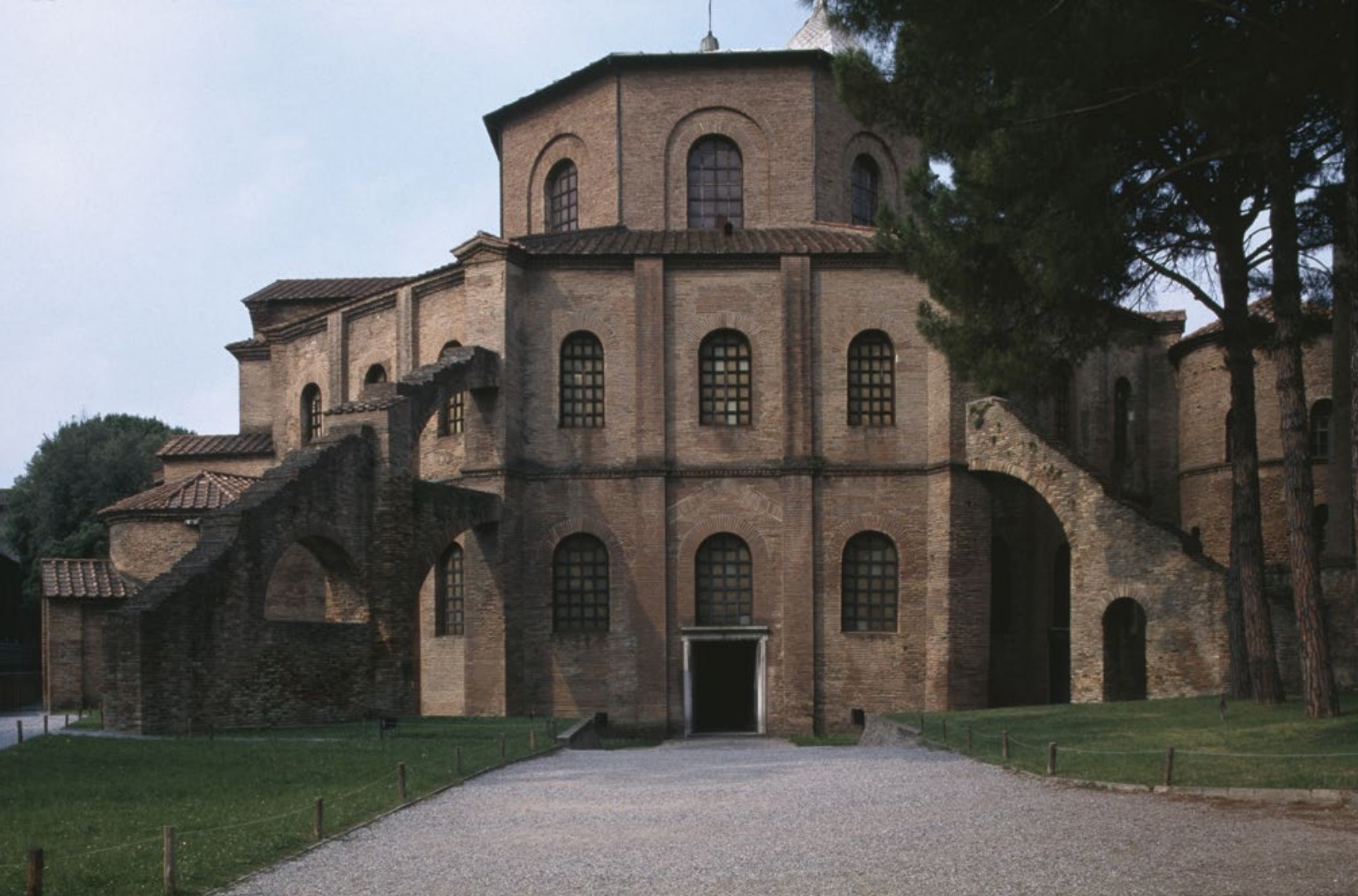
 San Vitale © Gérard Degeorge/The Bridgeman Art Library
San Vitale
Ravenna, Italy. Early Byzantine Europe. c. 526–547 C.E. Brick, marble, and stone veneer; mosaic.
Curator Note
"A centrally-planned octagonal church in Ravenna, built during the reign of Justinian. It is famous for its glittering interior mosaics, which depict Emperor Justinian and Empress Theodora participating in the mass, asserting their political and religious authority over Italy, even though they likely never visited."
Form
- Centrally planned octagon (8 sides) with a dome.
- Plain exterior (brick) vs. rich interior (mosaics/marble).
- Complex interior with exedrae (semicircular niches).
- Mosaics use tesserae set at angles to reflect light.
- Gold backgrounds symbolize the spiritual realm.
Function
- Martyrium dedicated to Saint Vitalis.
- To assert Byzantine control over Ravenna and the West.
- To show the unity of church and state (Caesaropapism).
- Imperial propaganda for Justinian and Theodora.
- Liturgical space for the Eucharist.
Content
- Justinian Panel: Emperor with soldiers and clergy (Bishop Maximianus).
- Theodora Panel: Empress with court ladies and chalice.
- Christ Enthroned on a blue orb (universe).
- Justinian wears purple/gold and has a halo (divine right).
- Lamb of God on the ceiling vault.
Context
- Ravenna was the capital of the Western Roman Empire then Byzantine stronghold.
- Funded by Julianus Argentarius (a banker).
- Justinian sought to reunite the East and West empires.
- Theodora was Justinian's powerful co-ruler.
- Influenced Charlemagne's Palatine Chapel.