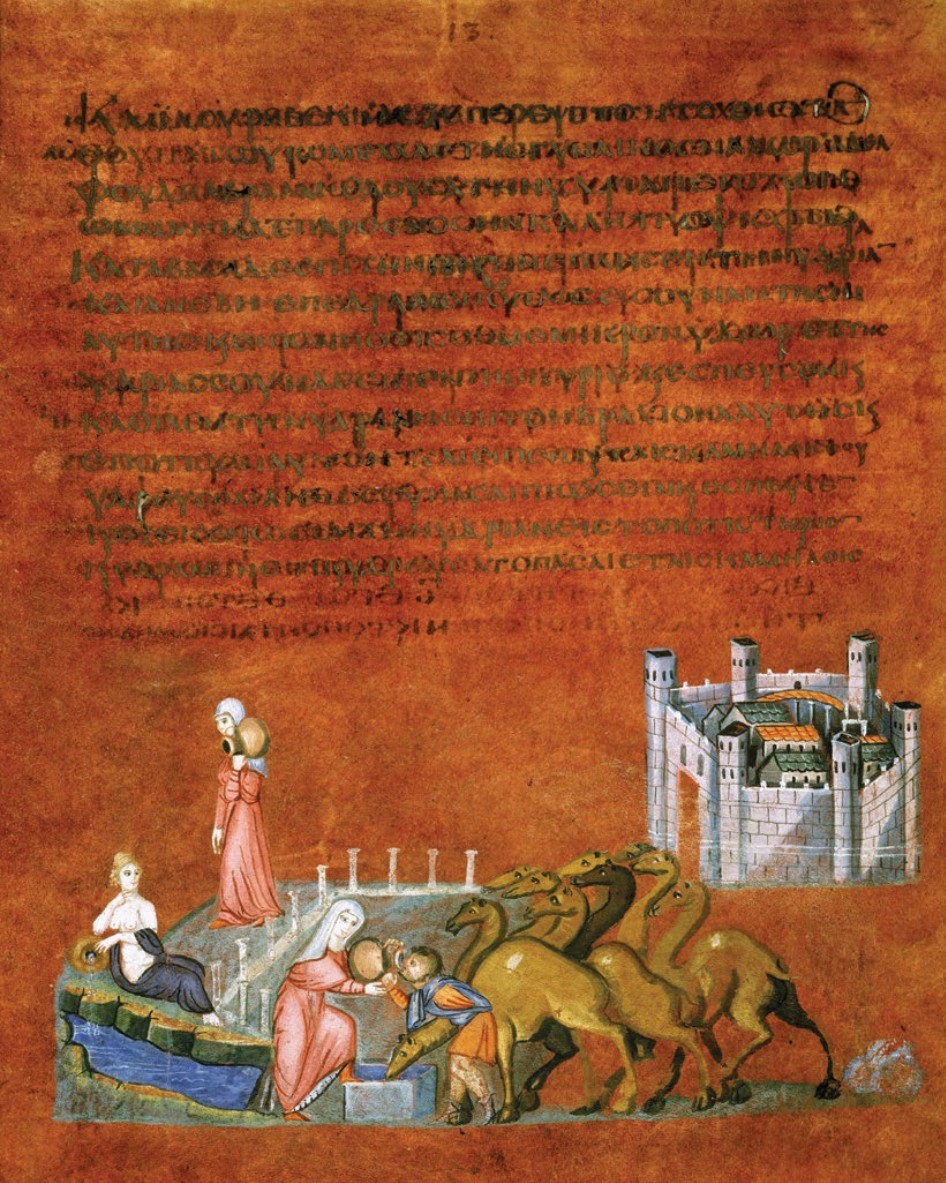
 Rebecca and Eliezer at the Well © Österreichische Nationalbibliothek, Gr. 31, fol. 7r
Vienna Genesis
Early Byzantine Europe. Early 6th century C.E. Illuminated manuscript (tempera, gold, and silver on purple vellum).
Curator Note
"The oldest surviving well-preserved illustrated biblical manuscript. Written in silver ink on purple-dyed vellum (indicating royal patronage), it illustrates scenes from the Book of Genesis, such as Rebecca at the Well, using a continuous narrative style that blends Classical realism with medieval abstraction."
Form
- Purple-dyed vellum (calfskin) indicating imperial luxury.
- Silver script (now oxidized to black).
- Continuous narrative: multiple scenes in one frame.
- Classical figures (drapery, movement) but skewed perspective.
- Mix of realistic details (animals) and symbolic scale.
Function
- To illustrate the stories of the Bible for a wealthy/royal patron.
- To display status and piety.
- Devotional object for reading and contemplation.
- To preserve the text of Genesis.
- Portable teaching tool.
Content
- Rebecca and Eliezer at the Well: Rebecca offers water to Abraham's servant.
- Jacob Wrestling the Angel: continuous story on a curved path.
- Personification of the spring (a pagan river nymph).
- Camels and colonnaded city (Nahor).
- Emphasis on the correct moral choice (Rebecca's kindness).
Context
- Created during the transition from scroll to codex (book).
- Likely made in Syria or Constantinople.
- Shows the persistence of Classical motifs in Christian art.
- Pages are fragmentary due to age.
- Example of an illuminated manuscript.