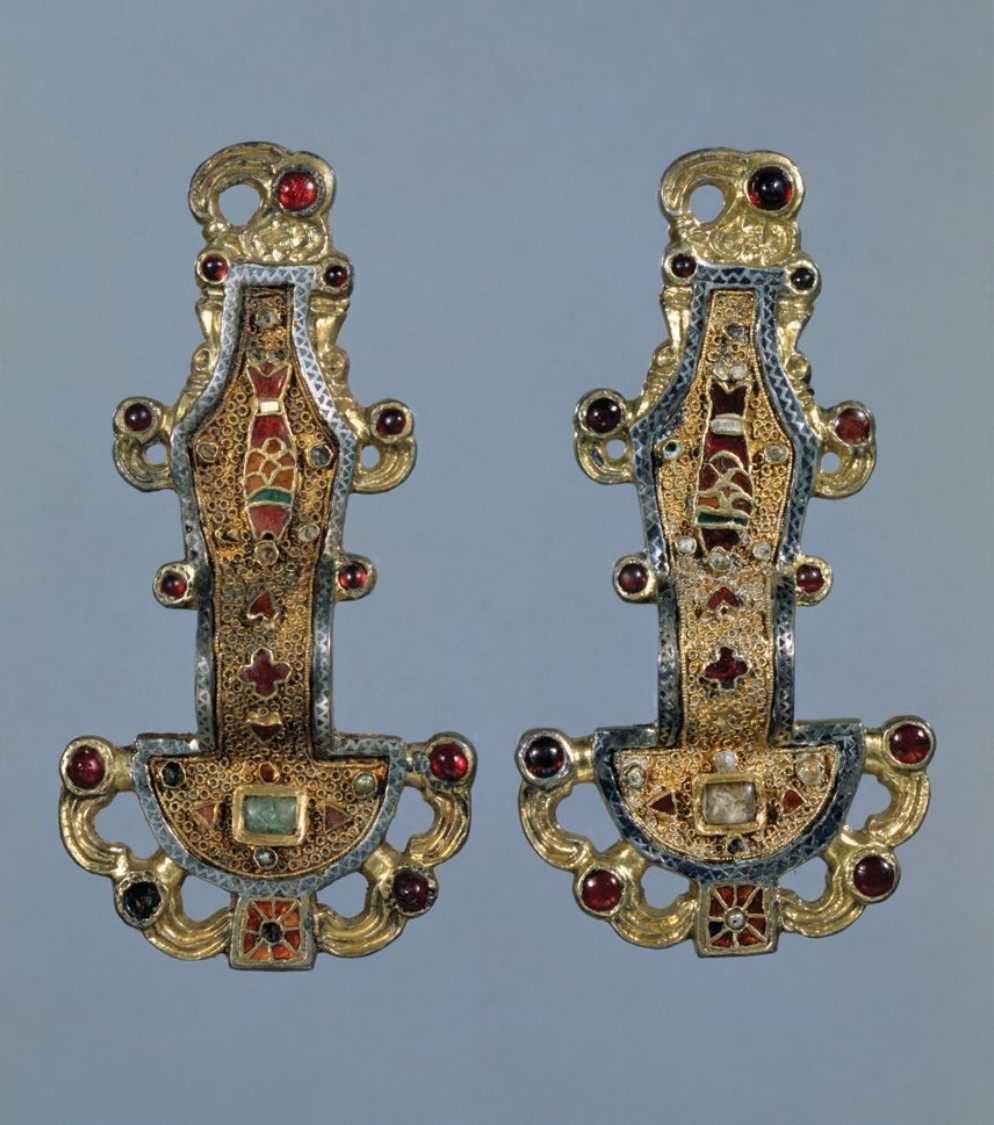
 Merovingian looped fibulae © RMN-Grand Palais/Art Resource, NY
Merovingian looped fibulae
Early medieval Europe. Mid-6th century C.E. Silver gilt worked in filigree, with inlays of garnets and other stones.
Curator Note
"These jeweled brooches (fibulae) were status symbols used to fasten garments. Found in a wealthy grave, they display the "cloisonné" technique (inlaid stones) and the "animal style" typical of barbarian/migration art, featuring stylized eagles and fish. They represent the fusion of Roman and non-Roman cultures."
Form
- Cloisonné technique: metal partitions filled with gems/glass.
- Zoomorphic decoration: stylized animals (eagles, fish).
- Symmetry and intricate geometric patterns.
- Silver gilt (gold-covered silver).
- Portable, functional art.
Function
- To fasten a cloak or garment at the shoulder.
- To display the wealth and elite status of the owner.
- Burial goods for the afterlife.
- To signal tribal identity.
- A gift or tribute between elites.
Content
- Eagle heads: symbol of the sun or power (Garuda/Rome).
- Fish: Christian symbol or decorative motif.
- Looped shape: characteristic of Merovingian style.
- Garnets: red gemstones emphasizing luxury.
- Horror vacui (fear of empty space) filling.
Context
- Merovingians were a Frankish dynasty (France).
- Found in the tomb of a wealthy woman.
- Migration Period art (art of the "barbarians").
- Similar to objects found at Sutton Hoo.
- Shows excellence in metalwork in "Dark Ages".