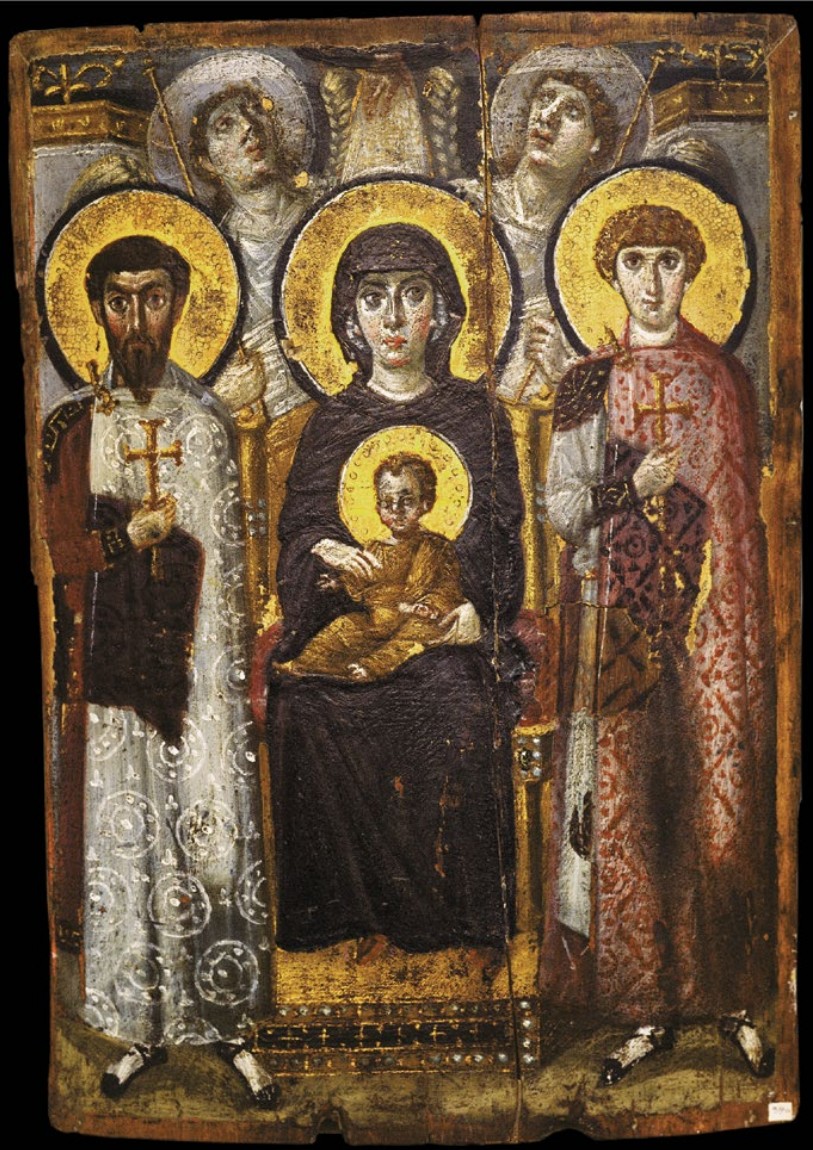
 Virgin (Theotokos) and Child between Saints Theodore and George © Erich Lessing/Art Resource, NY
Virgin (Theotokos) and Child between Saints Theodore and George
Early Byzantine Europe. Sixth or early seventh century C.E. Encaustic on wood.
Curator Note
"One of the few surviving pre-Iconoclastic icons, preserved at St. Catherine’s Monastery in Sinai. It depicts the Virgin Mary as "Theotokos" (God-bearer), flanked by warrior saints. The composition creates a hierarchy of holiness, moving from the earthly saints to the Virgin, to the angels gazing upward at the hand of God."
Form
- Encaustic painting (pigment mixed with hot wax).
- Frontal, stiff figures (saints and Virgin).
- Shallow space; figures seem to float.
- Angels are painted in an illusionistic (classical) style.
- Big eyes to engage the viewer.
Function
- Devotional object for prayer and intercession.
- To facilitate a connection with the divine.
- To visualize the hierarchy of intercessors.
- Protect the monastery (warrior saints).
- Didactic tool.
Content
- Theotokos: Virgin Mary enthroned with Baby Jesus.
- St. Theodore (beard) and St. George (shaved): warrior saints slaying evil.
- Angels: looking up at the hand of God (emotional).
- Hand of God: blessing the scene from above.
- Direct gaze of saints engages the viewer.
Context
- Preserved at St. Catherine's Monastery (remote location saved it).
- Iconoclasm (726–843) destroyed most icons in Constantinople.
- Continues the Roman tradition of portrait painting (Fayum).
- Reflects the debate over the nature of religious images.
- Classicizing style (angels) vs. Medieval abstraction (saints).