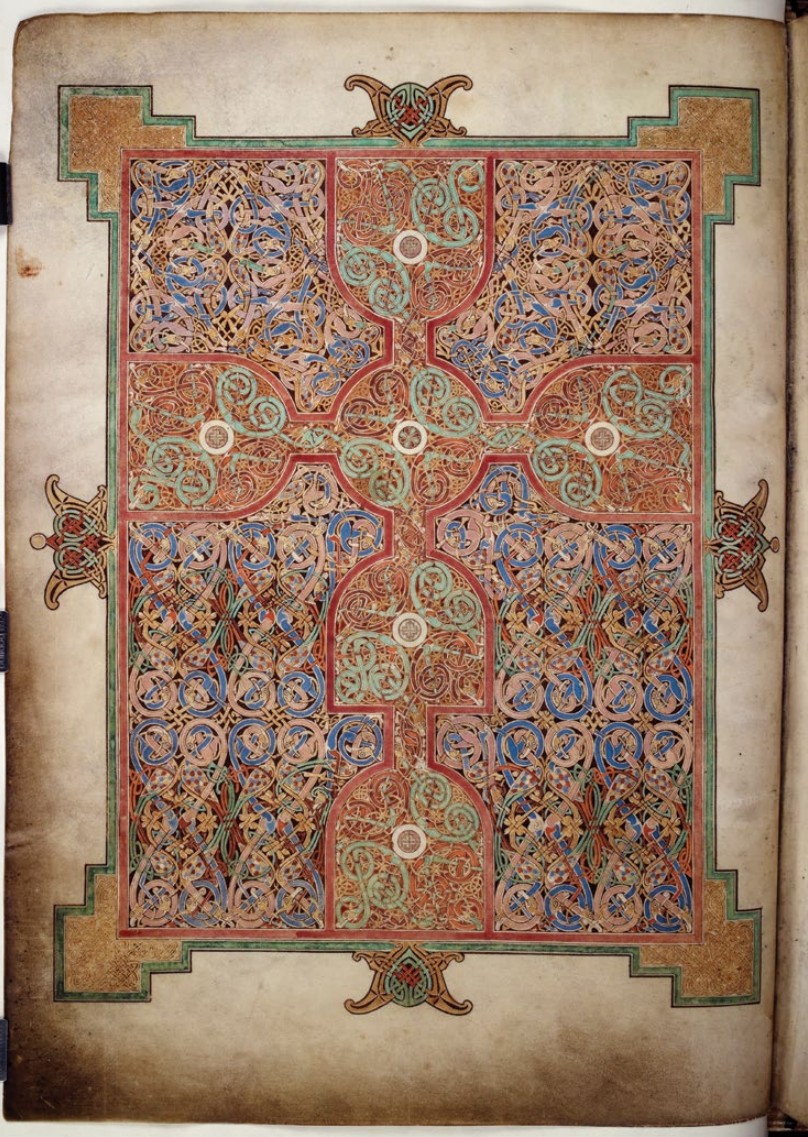
 St. Matthew, cross-carpet page © British Library Board/Robana/Art Resource, NY
Lindisfarne Gospels: St. Matthew, cross-carpet page; St. Luke portrait page; St. Luke incipit page
Early medieval (Hiberno-Saxon) Europe. c. 700 C.E. Illuminated manuscript (ink, pigments, and gold on vellum).
Curator Note
"A masterpiece of Hiberno-Saxon (Insular) art, produced by a single monk, Eadfrith, on a remote island. It combines Celtic, Germanic, and Roman artistic styles. The intricate "carpet pages" feature complex, knotwork designs that are meditative to create and to view, preparing the reader for the sacred text."
Form
- Hiberno-Saxon style (Insular art).
- Interlace patterns and knotwork (Celtic).
- Zoomorphic forms (birds, snakes) biting themselves.
- Bright, flat colors; no depth.
- Precision and complexity of design.
Function
- To honor God and St. Cuthbert.
- To house the Gospel texts for liturgical use.
- To impress the viewer with the sanctity of the Word.
- Meditative practice for the artist (Eadfrith).
- Tool for converting Vikings/locals.
Content
- Cross-carpet page: a cross embedded in chaotic knotwork (order vs. chaos).
- St. Luke Portrait: The Evangelist writing, with his symbol (the ox).
- Incipit Page: "Quoniam" (Since/For) text beginning the gospel.
- Blue winged calf: symbol of Luke (sacrificial).
- Latin text with later Old English translation added.
Context
- Created at the Lindisfarne Priory (Holy Island).
- Artist believed to be Bishop Eadfrith.
- Vikings raided Lindisfarne in 793 (book survived).
- Shows the fusion of pagan motifs with Christian content.
- Use of local pigments and expensive imports (lapis lazuli).