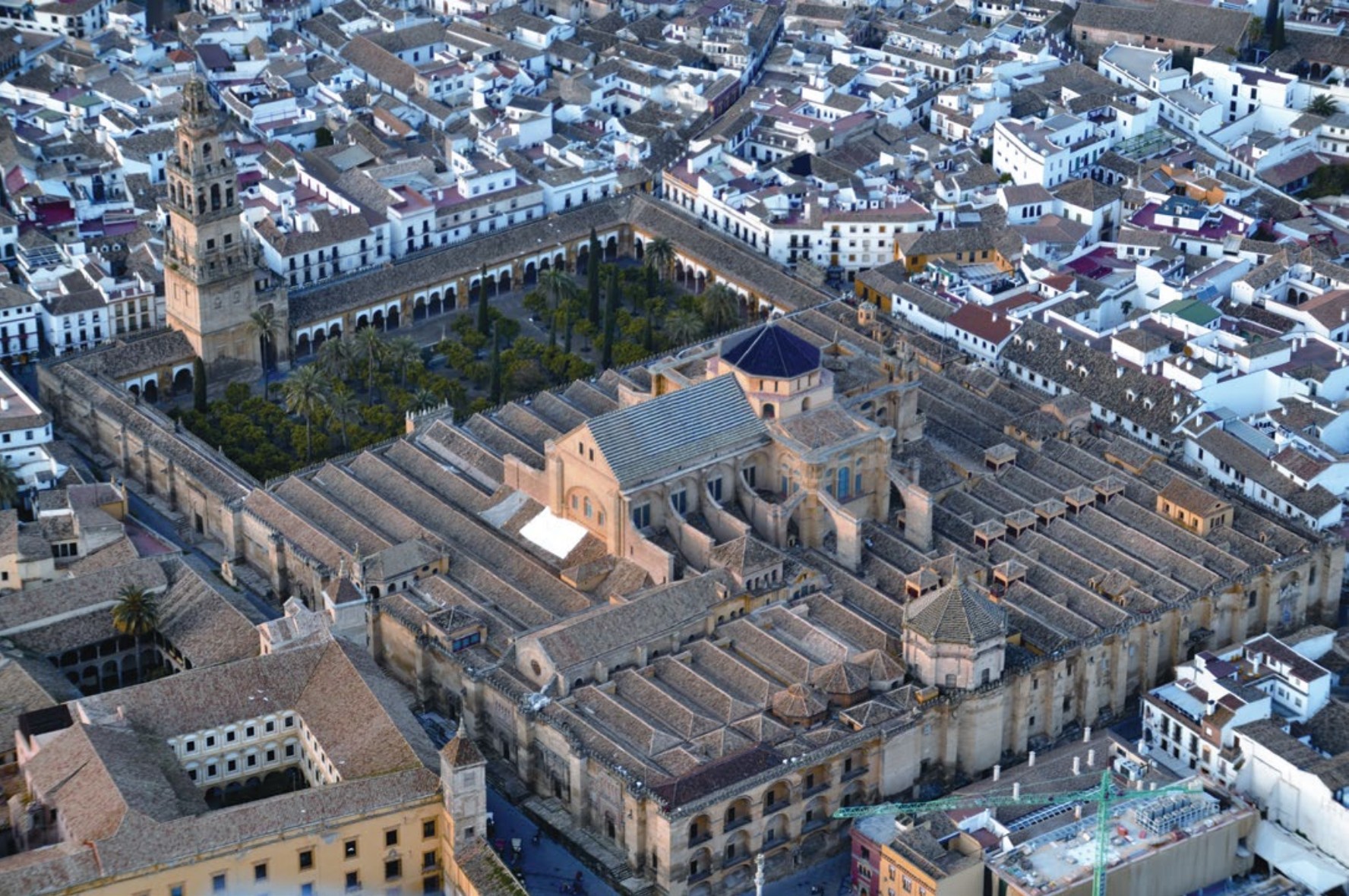
 Great Mosque © Toni Castillo/Getty Images
Great Mosque of Córdoba
Córdoba, Spain. Umayyad. c. 785–786 C.E. Stone masonry.
Curator Note
"A symbol of the Umayyad glory in Al-Andalus (Spain). It is famous for its vast hypostyle hall with unique double-tiered arches (red brick/white stone) that create a sense of infinity. It reuses Roman columns (spolia). Later, a Christian cathedral was built vertically right in the middle of it, creating a jarring architectural clash."
Form
- Hypostyle hall: forest of columns.
- Double-arched system: horseshoe arch over lower arch.
- Polychrome arches: alternating red brick and white stone (voussoirs).
- Ribbed dome over the Maqsura.
- Reuse of Roman/Visigothic columns (spolia).
Function
- Principal mosque for the city of Córdoba.
- Statement of Umayyad power and independence from Abbasids.
- Center of Islamic learning and prayer.
- Later: Catholic Cathedral.
- To orient the faithful towards Mecca (Mihrab).
Content
- Mihrab: niche indicating Qibla wall (direction of prayer).
- Maqsura: screened area for the Caliph.
- Calligraphy: Quranic inscriptions.
- Orange trees in the courtyard (sahn).
- The Cathedral modification: Renaissance nave inserted.
Context
- Built by Abd al-Rahman I, the exiled Umayyad prince.
- Córdoba was a thriving, multicultural capital.
- Expanded by subsequent rulers.
- Influenced by the Great Mosque of Damascus and Roman aqueducts.
- Reconquista converted it to a church in 1236.