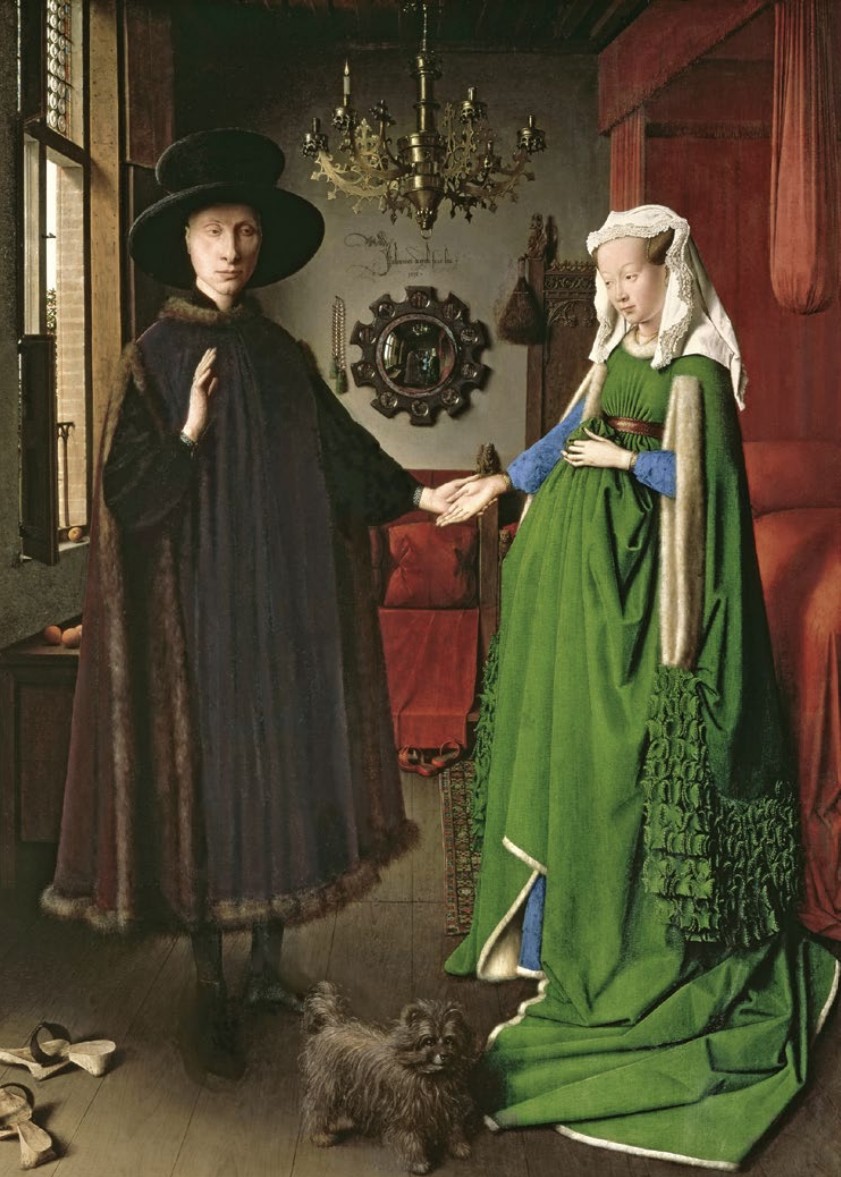
 The Arnolfini Portrait © National Gallery, London, UK/The Bridgeman Art Library
The Arnolfini Portrait
Jan van Eyck. c. 1434 C.E. Oil on wood.
Curator Note
"One of the most famous and mysterious paintings in art history. It shows an Italian merchant and his wife in their home in Bruges. The incredible detail achieved with oil paint (the mirror, the dog, the chandelier) makes it look like a photograph. The meaning is debated: is it a wedding, a betrothal, or a memorial?"
Form
- Oil on oak panel.
- Flemish Primitives style: microscopic detail.
- Soft, glowing light from the window.
- Rich colors and textures (fur, velvet, gold).
- Vertical composition.
Function
- Documentation of a marriage or betrothal?
- Display of wealth and status.
- Memorial to a deceased wife (possible theory).
- Legal document (witnesses in mirror).
- To show off Van Eyck's skill.
Content
- Mirror: reflects the couple and two visitors (witnesses).
- Signature: "Jan van Eyck was here 1434" (graffiti style).
- Dog: fidelity (Fido).
- Shoes off: Holy ground.
- Single candle: God's presence/Marriage candle.
- Green dress: hope/fertility (she is not pregnant, it's fashion).
Context
- Arnolfini was an agent for the Medici bank in Bruges.
- Bruges was a major trading center.
- Van Eyck perfected the use of oil glazes.
- Highlights the rise of secular portraiture.
- Interpreted by Panofsky as a wedding contract.