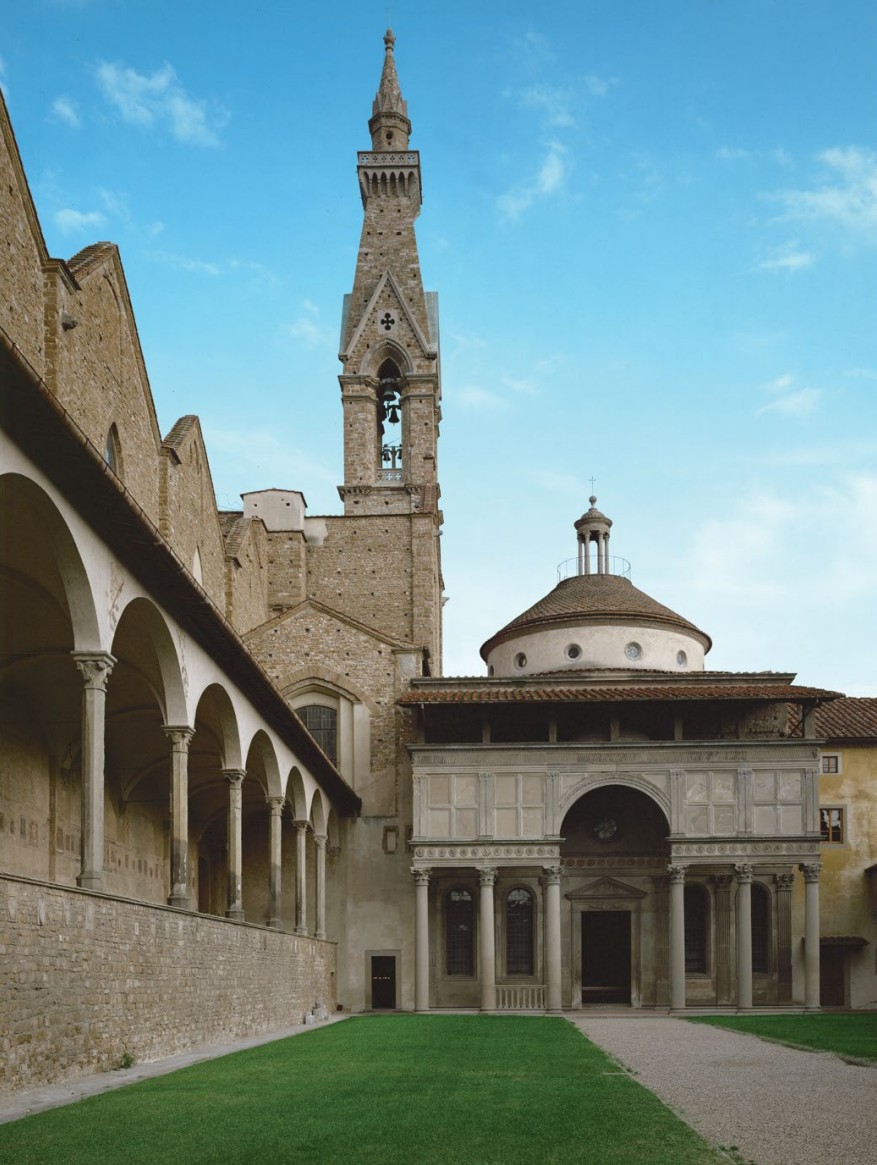
 Pazzi Chapel © Erich Lessing/Art Resource, NY
Pazzi Chapel
Basilica di Santa Croce. Florence, Italy. Filippo Brunelleschi (architect). c. 1429–1461 C.E. Masonry.
Curator Note
"A perfect example of Early Renaissance architecture by Brunelleschi. It breaks away from the Gothic style, returning to the order, rationality, and geometry of Rome (Grey stone and White walls). The space is calm, balanced, and intellectual, reflecting Humanist ideals."
Form
- Central plan with a dome.
- Pietra serena (grey sandstone) outlining the geometry against white stucco.
- Corinthian pilasters and rounded arches.
- Use of simple shapes (circle, square, rectangle).
- Rational and harmonious proportions.
Function
- Chapter House (meeting room) for the monks of Santa Croce.
- Burial chapel for the noble Pazzi family.
- To display the Pazzi family's wealth and power.
- To embody Renaissance clarity.
- Place of prayer.
Content
- Dome with occulus (light).
- Ceramic roundels (tondini) by Luca della Robbia (Evangelists).
- Pazzi crest features two dolphins.
- Umbrella vaulting.
- Bench running along the wall.
Context
- The Pazzi were rivals of the Medici (Pazzi Conspiracy).
- Brunelleschi rediscovered linear perspective and Roman engineering.
- Attached to the Gothic church of Santa Croce.
- Florence was the heart of the Renaissance.
- Focus on man's ability to create order.