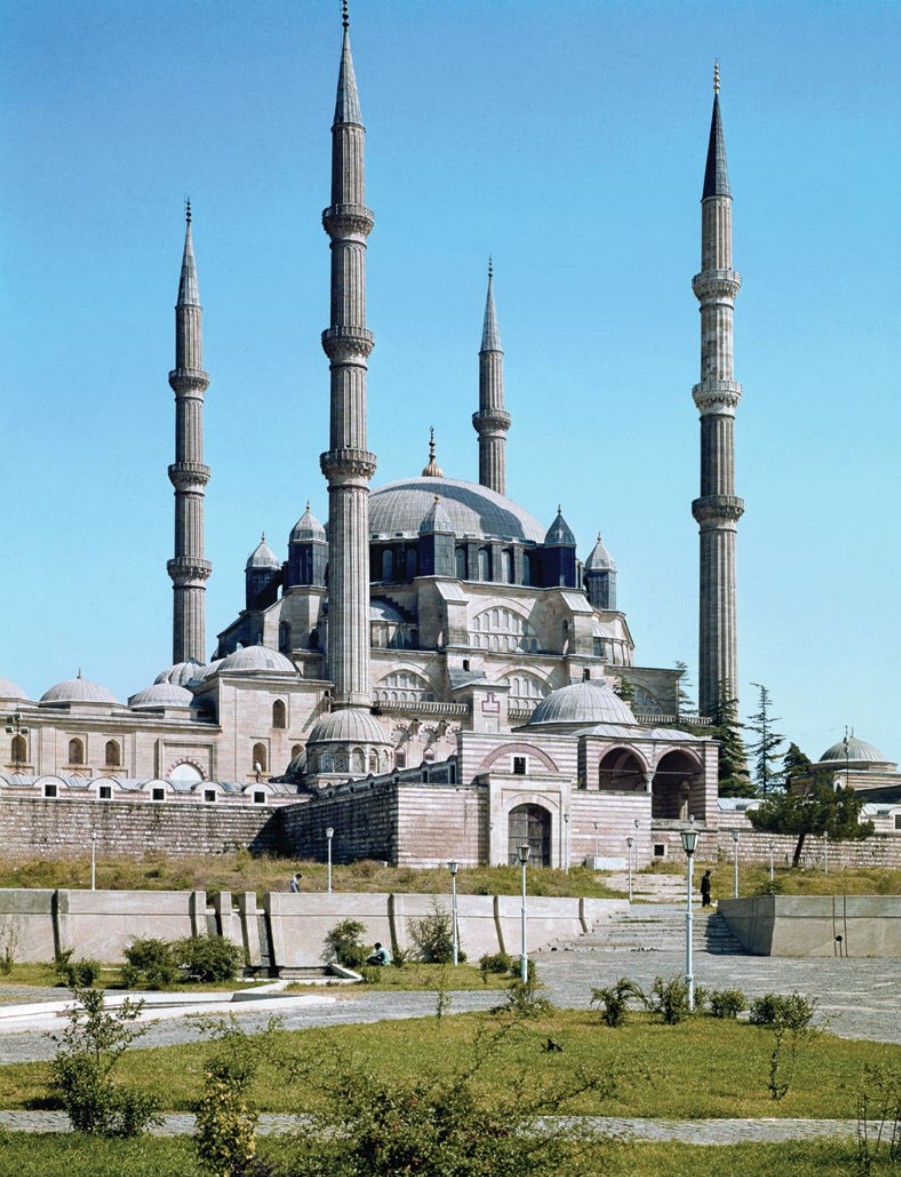
 Mosque of Selim II © Giraudon/The Bridgeman Art Library
Mosque of Selim II
Edirne, Turkey. Sinan (architect). 1568–1575 C.E. Brick and stone.
Curator Note
"The crowning achievement of Sinan the Great, the Ottoman Empire’s most famous architect. He sought to surpass the Hagia Sophia by building a dome that was higher and wider. The result is a perfectly unified central space where the dome seems to float effortlessly, representing the peak of Ottoman power and Islamic theology."
Form
- Central plan mosque.
- Massive central dome supported by 8 piers (octagon).
- Four pencil-thin minarets (highest in the world then).
- Polychrome voussoirs (red/white) and Iznik tiles.
- Pyramidal massing of forms on exterior.
Function
- Friday Mosque for Edirne (Selim's favorite city).
- To surpass the Christian Hagia Sophia.
- Center of a Kulliye (complex: school, market, library).
- Display of Ottoman imperial power.
- Prayer space.
Content
- Prayer hall: unified space (all can see the Mihrab).
- Muezzin's platform in the center (unusual).
- Dome: Symbol of the heavens/God's oneness (Tawhid).
- Windows: flooding light ("God is the light of the heavens").
- Slightly higher than Hagia Sophia.
Context
- Built for Sultan Selim II (son of Suleiman).
- Edirne was the first Ottoman capital in Europe.
- Sinan was born Christian, recruited via Devshirme.
- Represents the climax of Ottoman architecture.
- Funded by spoils of war (Cyprus?).