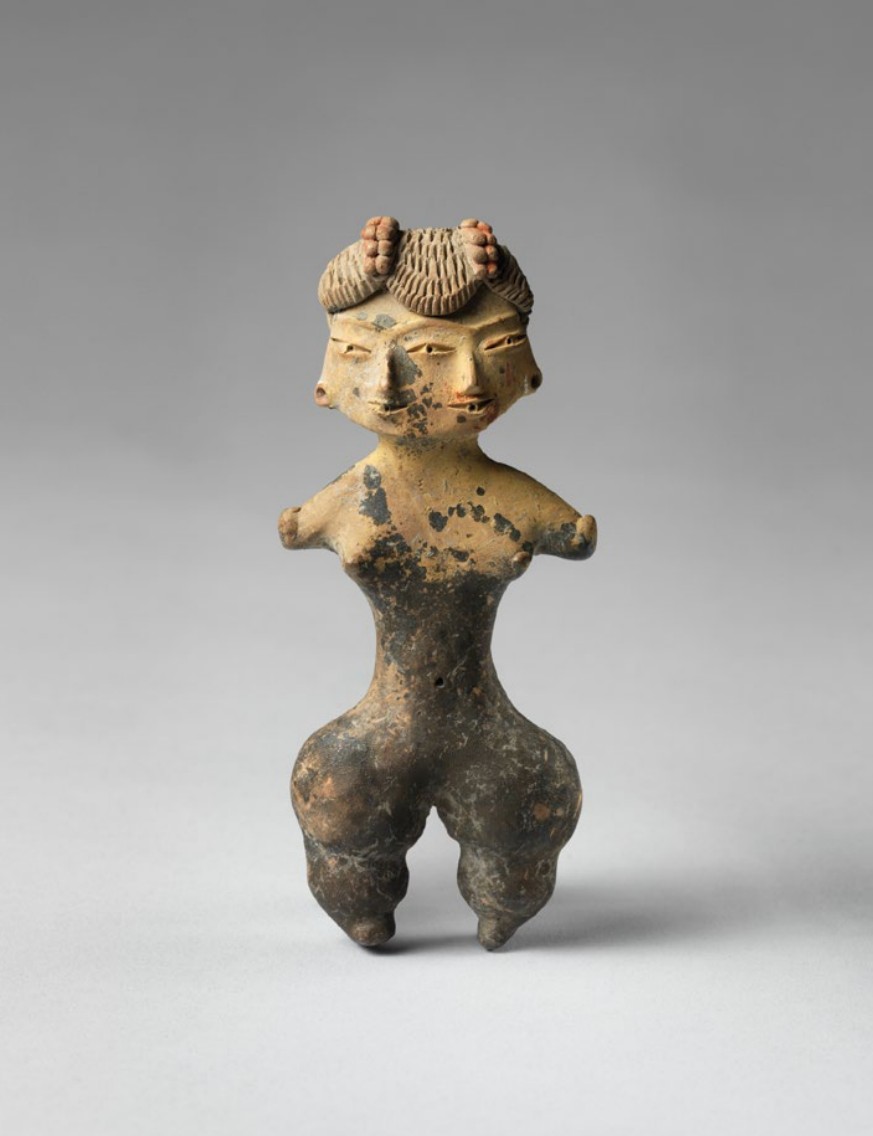
 Tlatilco female figurine © Princeton University Art Museum/Art Resource, NY
Tlatilco Female Figurine
Central Mexico, site of Tlatilco. 1200–900 B.C.E. Ceramic.
Curator Note
"A small ceramic figure depicting a woman with two heads/faces. It signifies duality and the complexity of spiritual beliefs in early Mexico."
Form
- Hand-modeled ceramic (clay) with incised details (no molds used).
- Pinched clay technique creates the nose and facial features.
- Exaggerated hips and thighs contrast with the pinched, narrow waist.
- Bifurcated (two-headed) face sharing a central eye (fused head).
- Traces of red, yellow, and black pigment suggest it was originally painted.
Function
- Funerary object found in graves, suggesting a role in the afterlife.
- Charm or talisman for fertility, safe childbirth, or women's health.
- Representation of duality (life/death, normal/supernatural, waking/dreaming).
- May represent a deity or a congenital anomaly (conjoined twins) viewed as sacred.
- Household idol used in domestic rituals before being buried.
Content
- Female figure with two noses, two mouths, and three eyes.
- Elaborate hairstyle shows the importance of personal adornment and status in Tlatilco society.
- Nude body with emphasis on the lower half (reproductive capabilities).
- Lack of hands/feet focuses attention on the torso and head.
- The serene expression suggests a peaceful or meditative state.
Context
- Found at Tlatilco ("place of hidden things"), a farming village near present-day Mexico City.
- Tlatilco culture (1200–900 B.C.E.) flourished alongside the Olmecs and interacted with them.
- High infant mortality rate may have influenced the intense focus on fertility and duality.
- Hundreds of graves have preserved these figurines, showing their widespread use.
- Prefigures the dualistic philosophy (Ometeotl) found in later Aztec culture.