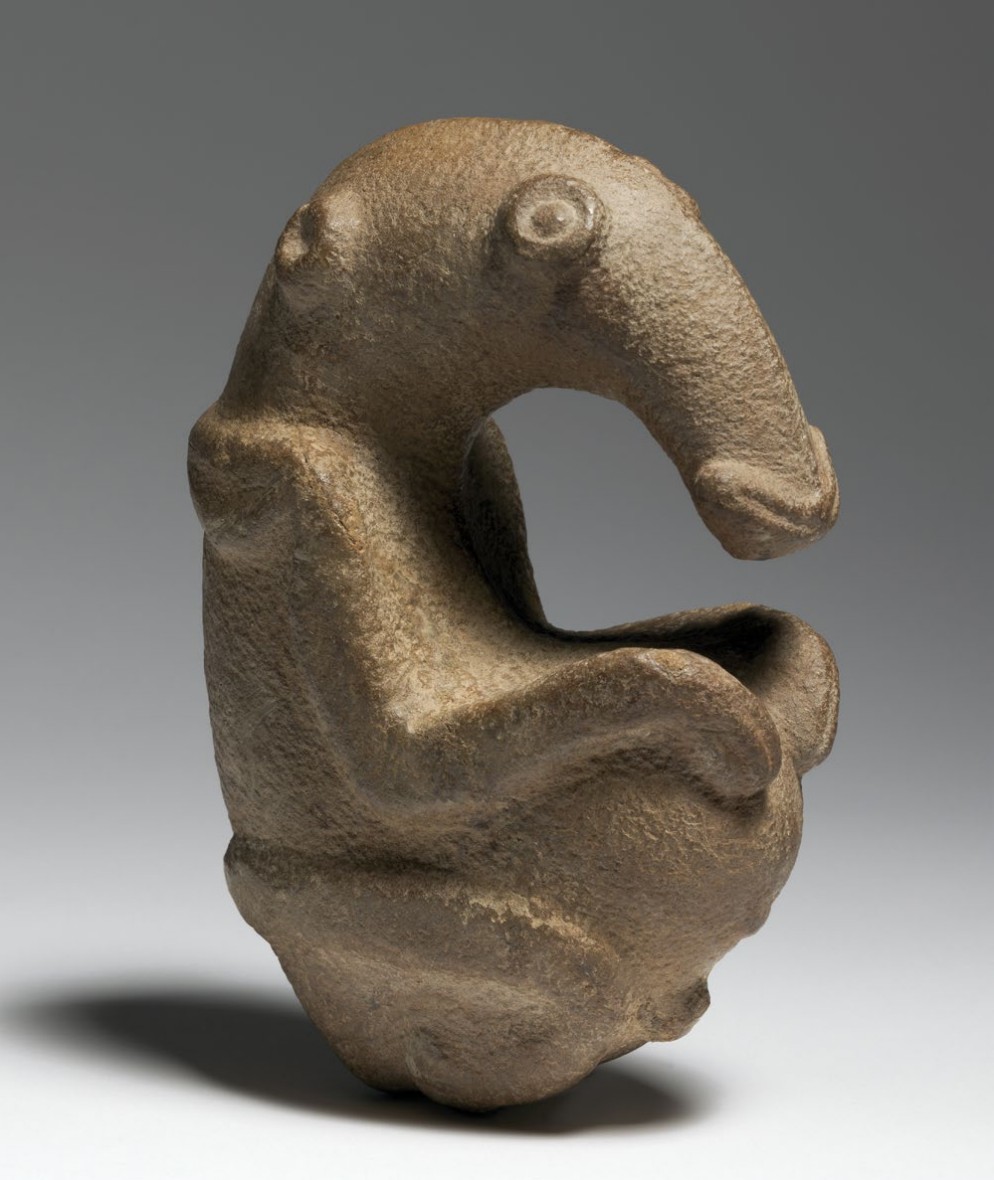
 The Ambum stone © National Gallery of Australia, Canberra
The Ambum Stone
Ambum Valley, Enga Province, Papua New Guinea. c. 1500 B.C.E. Greywacke.
Curator Note
"A stone carving of an echidna-like creature. It is one of the oldest and most detailed sculptures from Oceania."
Form
- Carved from greywacke, a very hard and durable sedimentary stone.
- Smooth, distinctive curved lines and a high level of polished refinement.
- Free-standing sculpture with a pleasing tactile quality (made to be held).
- Zoomorphic form with a rounded base (pestle shape).
- Symmetrical rendering of the creature's features.
Function
- Originally functioned as a pestle used for grinding herbs or food (taro) in a mortar.
- Later became a sacred object possessed by powerful clans, believed to have a life of its own.
- Ritual spirit stone ("bones of the ancestors") used to promote fertility and ward off danger.
- Buried in ancestral grounds to protect the tribe’s lineage and land.
- Used in "big man" exchange systems to demonstrate wealth and spiritual power.
Content
- Depicts a juvenile long-beaked echidna (spiny anteater), an animal revered for its fat.
- Human-like hands/arms holding the belly, possibly signifying fullness or fertility.
- Elongated nose and clearly defined eyes give it an alert expression.
- The stylized form could also represent a bird, fruit bat, or marsupial (composite creature).
- Possible phallic shape suggests male fertility power.
Context
- Discovered in the Ambum Valley (Enga Province) of Papua New Guinea in the 1960s.
- Enga people traditionally viewed such stones as powerful spirits that required sacrifice (pork fat).
- Dated to c. 1500 B.C.E., making it one of the oldest sculptures in Oceania.
- Demonstrates the long history of independent agriculture (taro/yam) in the New Guinea highlands.
- Currently held at the National Gallery of Australia, sparking debates about repatriation.