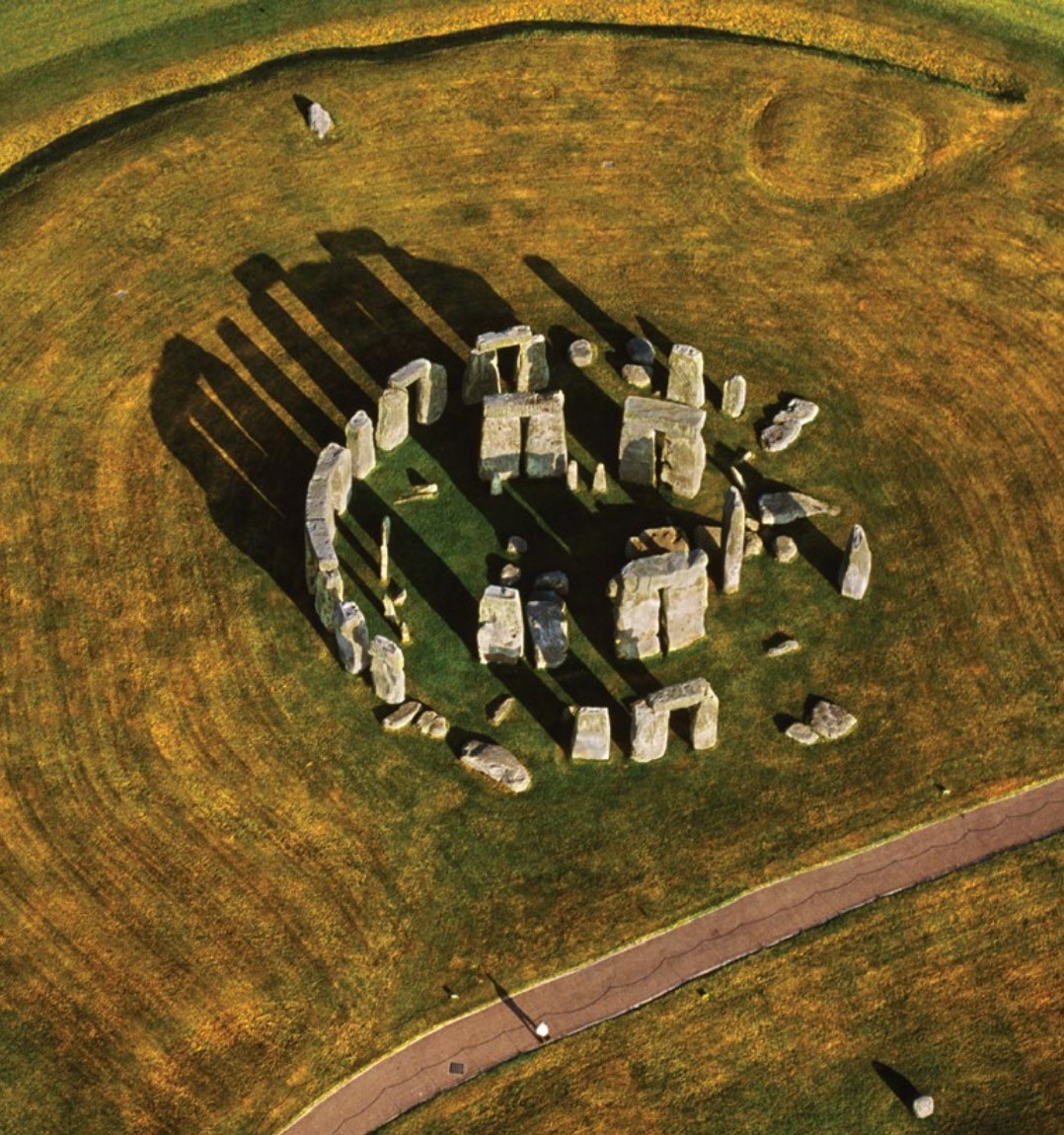
 Stonehenge © Last Refuge/Robert Harding World Imagery/Corbis
Stonehenge
Wiltshire, UK. Neolithic Europe. c. 2500–1600 B.C.E. Sandstone and bluestone.
Curator Note
"A prehistoric monument consisting of a ring of standing stones. It is a masterpiece of engineering and was built in several stages over 1,500 years."
Form
- Post-and-lintel construction (horizontal beams resting on vertical posts).
- Mortise-and-tenon joints (lego-like pegs and holes) secure the lintels to the uprights.
- Arranged in concentric circles and a central horseshoe shape.
- Sarsen stones (sandstone) characterize the outer ring; smaller Bluestones (volcanic) form the inner ring.
- Stones are tapered at the top to correct visual perspective (entasis-like effect).
Function
- Solar calendar and astronomical observatory (the heel stone aligns with the summer solstice sunrise).
- Burial site for elites (56 Aubrey holes contained cremation remains).
- Ceremonial center for healing (bluestones believed to have curative powers) or pilgrimage.
- A unifying monument bringing together people from across Britain for feasts and rituals.
- Symbol of the ancestors and the permanence of the afterlife (stone = death/eternity).
Content
- Outer ring of massive Sarsen stones topped with continuous lintels.
- Inner horseshoe of 5 giant Trilithons (two posts, one lintel), growing in height towards the center.
- Altar Stone (mica sandstone) lies flat at the center.
- Heel Stone stands outside the circle, marking the sunrise point.
- Lack of roof implies an open-air connection to the sky and celestial events.
Context
- Built on the Salisbury Plain in England in three major phases over 1,500 years (3000–1500 B.C.E.).
- The Bluestones were transported from the Preseli Hills in Wales (over 150 miles away), a massive logistical feat.
- Associated with the nearby wooded site of Durrington Walls (wood = life, stone = death).
- Reflects a highly organized Neolithic society with centralized leadership capable of mobilizing vast labor.
- Construction stopped around 1600 B.C.E., coinciding with the rise of the Bronze Age and new religious shifts.