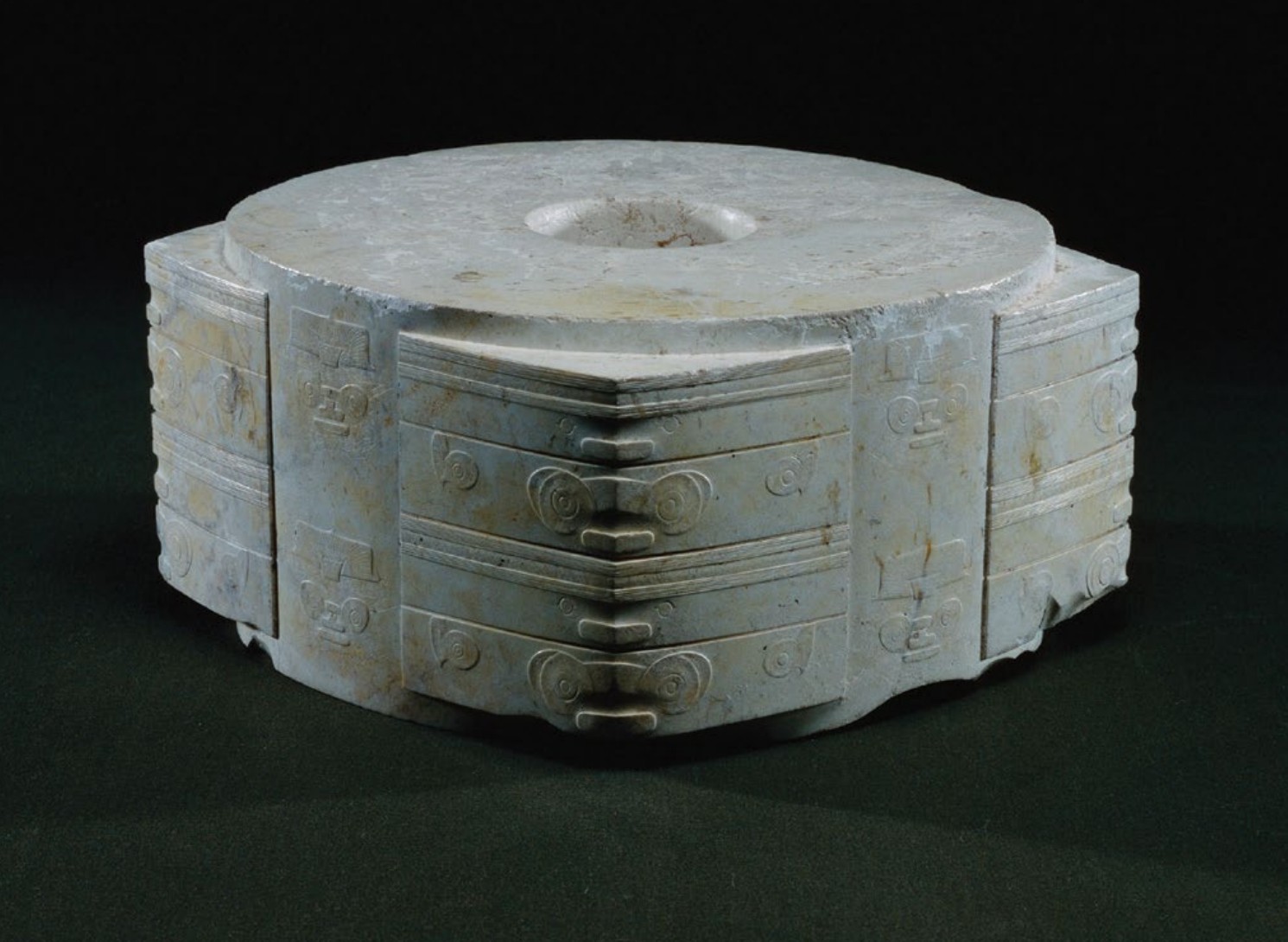
 Jade cong © Asian Art & Archaeology, Inc./Corbis
Jade Cong
Liangzhu, China. 3300–2200 B.C.E. Carved jade.
Curator Note
"A square jade tube with a circular bore, decorated with face patterns. It represents the Liangzhu culture's mastery of jade working and spiritual cosmology."
Form
- Rectangular/Square outer cross-section containing a circular inner bore.
- Made of nephrite jade (true jade), an extremely hard stone that cannot be carved with metal tools.
- Created through laborious abrasion using sand and water (no metal tools existed then).
- Precise, uniform lines and symmetry achieved without modern measuring instruments.
- Visual rhythm created by the stacked registers of faces on the corners.
Function
- Ritual object found exclusively in the graves of high-ranking individuals (elite burials).
- Symbolizes the connection between earth (square shape) and heaven (circular hole).
- Likely a protective charm, status symbol, or device to communicate with spirits.
- The vertical hole may have held a wooden pole, linking the tomb to the sky.
- Demonstrates the owner's control over skilled labor and precious resources.
Content
- Stylized faces (taotie or mask motifs) carved on the corners of the registers.
- Combination of human and animal features (perhaps a shaman riding a beast).
- The vertical hollow center represents the axis mundi (world axis).
- Fine lines represent hair or feathers.
- The juxtaposition of the square and circle represents the Chinese cosmological concept of "tian yuan di fang" (round sky, square earth).
Context
- Produced by the Liangzhu culture in the Yangtze River Delta (China's Neolithic period).
- Jade (yu) was valued more highly than gold, representing purity, durability, and moral integrity.
- Found in large numbers in tombs (up to 33 in one grave), often arranged around the body in a protective pattern.
- The difficulty of working jade implies a highly organized society with a surplus of food to support artisans.
- This specific form (Cong) appears in Chinese art for thousands of years, influencing later dynasties.