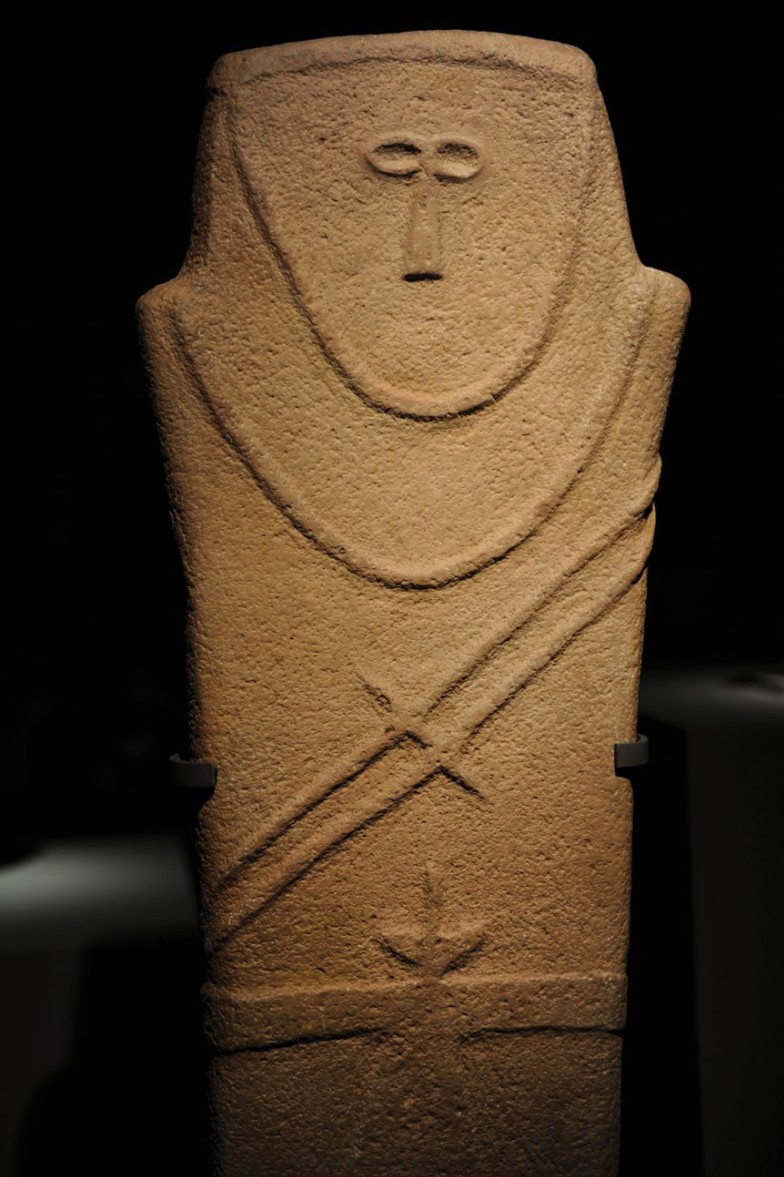
 Anthropomorphic stele © Album/Art Resource, NY
Anthropomorphic Stele
Arabian Peninsula. Fourth millennium B.C.E. Sandstone.
Curator Note
"A sandstone stele carved in low relief to represent a human figure. Its minimalist style suggests it was a grave marker or part of a sanctuary."
Form
- Carved sandstone stele (vertical stone slab) in low relief.
- Minimalist, abstract representation of a human figure with geometric simplification.
- Emphasis on frontality and linearity; the figure is stiff and upright.
- Trapezoidal head rests directly on the shoulders with no neck definition.
- Three distinct horizontal bands define the composition: face, chest/weapons, and waist.
Function
- Likely served as a grave marker or tombstone in an open-air sanctuary.
- Represents an ancestor, warrior, or deity to be venerated.
- Religious object involved in burial rites or pilgrimage practices.
- Marks territory or ownership of land by a specific lineage.
- Functions as a memorial to an individual's status and role (warrior).
Content
- Male figure wearing a double-bladed dagger (khanjar) tucked into a belt.
- A sash or belt crosses the torso diagonally.
- Simple facial features: two deeply carved eyes and a long nose, with no mouth depicted.
- An awl or tool is suspended from the belt, suggesting craftsmanship or utility.
- The double-sash might represent a specific type of ceremonial clothing.
Context
- Found near Ha’il in Saudi Arabia, a key location on ancient trade routes.
- Part of a network of similar steles found across the Arabian Peninsula (Jordan to Yemen).
- Evidence of pre-Islamic trade and shared cultural values across a vast geographic area.
- Reflects the "Anthropomorphic" period of Arabian rock art.
- The style links to other regional cultures, showing that Arabia was connected, not isolated.