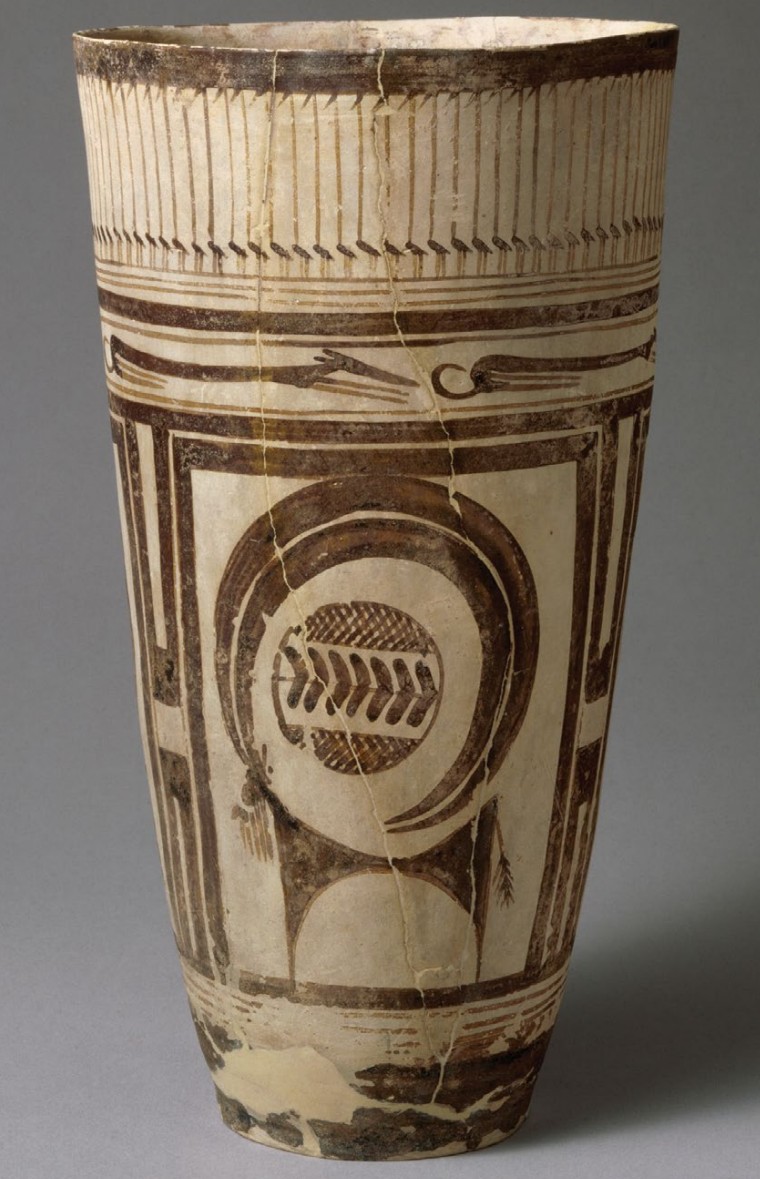
 Beaker with ibex motifs © RMN-Grand Palais/Art Resource, NY
Beaker with Ibex Motifs
Susa, Iran. 4200–3500 B.C.E. Painted terra cotta.
Curator Note
"A handmade clay beaker decorated with stylized animals. It was found in a cemetery, indicating its use in funerary practices."
Form
- Hand-thrown on a slow wheel, showing early technological advancement in pottery.
- Painted terra cotta with thin, fragile walls (not meant for daily utilitarian use).
- Highly stylized, geometric abstraction of animals rather than naturalistic representation.
- Use of registers (horizontal bands) and lines to organize the composition and create rhythm.
- Balanced, linear design that emphasizes the vessel's cylindrical shape.
Function
- Funerary object buried with the dead in the Susa necropolis (secondary burial context).
- Marker of clan identity, status, or wealth in the afterlife.
- Container for offerings (grains, food) to sustain the deceased.
- Symbolic representation of the orderly cosmos and the natural world controlled by man.
- The fragile nature suggests it was made specifically for burial, not for daily use.
Content
- Central motif: A mountain goat (ibex) composed of two triangles, with exaggerated, arching horns enclosing a clan symbol.
- Top register: A row of stretched-out aquatic birds with long necks, emphasizing verticality.
- Middle register: Running hunting dogs (greyhounds) stretched horizontally to suggest speed and motion.
- A criss-cross pattern within the circle of the horns likely represents a family crest or clan insignia.
- Integration of ground lines defining the space for the animals.
Context
- Excavated at the acropolis of Susa, Iran, a major settlement that later became a capital of the Elamite/Persian empires.
- Created during the Susa I period (4200–3500 B.C.E.), marking the transition to urban living.
- Reflects the start of specialized labor (potters) and social stratification.
- Found in a massive cemetery with thousands of similar vessels, indicating organized funerary practices.
- Susa was a trading hub; the quality of the ceramic implies a wealthy society.