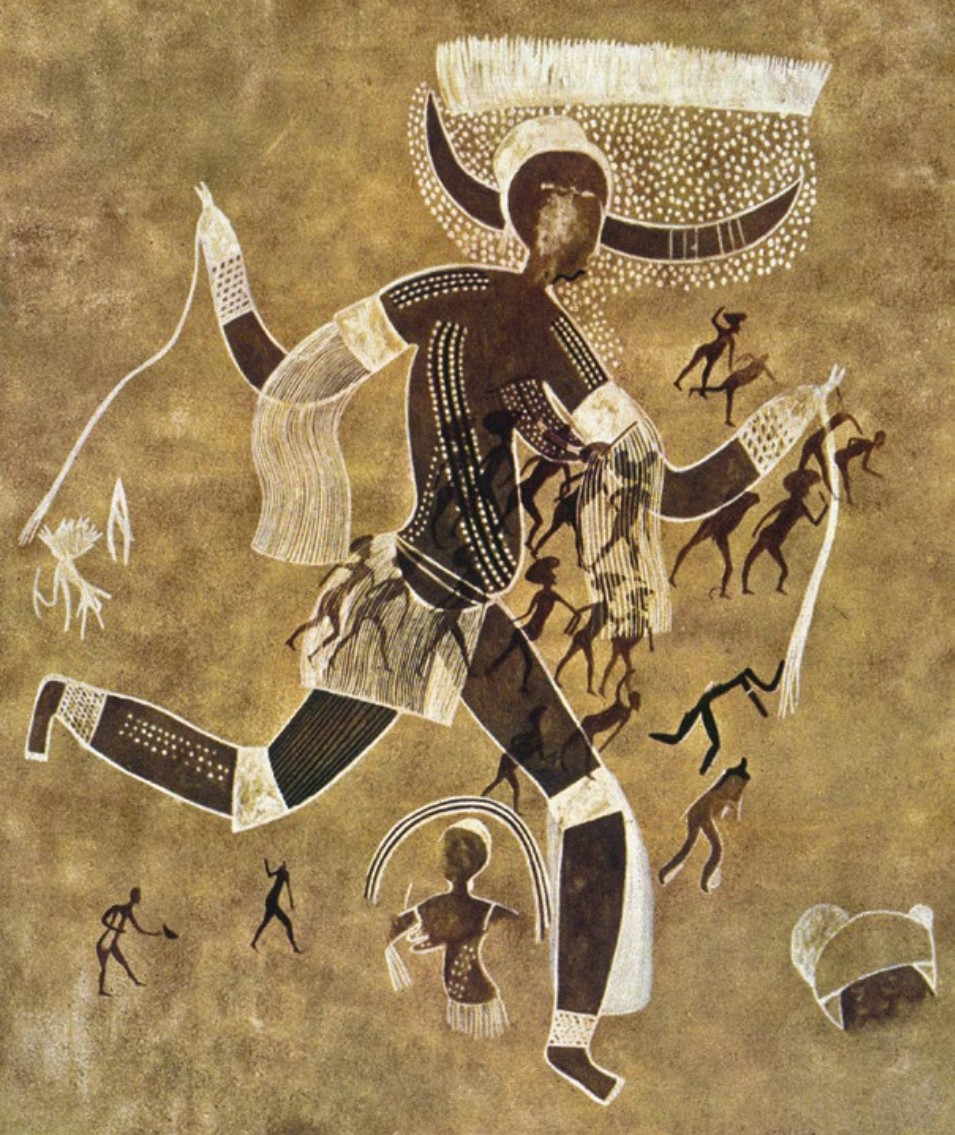
 Running horned woman © The Granger Collection, New York
Running Horned Woman
Tassili n'Ajjer, Algeria. 6000–4000 B.C.E. Pigment on rock.
Curator Note
"A rock painting depicting a large, horned female figure running. It suggests the significance of women in ritual and agriculture in early Sahara cultures."
Form
- Composite view of the body (torso frontal, profile head) typical of prehistoric art.
- Superimposed over older, smaller paintings, suggesting the site was sacred over a long period.
- Use of dots (stippling) on the limbs and torso to represent scarification or body paint.
- Hierarchy of scale: the main female figure is massive compared to the tiny background figures.
- Dynamic illusion of movement created through the running pose (diagonal lines) and flowing rafia streamers.
Function
- Depicts a goddess, priestess, or spirit performing a ritual for rain, fertility, or harvest.
- Marks a sacred site (sanctuary) within the rock shelter, possibly for women's initation.
- Records the transition from a hunter-gatherer lifestyle to an early agricultural or pastoral society.
- The horns may signify power or divinity, similar to deities in later Egyptian or Mesopotamian art.
- Serves as a visual prayer or invocation for the prosperity of the community.
Content
- A large, horned female deity/priestess wearing ceremonial attire with armlets and garters.
- A cloud of grain or rain (dots) depicted above her head, linking her to agricultural abundance.
- Background figures (much smaller) appear to be moving or dancing, perhaps in a procession.
- The horns are likely bovine, reflecting the importance of cattle in the region at the time.
- Prominent breasts indicate a focus on fertility and the female divinie.
Context
- Located in the Tassili n’Ajjer plateau in the Algerian Sahara, which was once a lush, green savannah.
- Discovered in the 1930s and popularized by Henri Lhote in the 1950s.
- Reflects the "Round Head" period of rock art, distinct from earlier "Large Wild Fauna" periods.
- Evidence of a thriving culture that herded cattle before the desertification of the Sahara.
- Some interpretations link the imagery to the Egyptian goddess Isis or Hathor, suggesting cross-cultural influence.