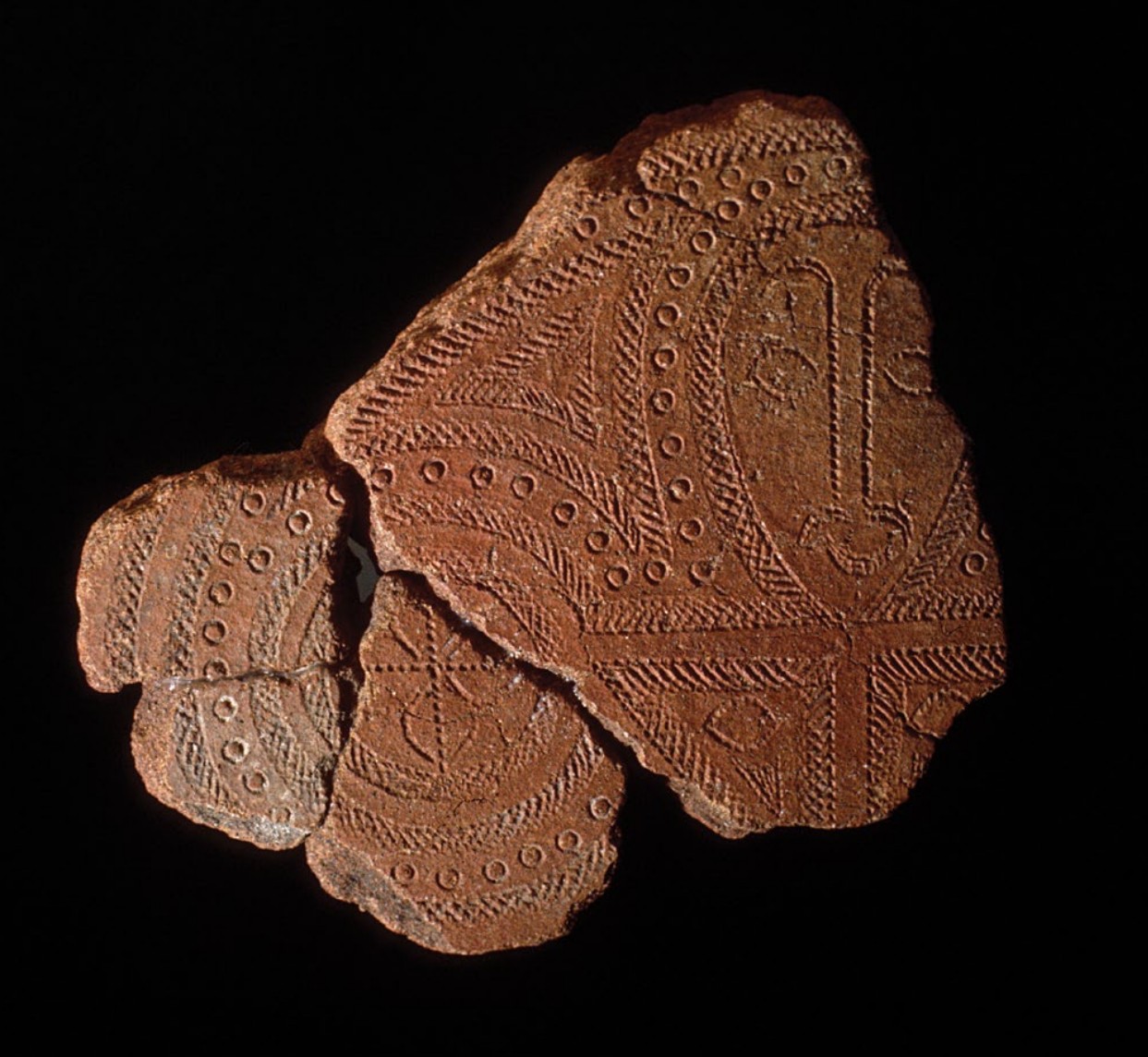
 Terra cotta fragment, Courtesy of the Anthropology Photographic Archive, Department of Anthropology, The University of Auckland
Terra Cotta Fragment
Lapita. Solomon Islands, Reef Islands. 1000 B.C.E. Terra cotta (incised).
Curator Note
"Fragments of pottery featuring intricate geometric patterns and face motifs. The Lapita people were master navigators who spread this style across the Pacific."
Form
- Red-slip earthenware (terra cotta) mixed with shell or sand temper.
- Dentate stamping technique: using comb-like tools to press dots/lines into wet clay.
- Intricate geometric and curvilinear designs (friezes).
- Low-fire pottery (fired in open pits, not kilns).
- Incised lines are filled with white lime paste to create contrast.
Function
- Serving vessel for food or drink used by elites or in rituals.
- Cultural marker: the pottery style defined the Lapita people as they migrated.
- Valuable trade item exchanged across the Pacific islands.
- Likely used for feasts or ceremonies rather than daily cooking (cooking pots were plainer).
- Preserved family or clan genealogy through symbolic patterns.
Content
- Anthropomorphic face design: a stylized human face is hidden in the geometric patterns.
- Linear and geometric patterns (circles, hatching, meanders).
- The "face" motif is one of the earliest representations of humans in Pacific art.
- Patterns often resemble tattoo designs found in the region centuries later.
- Repeated motifs suggest a shared visual language across the archipelago.
Context
- Lapita culture is the ancestor of Polynesians, Micronesians, and Melanesians.
- Found in the Reef Islands (Santa Cruz Group) but style spans 4,000 miles of ocean.
- The Lapita were master navigators who explored the Pacific c. 1000 B.C.E.
- Shows the sophisticated design sense and technical skill of early Pacific voyagers.
- Pottery production ceased in many areas as cultures settled, making these fragments rare.