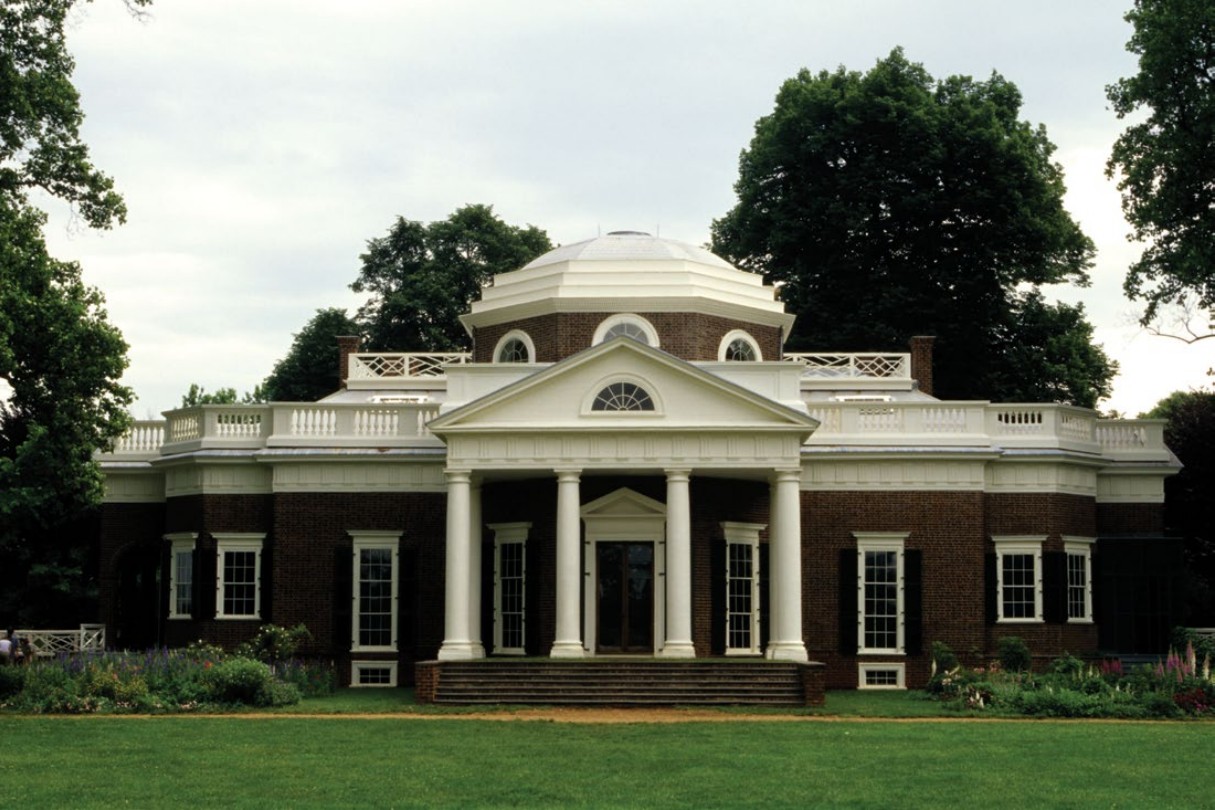
 Monticello © David Muenker/Alamy
Monticello
Virginia, U.S. Thomas Jefferson (architect). 1768–1809 C.E. Brick, glass, stone, and wood.
Curator Note
"Thomas Jefferson's plantation home, which he redesigned throughout his life based on his study of classical architecture. It introduces Neoclassicism to the United States, utilizing Roman forms (dome, portico) to symbolize the democratic ideals of the new republic. However, it was built and maintained by enslaved laborers."
Form
- Neoclassical style featuring a Doric portico and central dome.
- Symmetrical plan with a central axis.
- Use of local red brick with white wooden trim (Colonial blend).
- The dome is octagonal, not round.
- Integrated into the landscape on a "little mountain".
Function
- To serve as the private residence of Thomas Jefferson.
- To demonstrate the suitability of Classical architecture for America.
- To symbolize the virtues of the Roman Republic (civic duty, democracy).
- To house Jefferson's library and collections.
- To function as a working plantation.
Content
- The portico and dome reference the Pantheon in Rome.
- The layout reflects rationalism and order.
- Narrow staircases were hidden to save space.
- Innovative gadgets (dumbwaiters, clock) show Jefferson's ingenuity.
- The "dependencies" (slave quarters) were hidden from view.
Context
- Jefferson visited France and was influenced by the Hotel de Salm.
- He disliked the English Georgian style, preferring Roman roots.
- Neoclassicism became the official "Federal Style" of the US.
- Built by enslaved artisans who were highly skilled.
- Reflects the paradox of American liberty and slavery.