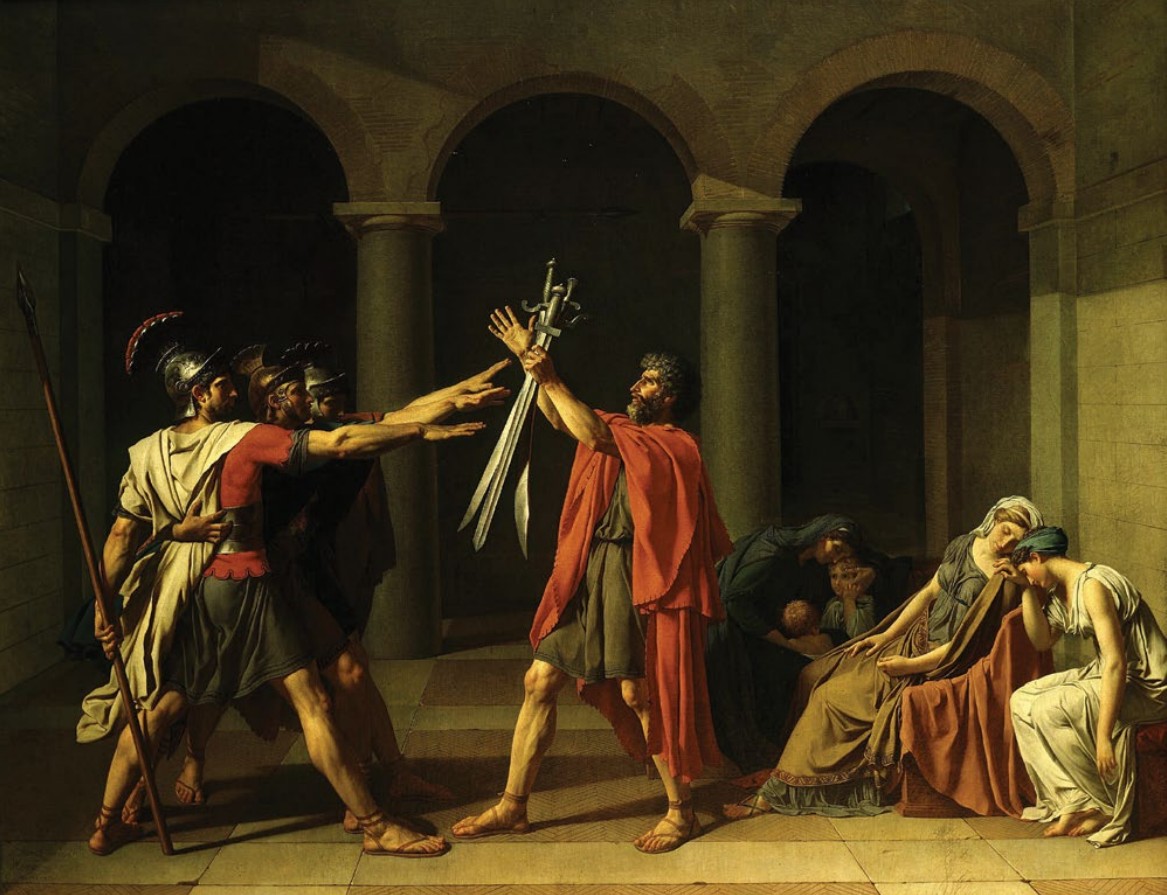
 The Oath of the Horatii © Gianni Dagli Orti/The Art Archive at Art Resource, NY
The Oath of the Horatii
Jacques-Louis David. 1784 C.E. Oil on canvas.
Curator Note
"The manifesto of Neoclassicism. It depicts three Roman brothers swearing an oath to their father to fight and die for Rome, even though it means killing their own family members (by marriage). The painting champions patriotism and self-sacrifice over personal emotion, foreshadowing the French Revolution."
Form
- Rigid, geometric composition with three Roman arches in the background.
- Strong, linear drawing with sharp contours (Linear Style).
- Subdued palette with emphasis on red (passion/blood).
- Contrast between the angular men and the curving, soft women.
- Like a shallow stage setting (frieze-like arrangement).
Function
- To inspire civic virtue and patriotism (exemplum virtutis).
- To reject the frivolity of the Rococo style.
- To call for a return to Roman moral values.
- To promote loyalty to the state above family.
- To establish David as the leader of the new French style.
Content
- Horatii brothers: symbol of strength, unity, and duty.
- The Father: holds the swords, representing the state/authority.
- The Women: weeping, representing emotion and the tragic cost of war.
- The Oath: strict, straight arms signify unwavering resolve.
- The story is from Roman history (war between Rome and Alba).
Context
- Painted five years before the French Revolution.
- Commissioned by the King (Louis XVI) but became a symbol of the revolution.
- David won the Prix de Rome and studied in Italy.
- Reflects the Enlightenment interest in Classical virtue.
- Became the visual language of the Jacobins.