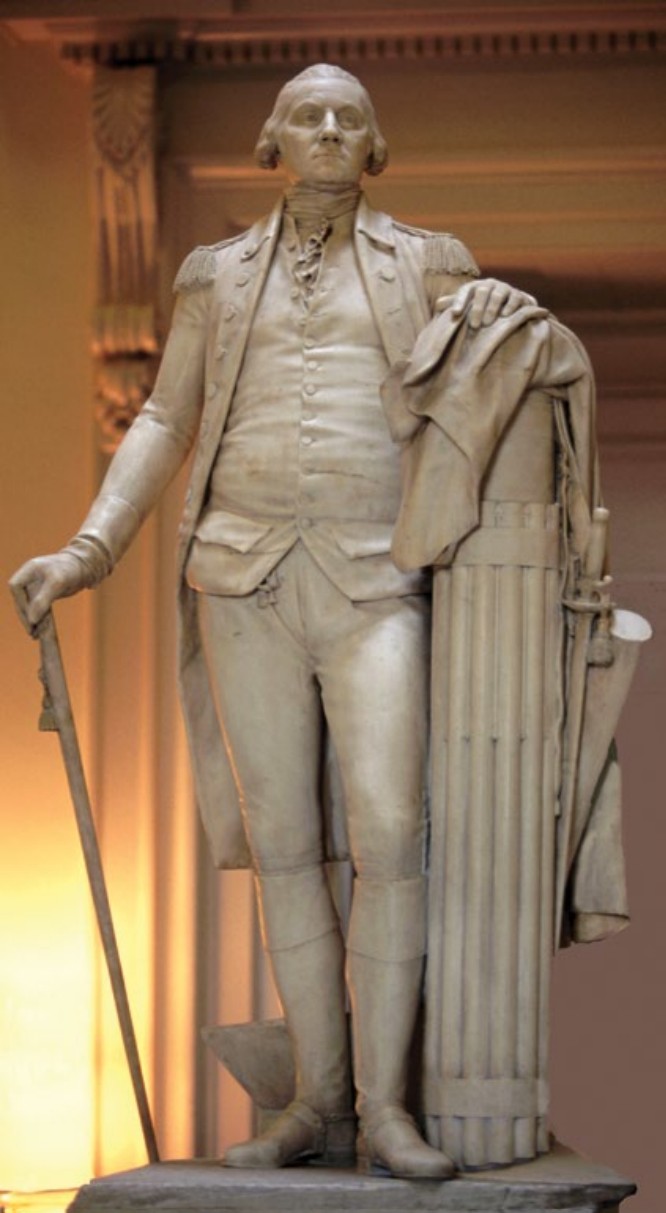
 George Washington © Buddy Mays/Corbis
George Washington
Jean-Antoine Houdon. 1788–1792 C.E. Marble.
Curator Note
"A life-size marble sculpture of George Washington commissioned by the Virginia legislature. Houdon, a French sculptor, traveled to Mount Vernon to take life measurements. Washington is depicted not as a god or a king, but as a gentleman farmer and a citizen-soldier, reflecting the democratic ideals of the new nation."
Form
- Neoclassical style but with realistic contemporary dress (uniform).
- Contrapposto stance, relaxed and natural.
- White marble, life-size.
- Detailed carving of textures (fabric, cane, sword).
- Washington looks slightly to the left, with a fatherly expression.
Function
- To commemorate Washington as the leader of the American Revolution.
- To visualize the ideal American leader: humble, civilian, democratic.
- To stand in the Virginia State Capitol rotunda.
- To set a precedent for American presidential imagery.
- To inspire future generations.
Content
- Fasces (bundle of generic rods): symbol of strength in unity (13 rods for 13 colonies).
- The sword hangs on the fasces: military power is laid aside.
- The plowshare behind him: return to farming (Cincinnatus).
- Civilian clothes: emphasizes he is not a monarch.
- Missing button on coat: a touch of realism/humanity.
Context
- Thomas Jefferson and Benjamin Franklin recommended Houdon.
- Washington refused to be depicted in a toga (Roman dress).
- Houdon took a life mask to ensure perfect likeness.
- Reflects the "Cincinnatus" archetype: the Roman general who returned to his farm.
- Symbolizes the peaceful transfer of power.