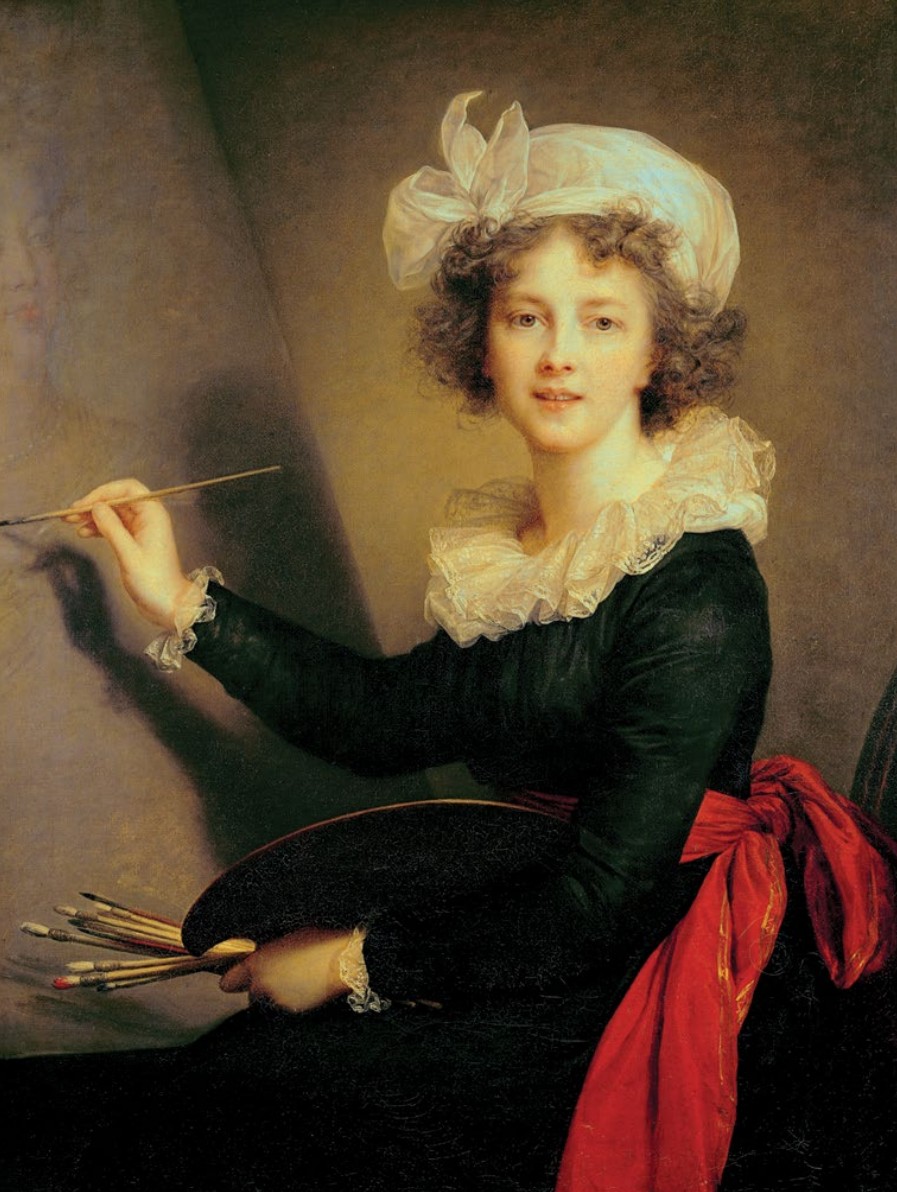
 Self-Portrait © Galleria degli Uffizi, Florence, Italy/The Bridgeman Art Library
Self-Portrait
Elisabeth Louise Vigée Le Brun. 1790 C.E. Oil on canvas.
Curator Note
"A vibrant self-portrait of the official court painter to Marie Antoinette. Vigée Le Brun depicts herself painting, confident and relaxed, despite the fact that she was painting this in exile during the French Revolution. It asserts her identity as a successful professional artist in a male-dominated field."
Form
- Rococo style: light, feathery strokes and pastel colors.
- Relaxed, informal pose.
- She looks directly at the viewer, smiling.
- Wears a white turban and loose dress (fashionable, non-restrictive).
- Holds palette and brushes, tools of her trade.
Function
- To advertise her skill and status as a painter.
- To express her personal identity and confidence.
- To secure commissions while in exile in Italy.
- To demonstrate her "natural" style of portraiture.
- To attain membership in art academies.
Content
- She is painting a portrait of Marie Antoinette (her patron).
- The smile shows her teeth, which was unconventional and modern.
- The red sash provides a color accent.
- The dark background pushes the figure forward.
- Youthful and idealized appearance.
Context
- Painted in Rome after she fled the French Revolution.
- She was one of the few women admitted to the French Academy.
- Her close association with the Queen made her a target.
- Example of late Rococo moving towards Neoclassicism (simpler dress).
- Shows the changing status of the female artist.