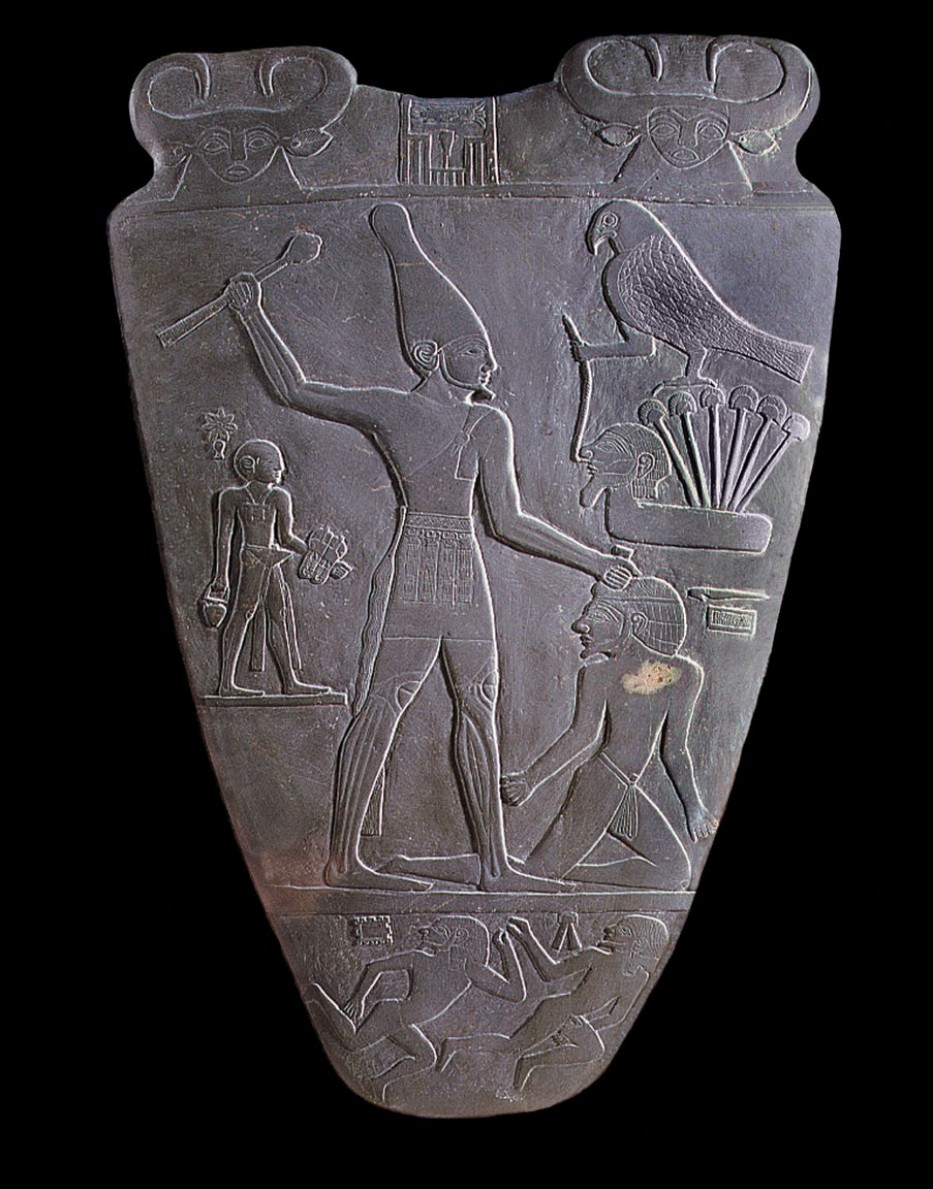
 Palette of King Narmer, front © Werner Forman/Art Resource, NY
Palette of King Narmer
Predynastic Egypt. c. 3000–2920 B.C.E. Greywacke.
Curator Note
"Often called the "first historical document in the world," this ritual object celebrates the unification of Upper and Lower Egypt. It sets the standard for Egyptian art for the next 3,000 years."
Form
- Carved from Greywacke (siltstone), a smooth, dark, and hard stone often used for elite objects.
- Low relief (bas-relief) carving on both sides, 2 feet tall.
- Hierarchy of scale: King Narmer is depicted significantly larger than all other figures.
- Composite view (twisted perspective): Frontal torso with profile head and legs, typical of Egyptian art.
- organized into registers (horizontal bands) to establish a narrative order and ground lines.
Function
- Originally a ritual object (makeup palette) used to grind pigments (kohl) for cult statues.
- Ceremonial/Votive object: Buried in the temple of Horus at Hierakonpolis as an offering.
- Political propaganda: Commemorates and asserts the unification of Upper and Lower Egypt under one king.
- Demonstrates the divine power of the Pharaoh as the upholder of order (Maat) over chaos (Isfet).
- Sets the artistic conventions (canon of proportions) for Egyptian art for the next 3,000 years.
Content
- Front (Upper Egypt side): Narmer wears the White Crown, smiting a kneeling enemy (mace pose).
- Back (Lower Egypt side): Narmer wears the Red Crown, marching in a victory procession viewing beheaded enemies.
- Intertwined necks of serpopards (mythical beasts) symbolize the unification of the two lands.
- Horus (falcon) holds a captive head/papyrus, representing dominion over Lower Egypt.
- Bull knocking down a city wall (bottom register) represents the King's strength.
Context
- Created during the Predynastic/Early Dynastic period (c. 3000–2920 B.C.E.).
- Discovered in the "Main Deposit" at Hierakonpolis, a cache of sacred objects.
- Marks the transition from prehistory to the historical period of Pharaonic Egypt.
- Reflects the importance of establishing kingship ideology: the King is a god on earth.
- The makeup ground on the palette would have been applied to the image of the god, not a human.