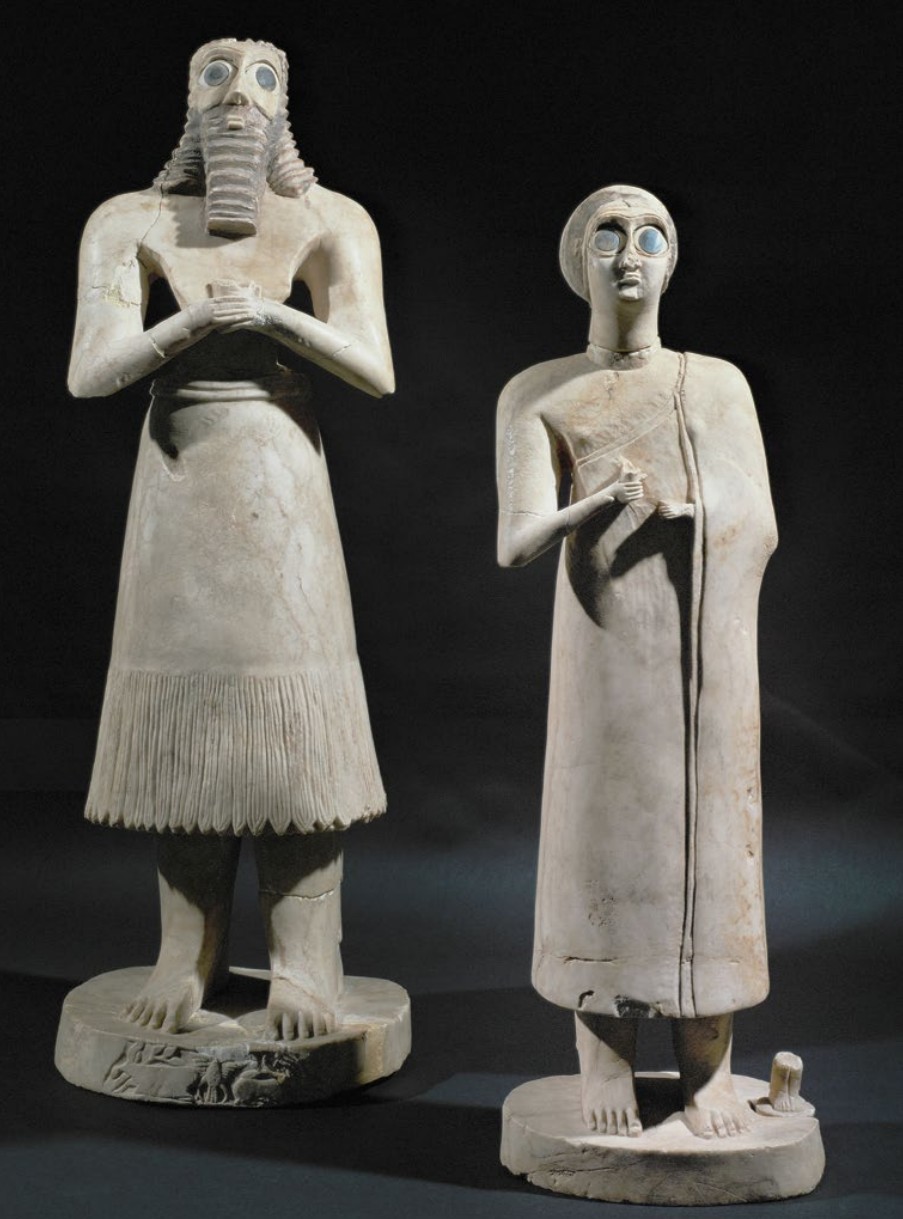
 Statues of votive figures © Erich Lessing/Art Resource, NY
Statues of Votive Figures
Square Temple at Eshnunna (modern Tell Asmar, Iraq). Sumerian. c. 2700 B.C.E. Gypsum inlaid with shell and black limestone.
Curator Note
"These figures were not meant to be looked at by humans, but by gods. They were buried under temple floors to offer eternal prayers on behalf of their donors."
Form
- Carved from gypsum (soft stone) and inlaid with shell and black limestone impacting the eyes.
- Geometric simplification: Bodies are cylindrical or conical (skirt shapes).
- Static, symmetrical pose with hands clasped in prayer (at the waist or chest).
- Hierarchical scale: Figures vary in size, likely indicating the status or wealth of the donor.
- Varied stylization: Men wear fringed skirts and have beards; women wear draped dresses; some are bald.
Function
- Served as stand-ins for the donors (worshippers) within the temple sanctuary.
- Offered constant, eternal prayer to the deity (Abu) on behalf of the person who commissioned them.
- Votive offering: A gift to the gods to show devotion and ask for favor or protection.
- Not intended as realistic portraits, but as symbolic representations of piety.
- Ensured the donor was "present" in the temple even when physically absent.
Content
- Wide, staring eyes symbolize eternal wakefulness and awe in the presence of the divine.
- The inscription on the base sometimes names the donor and the specific prayer.
- Clasped hands hold a small beaker or cup, used for pouring libations.
- Men have stylized, rippled beards; women have hair wrapped in buns.
- Feet are large and flat to ensure the stability of the standing figure.
Context
- Found buried in a cache under the floor of the Square Temple at Eshnunna (modern Tell Asmar).
- Created during the Sumerian Early Dynastic period (c. 2700 B.C.E.).
- Sumerian religion was often pessimistic; gods were viewed as unpredictable and needing constant appeasement.
- Burial in the temple floor suggests they were too sacred to throw away after they were replaced.
- Reflects the social stratification of early Mesopotamia, where only the wealthy could afford such statues.