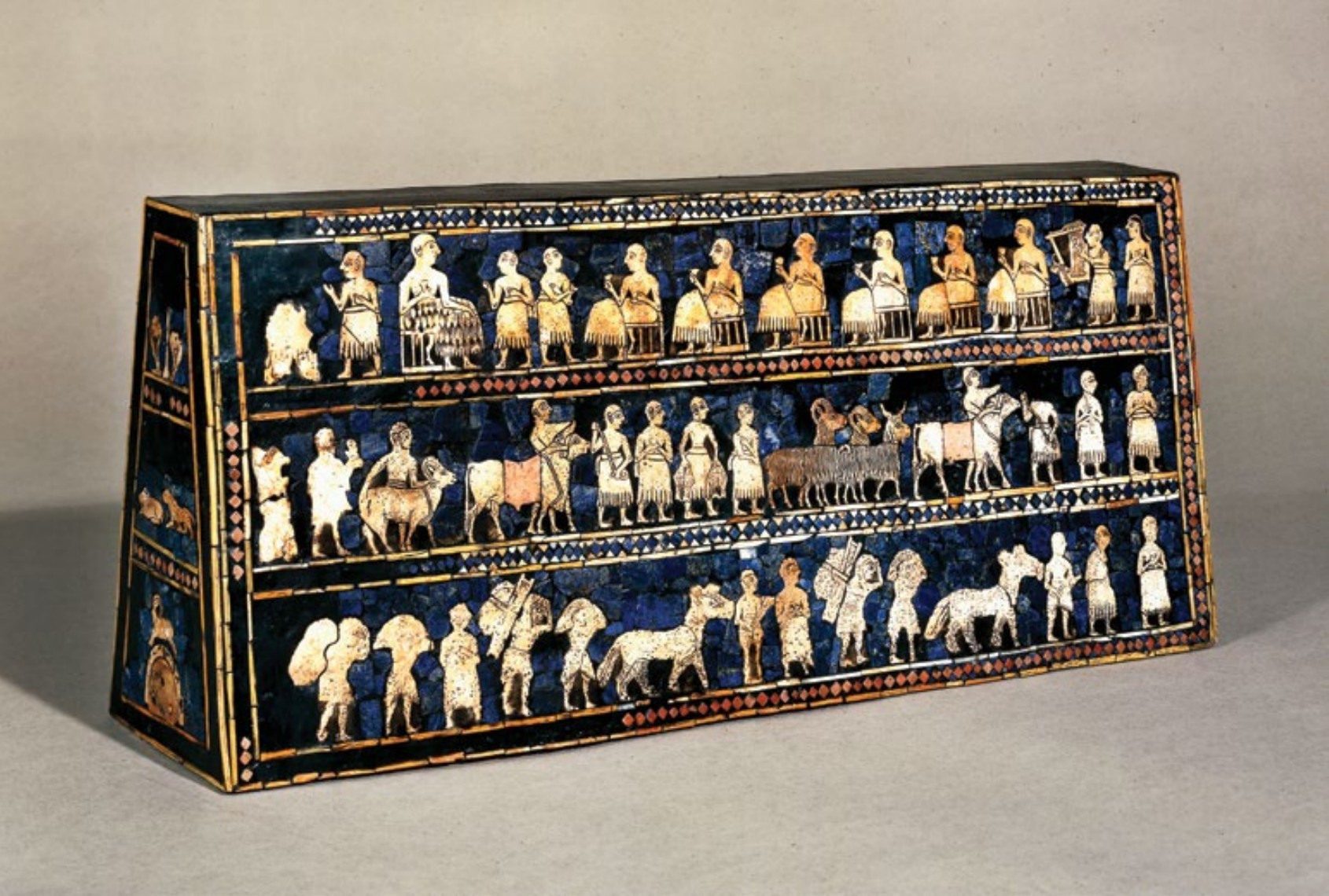
 Standard of Ur, Peace © Erich Lessing/Art Resource, NY
Standard of Ur
Royal Tombs at Ur (modern Tell el-Muqayyar, Iraq). Sumerian. c. 2600–2400 B.C.E. Wood inlaid with shell, lapis lazuli, and red limestone.
Curator Note
"Discovered by Leonard Woolley in the Royal Graves, this box features one of the earliest depictions of an army on the march and a peace banquet, showcasing the dual roles of a Sumerian ruler."
Form
- Hollow wooden box consisting of four trapezoidal sides.
- Inlaid with a mosaic of shell (from the Persian Gulf), red limestone (from India), and lapis lazuli (from Afghanistan) set in bitumen.
- Narrative organized into three registers (horizontal bands) on each side.
- Hierarchy of scale: The king is depicted larger than everyone else, breaking the top frame.
- Composite view: Figures shown with frontal shoulders and profile faces.
Function
- Original function is unknown; possibly a soundbox for a lyre or a container for currency.
- Found in a royal tomb, serving as a grave good for the afterlife.
- Historical narrative illustrating the dual aspects of Sumerian kingship: Warrior and Protector/Priest.
- Propaganda piece displaying the power, wealth, and reach of the ruler.
- Carried on a pole (standard) in processions (historical theory, though now doubted).
Content
- War Side: Bottom register shows war chariots trampling enemies; middle shows infantry battles; top shows captives brought to the king.
- Peace Side: Bottom shows laborers carrying provisions; middle shows animals for banquet/sacrifice; top shows the King and elites feasting.
- War Side depicts the violence and chaos of battle; Peace Side depicts the order and prosperity that follows victory.
- Nudity of captives symbolizes their shame and loss of status.
- The King is distinguished by his size and central position.
Context
- Excavated by Leonard Woolley in the 1920s from the Royal Cemetery at Ur (modern-day Iraq).
- Created during the Sumerian Early Dynastic III period (c. 2600–2400 B.C.E.).
- Demonstrates the extensive trade networks of Ur: Lapis (Afghanistan), Red Stone (India), Shells (South).
- Ur was a wealthy city-state ruled by a priest-king (Lugal).
- Found near the shoulder of a man, suggesting it was carried or displayed.