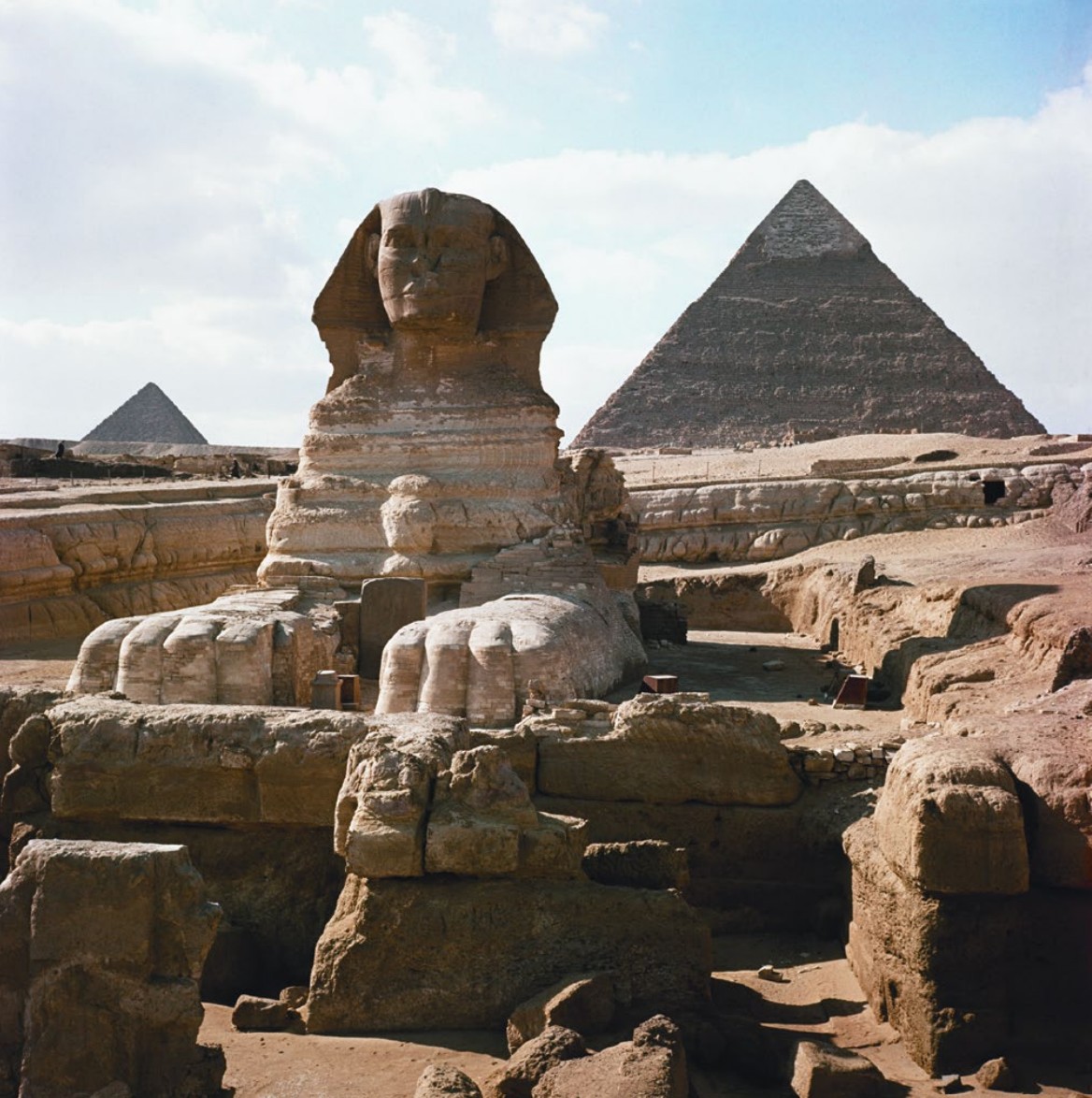
 Great Pyramids with Sphinx © Roger Wood/Corbis
Great Pyramids and Great Sphinx
Giza, Egypt. Old Kingdom, Fourth Dynasty. c. 2550–2490 B.C.E. Cut limestone.
Curator Note
"The only surviving Wonder of the Ancient World. These massive tombs were built not by slaves, but by a conscripted workforce of skilled laborers and farmers during the flood season."
Form
- Constructed from millions of limestone blocks (ashlar masonry) weighing 2.5 tons on average.
- Pyramidal shape with four smooth, angled sides facing the cardinal points.
- Sphinx: Carved in situ from a natural limestone outcrop (live rock).
- Originally covered in smooth white limestone casing stones (mostly stolen) and topped with a gold capstone (pyramidion).
- Complex internal system of chambers (King's chamber, Queen's chamber) and relieving blocks to handle weight.
Function
- Monumental tombs for three Old Kingdom pharaohs: Khufu, Khafre, and Menkaura.
- Designed to protect the mummified body and possessions of the King.
- Active machines for resurrection: Shape symbolizes the ben-ben stone (creation mound) and solar rays (ramp to the sky).
- Sphinx: Guardian figure preventing evil from entering the necropolis.
- Served as the focal point of a vast mortuary complex for ongoing worship of the deceased king.
Content
- Great Pyramid (Khufu): The largest and oldest.
- Pyramid of Khafre: Includes the Sphinx and retains some casing stones at the top.
- Pyramid of Menkaura: The smallest, with three smaller queen's pyramids.
- Sphinx: Lion's body with a human head (likely Khafre), wearing the nemes headdress.
- Mortuary temples, causeways, and valley temples connected each pyramid to the Nile.
Context
- Built during the Fourth Dynasty of the Old Kingdom (c. 2550–2490 B.C.E.), the "Age of Pyramids."
- Constructed by a massive workforce of conscripted laborers (not slaves) during the annual Nile flood.
- Reflects the absolute power and divinity of the Pharaoh as the son of Ra (Sun God).
- Aligned with stars (Orion's Belt theory) and cardinal directions with shocking precision.
- The evolution from mastaba -> stepped pyramid -> smooth pyramid shows architectural advancement.