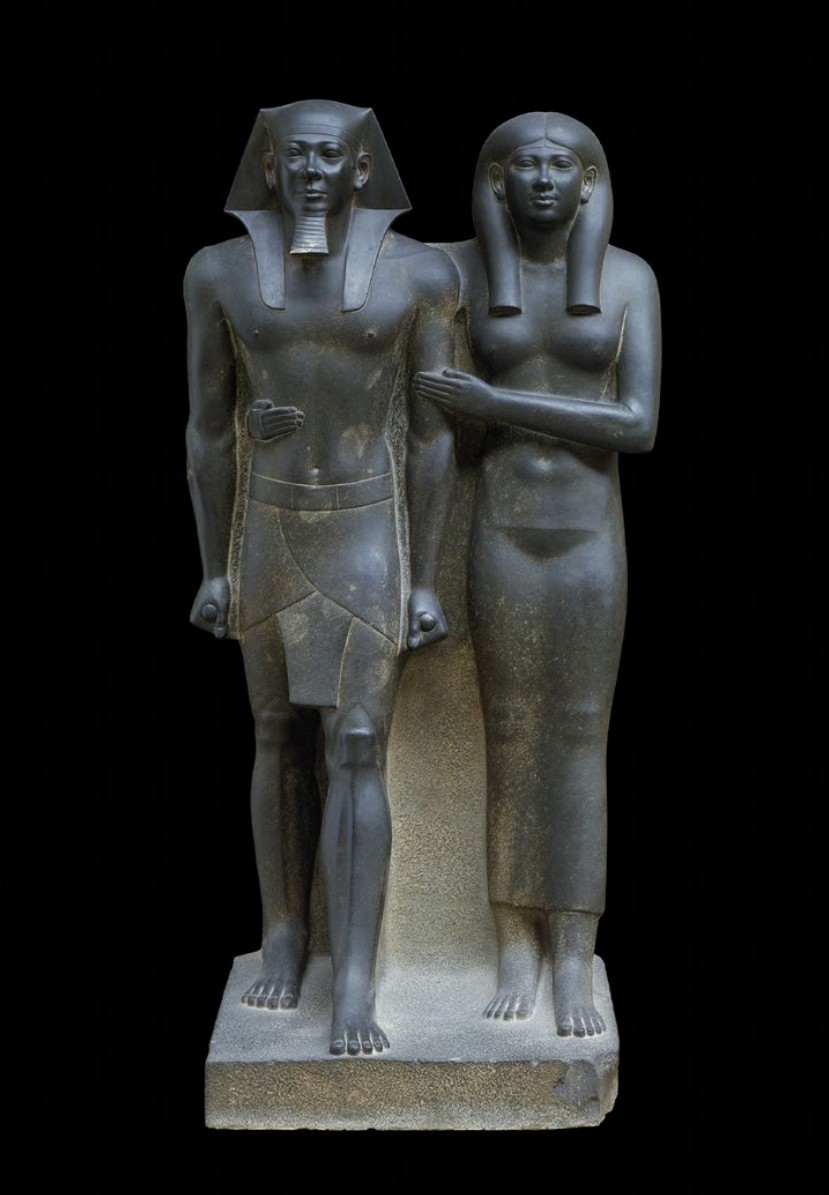
 King Menkaura and queen Photograph © 2013 Museum of Fine Arts, Boston
King Menkaura and Queen
Old Kingdom, Fourth Dynasty. c. 2490–2472 B.C.E. Greywacke.
Curator Note
"This dyad statue was found in Menkaura's valley temple. Interestingly, it was left unfinished—the polish stops at the legs, revealing the artist's process."
Form
- Carved from Greywacke, a very hard, dark stone, ensuring durability and timelessness.
- High relief sculpture: The figures remain attached to the stone block back pillar.
- Idealized, youthful bodies conforming to the strict Egyptian canon of proportions.
- Rigid, frontal pose with the left foot advanced (for both figures), signifying stride/power.
- Unfinished: The lower legs show polish marks, revealing the artistic process.
Function
- Ka statue: Intended to house the spirits of the King and Queen in the afterlife.
- Placed in the Menkaura Valley Temple to receive food offerings and worship.
- Visualizes the King's divine power and the Queen's supportive role.
- Ensures the eternal survival of the monarch's image.
- Demonstrates the continuity and stability of the royal line.
Content
- King Menkaura wears the nemes headdress, royal beard, and shendyt kilt.
- Queen (likely Khamerernebty II or a goddess) embraces him with her arm around his waist.
- Both figures are the same height, suggesting equality or her status as the Queen Mother.
- Menkaura holds ritual cylinders (scroll cases?) in his clenched fists.
- Gaze is fixed forward on the horizon/eternity, not interacting with each other.
Context
- Found in 1910 by the Harvard-Boston expedition in the Valley Temple of Menkaura's pyramid complex.
- Menkaura built the third and smallest pyramid at Giza.
- The dyad (pair) format was common for showing royal lineage or divine protection.
- Old Kingdom art prioritized permanence and idealism over emotional realism.
- The pose and style remained unchanged for millennia, symbolizing Maat (order/stability).