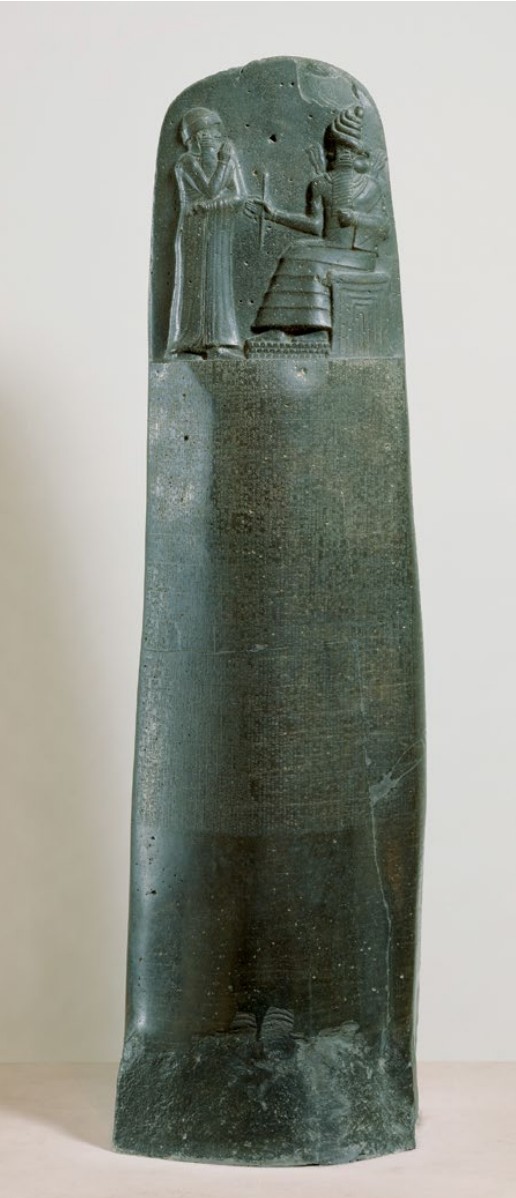
 The Code of Hammurabi © The Gallery Collection/Corbis
The Code of Hammurabi
Babylon (modern Iran). Susian. c. 1792–1750 B.C.E. Basalt.
Curator Note
"One of the earliest comprehensive legal codes, containing 282 laws. The stele visually legitimizes the laws by showing Hammurabi receiving them directly from the sun god Shamash."
Form
- Monumental stealth carved from black basalt (hard, durable volcanic stone).
- Top is high relief sculpture; bottom is covered in cuneiform inscription.
- Hierarchical scale: Shamash (seated) is larger than Hammurabi (standing).
- Composite view in the relief: Shoulders frontal, faces in profile.
- 7.4 feet tall, intended to be a towering, unmovable public monument.
Function
- To publicize the laws of Babylon (282 laws total) to the subjects.
- To legitimize Hammurabi's rule by showing him receiving authority directly from the gods.
- To standardize justice across the diverse empire ("an eye for an eye, a tooth for a tooth").
- To serve as a warning to future kings not to alter the laws.
- Propaganda: Portrays Hammurabi as a pious servant of the gods and a protector of the weak.
Content
- Top relief: The sun god Shamash (god of justice) seated on a mountain/throne.
- Flames/Rays rise from Shamash's shoulders.
- Shamash hands Hammurabi a ring and rod (measuring tools), symbols of kingship and the law.
- Hammurabi stands in a gesture of reverence and prayer.
- Text: Contains a prologue, the 282 laws, and an epilogue cursing anyone who destroys it.
Context
- Created in Babylon (modern Iraq) c. 1792–1750 B.C.E. during the First Babylonian Dynasty.
- Hammurabi united Mesopotamia and needed a unified legal code to control his empire.
- The stele was captured as war booty by the Elamites and taken to Susa, where it was found.
- Predates biblical laws (like the Ten Commandments) but shares similarities in content.
- Reflects a rigid class structure: punishments varied depending on the victim's status (Noble, Commoner, Slave).