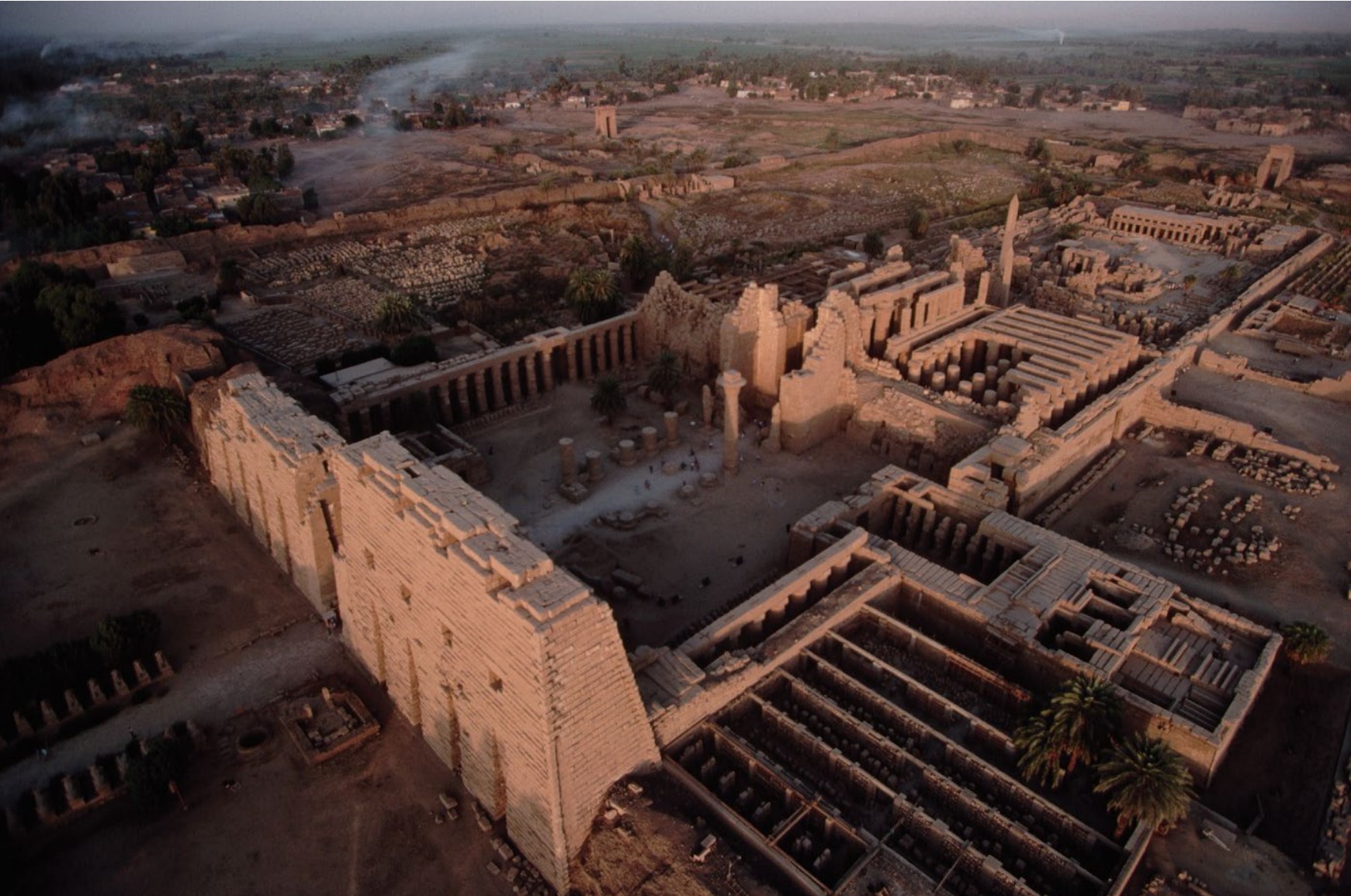
 Temple of Amun-Re © Yann Arthus-Bertrand/Corbis
Temple of Amun-Re and Hypostyle Hall
Karnak, near Luxor, Egypt. New Kingdom, 18th and 19th Dynasties. Temple: c. 1550 B.C.E.; Hall: c. 1250 B.C.E. Cut sandstone and mud brick.
Curator Note
"The largest religious complex ever built, expanded by successive pharaohs for over 1,500 years. The Hypostyle Hall alone could fit the cathedral of Notre-Dame inside it."
Form
- Axial plan (processional route) moving from open courtyards to smaller, darker sanctuaries.
- Pylon gates: Massive sloping walls representing the horizon (akhet).
- Hypostyle Hall: A forest of 134 massive sandstone columns with papyrus, lotus, and bud capitals.
- Clerestory lighting: Stone grilles allowed light to filter into the central aisle.
- Constructed from cut sandstone and mud brick over many generations.
Function
- The principal religious center of the god Amun-Re (King of the Gods) in the New Kingdom.
- Served as the setting for the Opet Festival, where the god's statue traveled from Karnak to Luxor.
- A "working estate" for the priesthood, controlling vast land and wealth.
- Restricted access: The deeper you went, the fewer people were allowed (Sacred Lake -> Hall -> Sanctuary).
- Microcosm of the universe: The temple design reflected the moment of creation.
Content
- Columns in the Hypostyle Hall carved with sunken relief depicting rituals and history.
- Obelisks (including Hatshepsut's) acting as petrified sun rays connecting earth to sky.
- Sacred Lake used for ritual purification of priests.
- Statues of pharaohs and gods filling the courtyards.
- The floor rises and the ceiling lowers as you enter the sanctuary, mimicking the primordial mound.
Context
- Located at Karnak (Thebes), the religious capital of the New Kingdom.
- Expanded by successive pharaohs (Thutmose III, Ramses II) for over 1,500 years.
- Amun-Re priesthood became so powerful they rivaled the Pharaoh, leading to later conflicts.
- Constructed using the post-and-lintel system; the massive columns were needed to support the heavy stone roof.
- The Hypostyle Hall is one of the largest religious rooms in the world (55,000 sq ft).