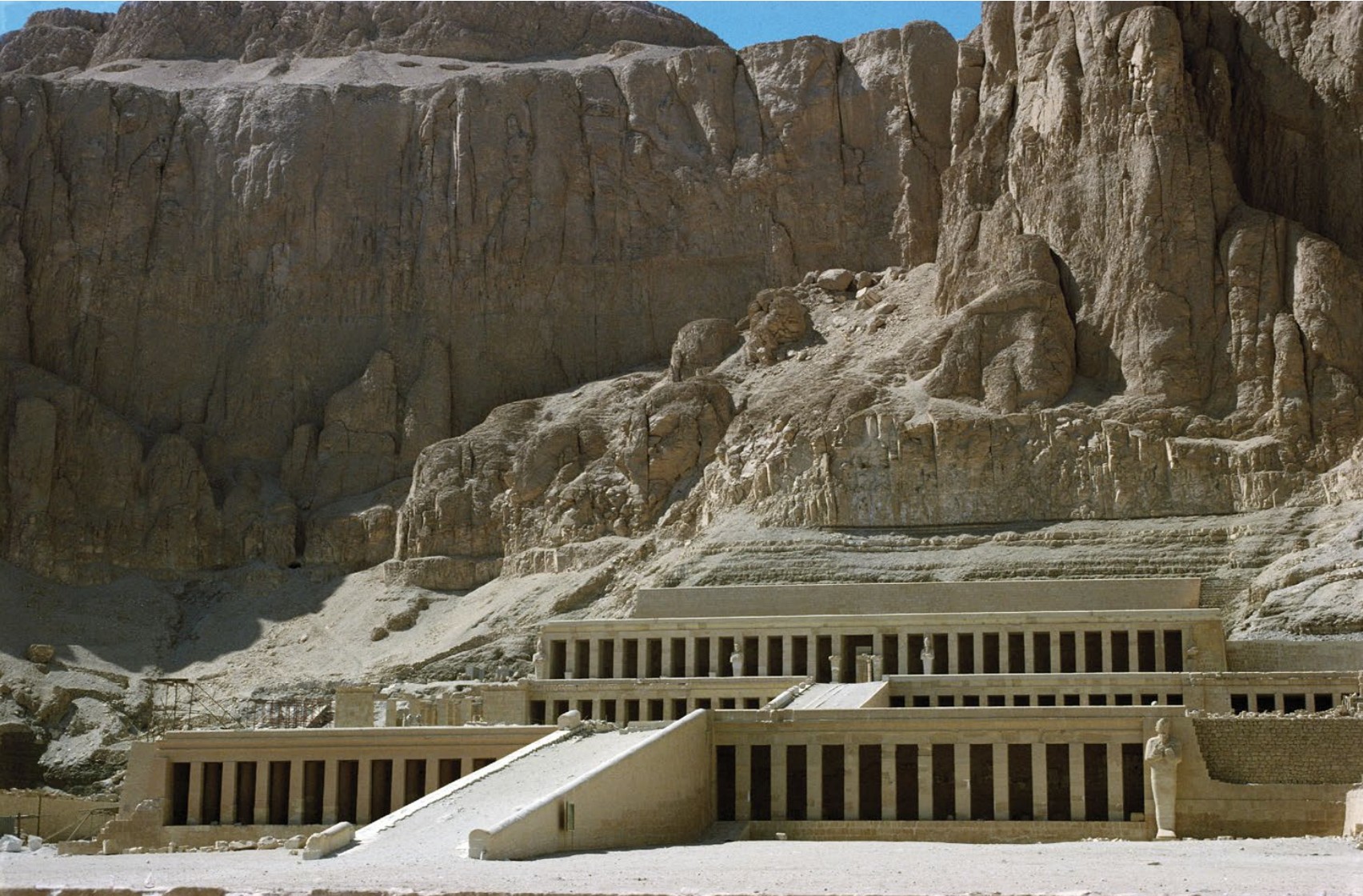
 Mortuary temple of Hatshepsut © Erich Lessing/Art Resource, NY
Mortuary Temple of Hatshepsut
Luxor, Egypt. New Kingdom, 18th Dynasty. c. 1473–1458 B.C.E. Sandstone, partially carved into a rock cliff, and red granite.
Curator Note
"Designed by her lover/architect Senenmut, this temple is a masterpiece of harmony with nature. Tragically, her stepson Thutmose III attempted to erase her legacy by smashing her statues after her death."
Form
- Terraced architecture with three levels connected by long ramps.
- Axial plan aligned with the temple of Amun-Re at Karnak across the river.
- Colonnades with simple, chamfered square pillars (Proto-Doric look) creating rhythmic light/dark patterns.
- Partially cut into the living rock of the cliff, partially constructed masonry.
- Harmonious integration with the rugged limestone cliffs of Deir el-Bahri.
Function
- Mortuary temple meant to worship the spirit (Ka) of Hatshepsut and honor her divine father Amun-Re.
- Not her tomb; she was buried in the Valley of the Kings behind the cliff.
- Propaganda: To validate her rule as a female Pharaoh and claim divine lineage.
- Ceremonial destination for the statue of Amun during the Beautiful Feast of the Valley.
- Sanctuary for the gods Anubis and Hathor.
Content
- Paintings and reliefs depicting Hatshepsut's divine birth and her famous trade expedition to Punt.
- Kneeling statues of Hatshepsut offering jars of ma'at (order) to the gods.
- Representations of frankincense trees and exotic animals brought from Punt.
- Originally featured lush gardens with pools and trees on the terraces.
- Images of Hatshepsut as a male king (beard, kilt) mixed with female titles.
Context
- Hatshepsut was the first great female monarch in recorded history (18th Dynasty).
- She ruled first as regent for her stepson Thutmose III, then declared herself Pharaoh.
- Designed by her Royal Architect (and likely lover) Senenmut.
- Thutmose III later attempted "damnatio memoriae," smashing her statues to erase her from history.
- The temple alignment allows the winter solstice sunrise to illuminate the sanctuary.