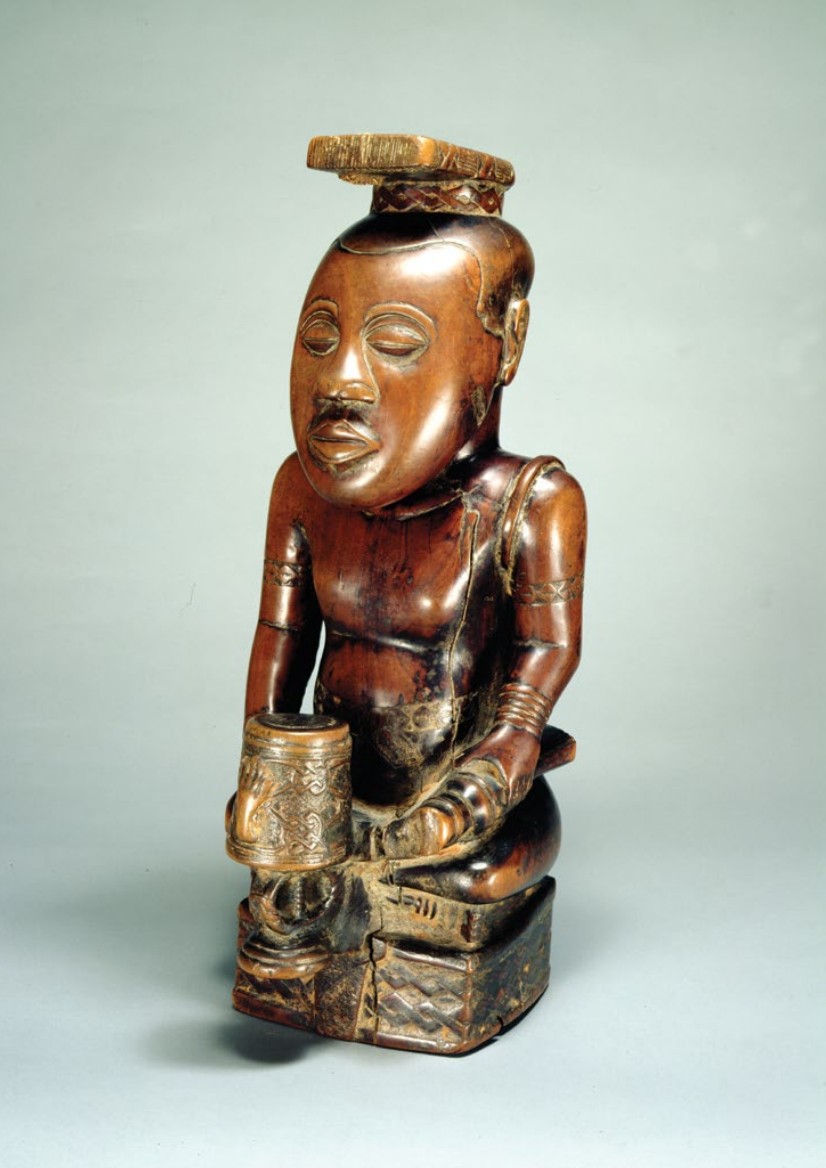
 Ndop © Brooklyn Museum of Art, New York, USA/The Bridgeman Art Library
Ndop (portrait figure)
Kuba peoples (Democratic Republic of the Congo). c. 1760–1780 C.E. Wood.
Curator Note
"A frozen ideal. An Ndop doesn't look like the king's face; it looks like his spirit. Seated calmly with his unique identifying symbol (ibol), it captures the essence of his reign for future generations."
Form
- Hardwood treated with palm oil (shiny surface).
- Ratio 1:3: The head is one-third the size of the body (seat of intelligence).
- Stylized anatomy: Rounded contours, closed eyes, calm expression.
- Cross-legged posture on a square platform.
- Geometric patterns (scarification) on the stomach and back.
Function
- Soul Double: Housed the king's spirit during his absence or after death.
- Historical Marker: Recorded the reign of a specific king (nyim).
- Surrogate: Wives would care for the statue when the king was away at war.
- Fertility: Placed near the royal wives to ensure safe childbirth.
- Dynastic succession: New kings slept with the old Ndop to transfer power.
Content
- Ibol: The personal emblem chosen by the king (e.g., a drum, a severed head, a game board).
- Examples: Mishe miShyaang maMbul chose a drum with a severed hand.
- Weal cowrie shells: Carved on the belt/armbands, symbolizing royal wealth.
- Peace knife (Ikul): Held in the left hand (handle out), showing non-aggression.
- Disinterested Gaze: The king looks above mortal affairs (Aloofness/Coolness).
Context
- Kuba Kingdom (DRC) was a federation of 19 ethnic groups.
- History was oral; Ndop figures served as a visual chronology.
- Commissioned by the King himself during his lifetime.
- Seven original Ndops exist in Western museums.
- Reflects the Kuba belief that the head is the source of divine power.