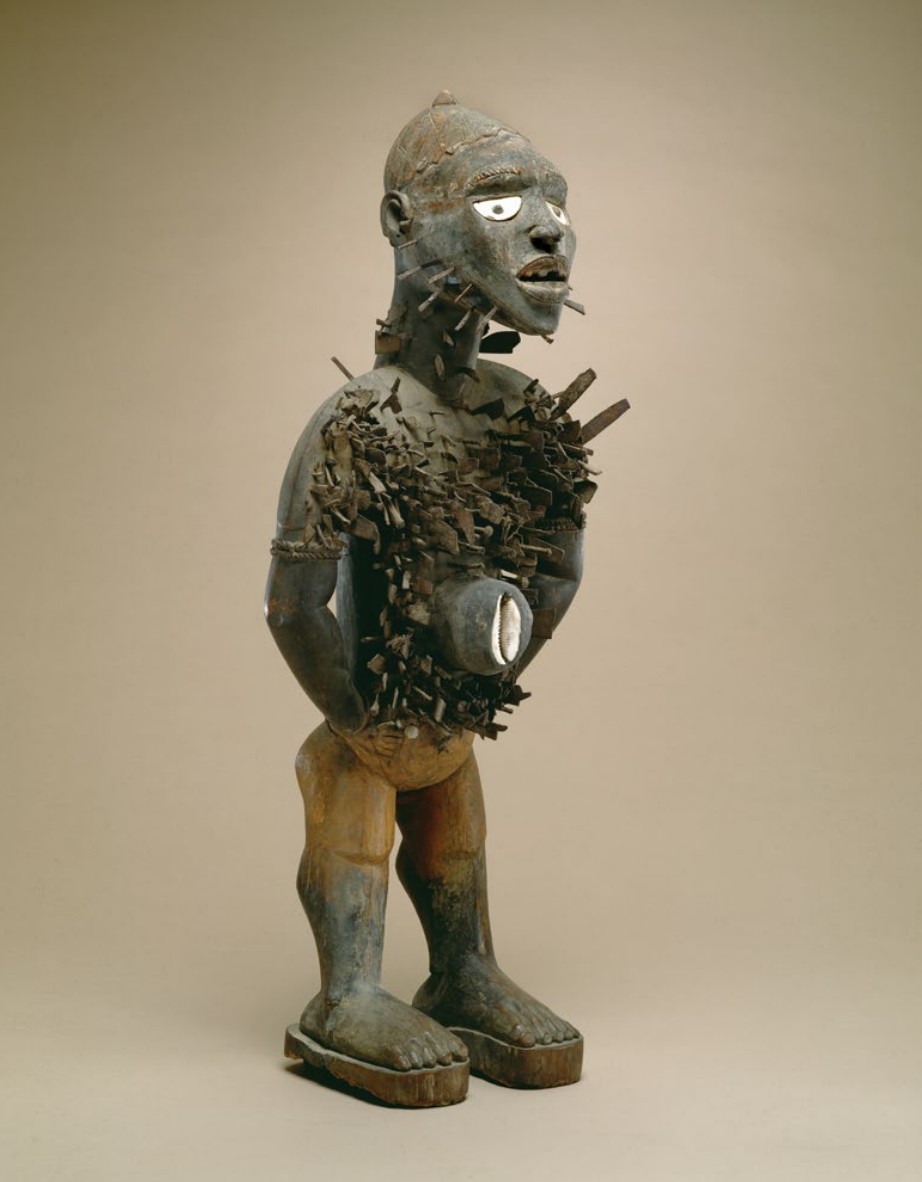
 Nkisi n’kondi © Detroit Institute of Arts, USA/Founders Society Purchase/Eleanor Clay Ford Fund for African Art/The Bridgeman Art Library
Power figure (Nkisi n’kondi)
Kongo peoples (Democratic Republic of the Congo). c. Late 19th century C.E. Wood and metal.
Curator Note
"A spiritual contract enforcer. This isn't a doll; it's a vessel for a hunter spirit. Every nail driven into it represents a solved dispute, a sealed vow, or a curse activated. It is legal documentation in wood."
Form
- Anthropomorphic wooden figure (human or dog shape).
- Accumulative sculpture: The form changes over time as nails/blades are added.
- Aggressive stance: Hands on hips (pakalala), leaning forward, mouth open.
- Bilongo: Medicinal packet (herbs, stones, clay) stored in the belly cavity.
- Reflective surface: Mirror or glass covers the medicine packet.
Function
- Dispute resolution: Used to seal contracts, treaties, or marriages.
- Law enforcement: The spirit ("The Hunter") punishes those who break their oath.
- Healing: Could identify and cure illnesses caused by spiritual forces.
- Protection: Guarded villages from witchcraft or evil spirits.
- Visual record: The number of nails illustrates the history of community justice.
Content
- Iron nails/blades: Driven in to "wake up" the spirit to act.
- Open mouth: The spirit is speaking judgment or breathing life.
- Mirror: Represents the "other world" (watery realm of the dead) and "seeing" hidden things.
- Belly (Mooyo): The soul/life force resides here.
- Peg vs. Blade: Pegs were for civil matters; blades were for serious crimes (murder).
Context
- Kongo peoples (DRC/Angola).
- Nganga: The ritual specialist/priest who activated the figure.
- Europeans called them "fetishes" (derogatory) and destroyed many as witchcraft.
- The concept: Spirits can be trapped and used for human benefit.
- Reflects a legal system based on spiritual accountability.