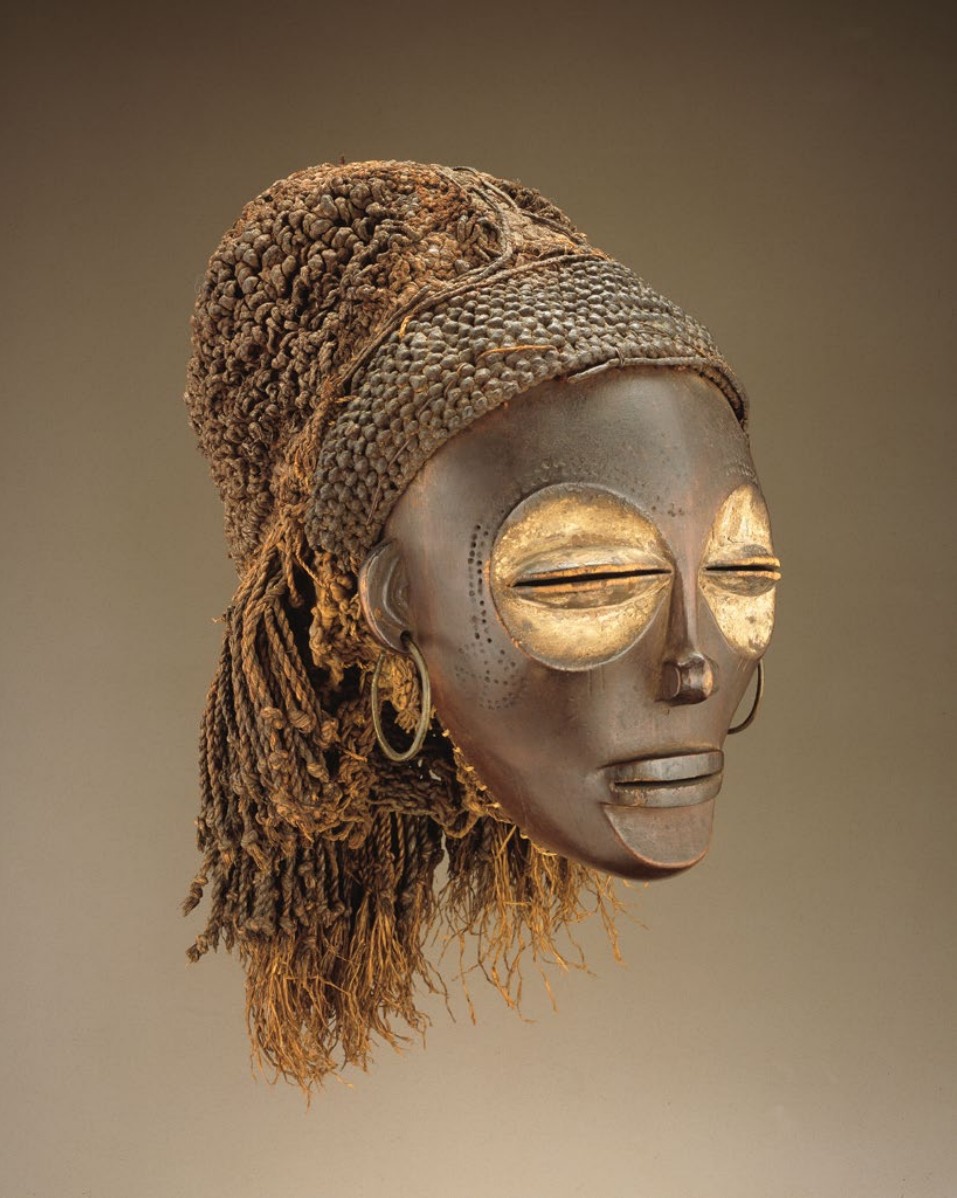
 Female (Pwo) mask Photograph © by Franko Khoury/National Museum of African Art/Smithsonian Institution
Female (Pwo) mask
Chokwe peoples (Democratic Republic of the Congo). Late 19th to early 20th century C.E. Wood, fiber, pigment, and metal.
Curator Note
"A tribute to female beauty, worn by men. When a Chokwe man danced this mask, he wasn't mocking women—he was honoring the mothers who had given birth. It mimics the graceful, slow movements of an ideal woman."
Form
- Idealized female face: High forehead, large eyes, small chin.
- Symmetry: Perfectly balanced features symbolising moral correctness.
- Material: Thin, delicate wood stained with red earth (tukula) and oil.
- Details: Real hair, metal earrings, and fiber costumes were attached.
- Scarification (Cingelyengelye): Geometric patterns (cross on forehead) mark identity.
Function
- Honoring ancestors: Pwo represents the founding female ancestor of the lineage.
- Matrilineal homage: Honors the fertility and role of women in a matrilineal society.
- Dance Performance: Worn by men (dressed as women) in slow, graceful dances.
- Initiation closing: Performed for boys graduating from Mukanda (initiation camp).
- Entertainment: Bringing joy and beauty to the community.
Content
- Closed eyes/mouth: Symbolizes introspection, wisdom, and not gossiping.
- White clay around eyes: Connects to the spiritual realm/ancestors.
- Cross on forehead: Cosmo-gram representing the universe?
- Tears (frequently depicted): The pain of childbirth or the mother losing her son to manhood.
- The dancer wears false breasts and moves with elegance.
Context
- Chokwe peoples (DRC) are matrilineal (descent traced through women).
- Men dance the Pwo to foster fertility and goodwill.
- The mask was buried with the dancer (personal connection).
- Contrasts with the "Cihongo" mask (male spirit of wealth/power).
- Represents the Chokwe aesthetic of "Utotombo" (careful execution/beauty).