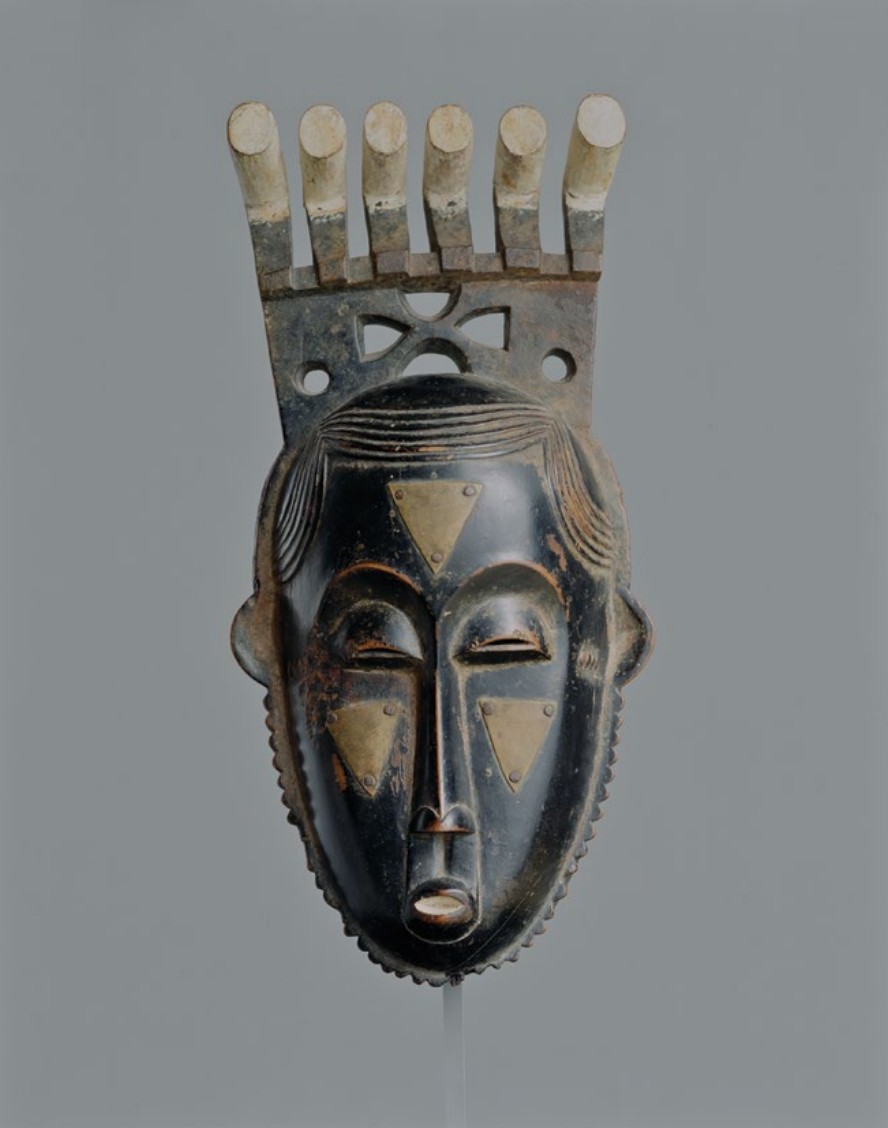
 Mblo © Jerry L. Thompson
Portrait mask (Mblo)
Baule peoples (Côte d’Ivoire). Early 20th century C.E. Wood and pigment.
Curator Note
"A rare "portrait" of a living person. This specific mask honors Moya Yanso, a respected dancer. It doesn't look exactly like her, but captures her "spirit age" and dignity. She would dance alongside it."
Form
- Oval face with elongated nose and small mouth.
- High forehead implies wisdom and intellect.
- Downcast eyes: Signify respect and modesty.
- Ornamentation: Brass triangles on cheeks/forehead catch the light (health/status).
- Coiffure: Elaborate hairstyles or crowns/horns top the mask.
Function
- Entertainment mask (Gbagba dance): Secular, not secret or sacred.
- Social honor: Commissioned to honor a specific, respected member of the community.
- Performance: The subject (Moya Yanso) would dance with the masker.
- Aesthetic display: To show the beauty and skill of the carver (Owie Kimou).
- Finale: Appearing at the end of a long sequence of dances (the climax).
Content
- Portraiture: Not a photorealistic copy, but an idealized "essence" of the person.
- Double-nature: The mask is the "double" or namesake of the living person.
- Beard: Often appears on female masks, symbolizing age/wisdom.
- Triangles: Texture represents the quality of the skin and light.
- Expression: "Peaceful containment" (coolness).
Context
- Baule peoples (Ivory Coast).
- Carver: Owie Kimou (one of the few known African artists in the canon).
- Subject: Moya Yanso (a famous dancer and beauty).
- Provenance: We know the exact history because the family was interviewed.
- Baule art is unique for its "art for art's sake" appreciation.