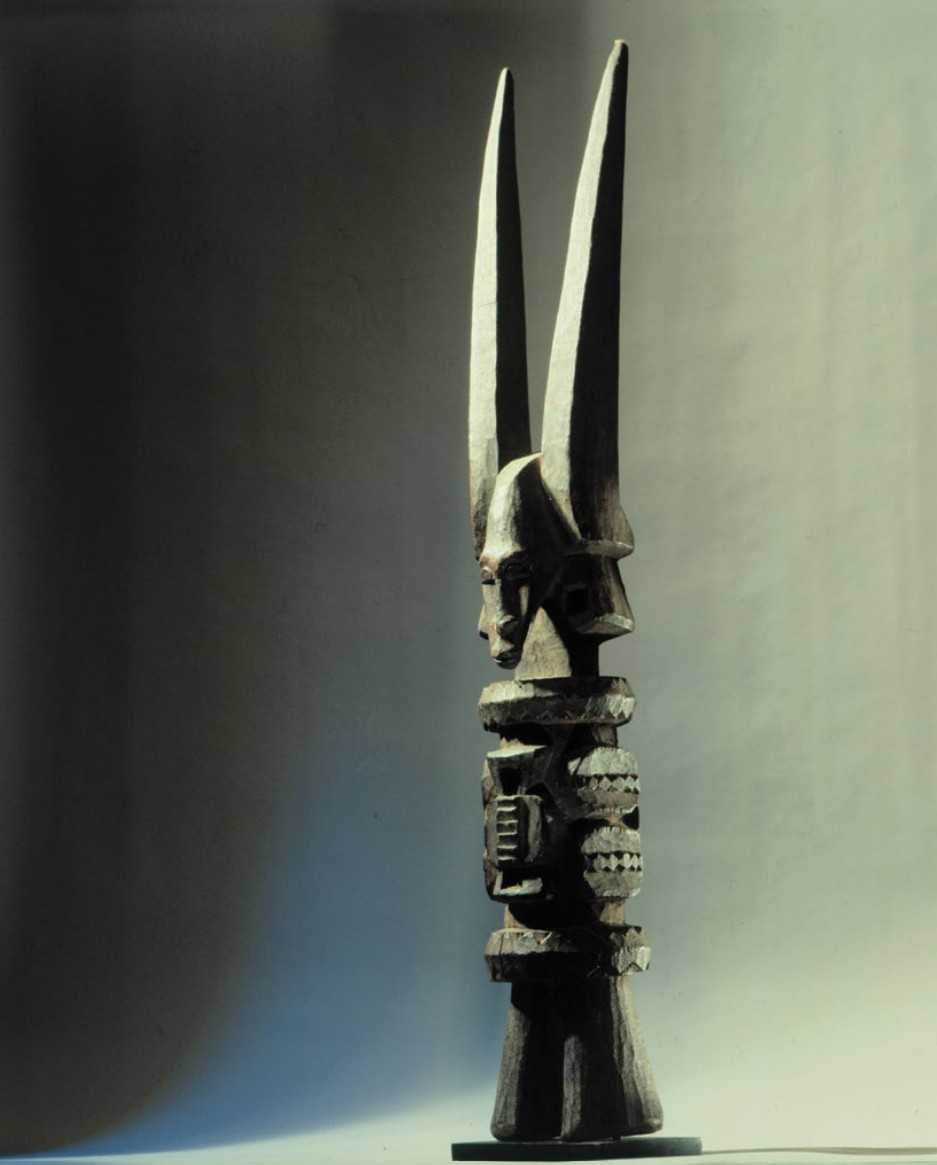
 Ikenga © Werner Forman/Art Resource, NY
Ikenga (shrine figure)
Igbo peoples (Nigeria). c. 19th to 20th century C.E. Wood.
Curator Note
"The power of the right hand. Every successful Igbo man kept an Ikenga ("place of strength"). It honored his personal ability to work, fight, and succeed. It is a diploma, a trophy, and a personal god all in one."
Form
- Horned anthropomorphic figure (abstract or naturalistic).
- Wood: Carved from hardwood (masculine material).
- Horns: Always present, usually large Ram horns (aggression/stubbornness).
- Seated posture: Implies stability and judgment.
- Sword and Head: Often holds a sword (right hand) and a severed head (left hand).
Function
- Personal Shrine: Dedicated to the owner's "Chi" (personal god) and right hand (action).
- Status Symbol: The complexity of the carving reflects the owner's achievements.
- Ritual use: Offerings (kola nuts, gin) are made before important ventures.
- Motivation: Encourages the owner to "get things done" (agency).
- Destruction: Often destroyed or thrown away when the owner dies.
Content
- Right Hand: The "hand of action" (holding the sword/tool).
- Horns: Symbolize the ram, which fights with its head (determination).
- Pipe/Staff: Symbols of elder status or title.
- Ichii marks: Scarification on the face indicating high rank.
- Abstract vs Naturalistic: Style varies by region and individual preference.
Context
- Igbo peoples (Nigeria).
- Egalitarian society: Status is achieved (meritocracy), not inherited.
- Individualism: "A man is as great as his Ikenga."
- The concept of the "Right Hand" is central to Igbo beliefs about success.
- Not an ancestor portrait, but a portrait of ability.