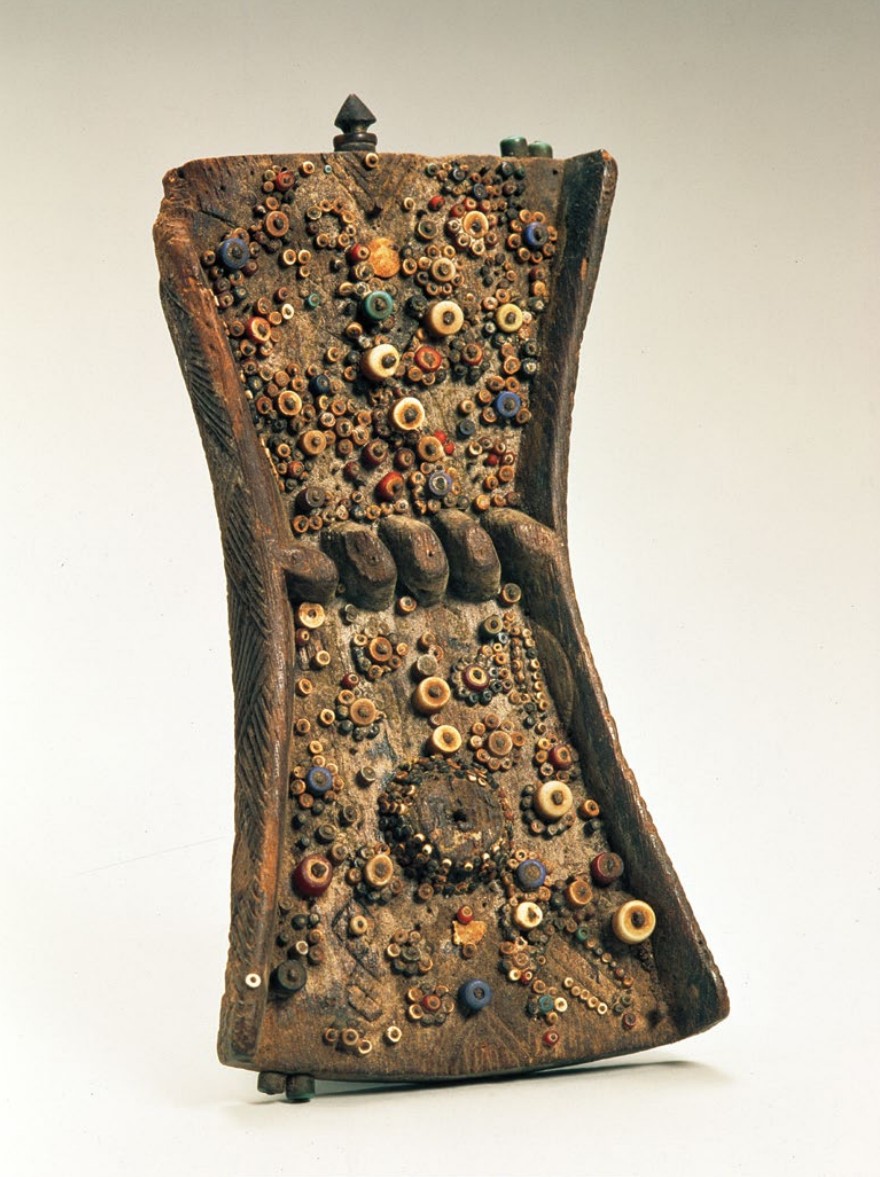
 Lukasa Photo © Heini Schneebeli/The Bridgeman Art Library
Lukasa (memory board)
Mbudye Society, Luba peoples (Democratic Republic of the Congo). c 19th to 20th century C.E. Wood, beads, and metal.
Curator Note
"A library in the palm of your hand. Only the highest-ranking historians (Mbudye) could read this board. By touching the beads and shells, they recited royal genealogies, migration routes, and spirit locations."
Form
- Hourglass-shaped wooden board (hand-held).
- Tactile interface: Covered in beads, shells, and metal pins.
- Ergonomic: Designed to be held in the left hand and traced with the right.
- Varied topography: The placement, size, and color of beads convey data.
- Zoomorphic elements: Often features a tortoise or crocodile head (earth/duality).
Function
- Mnemonic device: Helps the user recall vast amounts of oral history.
- Political validation: Used to prove the king's right to rule via genealogy.
- Problem solving: Used to settle disputes by citing precedent.
- Secret knowledge: Restricted to the Mbudye Society (men of memory).
- Ritual performance: Reading the board is a spiritual act.
Content
- Large beads: Might represent Kings or Chiefs.
- Small beads: Locations, clans, or events.
- Lines of beads: Migration paths or expansion of the kingdom.
- Tortoise shell concept: The hard shell protects the soft knowledge inside.
- Blue/White beads: Spirit world vs. Human world.
Context
- Luba Kingdom (DRC) was a massive, centralized empire.
- Information was power—controlling the history meant controlling the present.
- Mbudye Society acted as a check on the King's power.
- No two Lukasas are alike; they are interpreted, not read literally.
- Demonstrates a complex, non-written system of recording history.