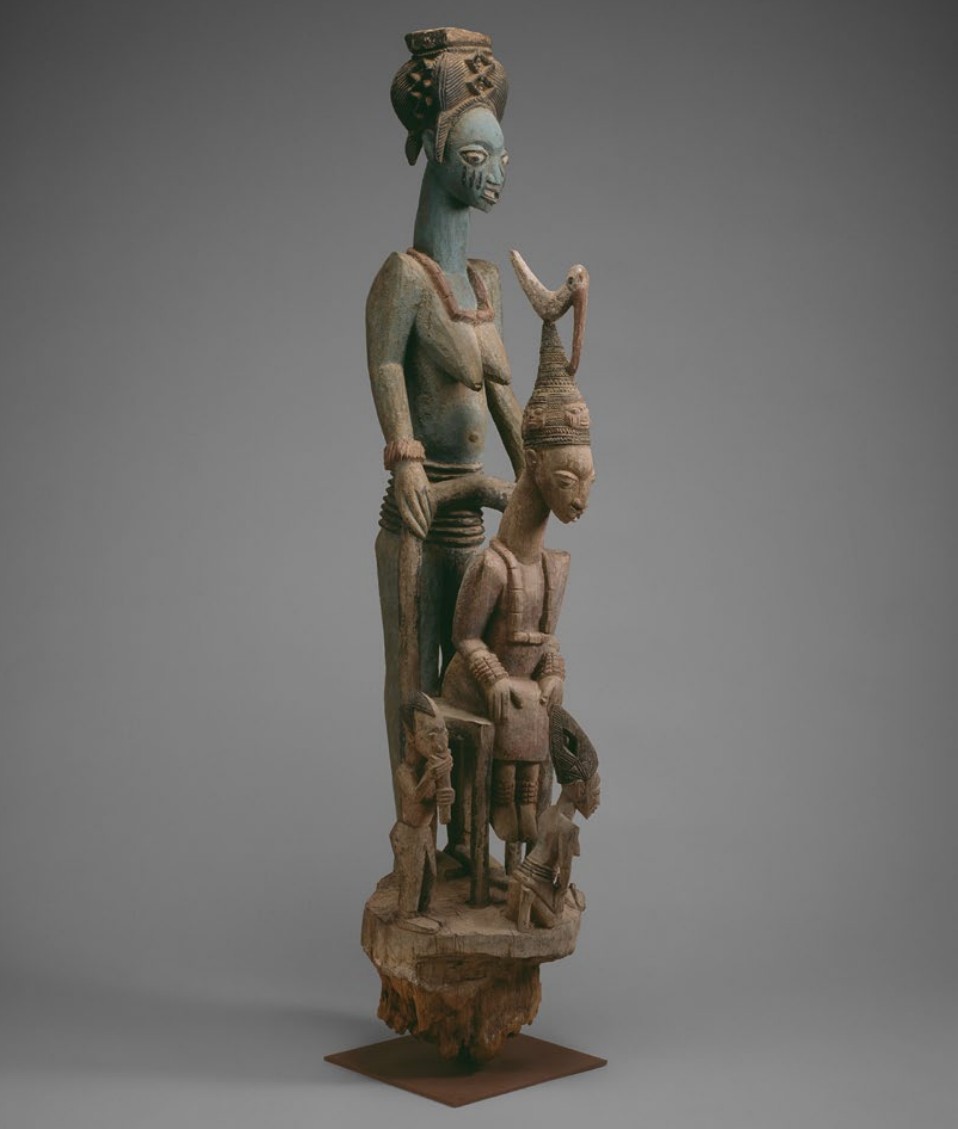
 Veranda post of enthroned king and senior wife (Opo Ogoga) Used by Permission of the Art Institute of Chicago
Veranda post of enthroned king and senior wife (Opo Ogoga)
Olowe of Ise (Yoruba peoples). c. 1910–1914 C.E. Wood and pigment.
Curator Note
"The power behind the throne. The King sits, but his Senior Wife stands huge behind him, her hands on his throne. She is the structural and spiritual support of his reign. Carved by Olowe of Ise, the "Michelangelo of Africa.""
Form
- Architectural column: Carved from a single massive piece of wood.
- Hierarchical scale: The wife is much larger than the king.
- Negative space: Olowe's signature open-work style (space between figures).
- Dynamic composition: Diagonal lines and leaning figures create movement.
- Polychrome: Originally painted with bright colors (traces remain).
Function
- Structural support: Held up the roof of the palace veranda.
- Visual statement: Defined the roles of the King and Queen.
- Celebrity attribution: Commissioned from Olowe to show the King's taste/wealth.
- Welcoming: Greeted visitors to the inner palace courtyard.
- Gender roles: Showed that male power relies on female support.
Content
- Senior Wife: Stands tall, huge eyes (spiritual vision), supports the throne.
- The King: Seated (status), wearing a conical crown with a bird on top.
- Bird on Crown: Represents "Our Mothers" (witches/women) who protect the King.
- Junior Wife: Smaller figure at the King's feet (flute player also present).
- Gap-toothed smile: A sign of beauty in Yoruba culture.
Context
- Yoruba peoples (Nigeria).
- Olowe of Ise (d. 1938): A famous royal carver with a distinct personal style.
- Commissioned by the Ogoga (King) of Ikere.
- The role of the Senior Wife was crucial: She placed the crown on the King's head.
- Example of individual artist recognition in African art history.